
Tổng hợp các cấu trúc tiếng Anh cơ bản


Bạn đang xem tài liệu "Tổng hợp các cấu trúc tiếng Anh cơ bản", để tải tài liệu gốc về máy bạn click vào nút DOWNLOAD ở trên
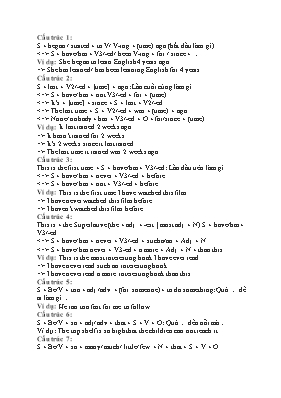
Cấu trúc 1:
S + began / started + to V/ V-ing + (time) ago (bắt đầu làm gì)
 S + have/has + V3/-ed/ been V-ing + for / since +
Ví dụ: She began to learn English 4 years ago.
=> She has learned/ has been learning English for 4 years.
Cấu trúc 2:
S + last + V2/-ed + [time] + ago: Lần cuối cùng làm gì
 S + have/ has + not V3/-ed + for + (time)
 It’s + [time] + since + S + last + V2/-ed.
 The last time + S + V2/-ed + was + (time) + ago.
 None/ nobody + has + V3/-ed + O + for/since + (time)
Ví dụ: It last rained 2 weeks ago.
=> It hasn’t rained for 2 weeks.
=> It’s 2 weeks since it last rained.
=> The last time it rained was 2 weeks ago.
Cấu trúc 3:
This is the first time + S + have/has + V3/-ed: Lần đầu tiên làm gì
 S + have/ has + never + V3/-ed + before.
 S + have/ has + not + V3/-ed + before.
Ví dụ: This is the first time I have watched this film.
=> I have never watched this film before.
=> I haven’t watched this film before.
Cấu trúc 4:
This is + the Superlative (the + adj. + -est | most adj. + N) S + have/has + V3/-ed.
 S + have/ has + never + V3/-ed + such a/an + Adj. + N
 S + have/ has never + V3-ed + a more + Adj. + N + than this.
Ví dụ: This is the most interesting book I have ever read.
=> I have never read such an interesting book.
=> I have never read a more interesting book than this.
Cấu trúc 5:
S + Be/V + too + adj./adv. + (for someone) + to do something: Quá  để ai làm gì
Ví dụ: He ran too fast for me to follow.
Cấu trúc 6:
S + Be/V + so + adj/ adv + that + S + V + O: Quá  đến nỗi mà
Ví dụ: The top shelf is so high that the children can not reach it.
Cấu trúc 7:
S + Be/V + so + many/ much/ little/ few + N + that + S + V + O.
Ví dụ: She has so much work to do that she can not go out with her friends.
Cấu trúc 8:
It + Be/V + such + a/an + Adj. + N(s) + that + S + V +O: Quá  đến nỗi mà
Ví dụ: He was such a fast runner that I could not follow him.
Cấu trúc 9:
S + Be/V + Adj./ Adv. + enough + (for someone) + to do something: Đủ  cho ai đó làm gì
Ví dụ: She is too young to get married. => She isn’t old enough to get married.
Lưu ý: Có thấy lấy tính từ trái nghĩa với tính từ trong cấu trúc too  to để thành lập cấu trúc enough  to
Cấu trúc 10:
It’s + adj. (for someone) + to do something: Ai đó làm gì như thế nào?
 Doing something + be+ Adj. (for someone)
 S + find + V-ing/ it/ N + Adj. to do sth.
Ví dụ: It’s difficult for me to stay up late at night.
=> Staying up late at night is difficult for me.
=> I find staying up late at night in the morning difficult.
=> I find it difficult to stay up late at night.
Với N: I find English interesting to study.
Các cấu trúc liên quan đến câu gián tiếp:
Câu đề nghị:
SUGGEST
Shall we + V  | Let’s + V  | How/ What about + V-ing  | Why don’t we + V
=> S + suggested + V-ing: đề nghị cùng làm gì.
Ví dụ: “Why don’t we go out for a walk?” said the girl.
=> The girl suggested going out for a walk.
Gợi ý cho người khác:
Why don’t you+ V(bare) ?
 S + suggested + that + S + should/ shouldn’t + V
Ví dụ: “Why don’t you have a rest?” he said to his friend.
=> He suggested that she should have a rest.
Cấu trúc câu cáo buộc:
S + accused + someone + of V-ing something.
Ví dụ: “You stole the money on the table”, she said to him.
=> She accused him of stealing the money on the table.
Cấu trúc câu thừa nhận hoặc phủ nhận:
S + admitted/ denied + V-ing/ having + V2/-ed.
Ví dụ: He said “Yes, I did”.
=> He admitted stealing/ having stolen the money on the table.
He said: “No, I didn’t”
=> He denied stealing/ having stolen the money on the table.
Cấu trúc lời khuyên: should/ ought to/ had better/ If I were you  / Why don’t you
S + advised + someone + (not) to V.
Ví dụ: “If I were you, I would save some money” - she said.
=> She advised me to save some money.
“You shouldn’t believe him” Jane said to Peter.
=> Jane advised Peter not to believe him.
Cấu trúc câu mời chào (Would you like?)
S + offered someone + something.
S + offered to do something.
S + invited someone + to V
Ví dụ: “Would you like a cup of coffee, Peter?” I said.
=> I offered Peter a cup of coffee.
“Would you like me to clean the house for you” he said.
=> He offered to clean the house for me.
“Would you like to go to the cinema with me tonight?” he said.
=> He invited me to go to the cinema with him that night.
Cấu trúc câu dặn dò:
S + remember + to do something.
 S + don’t forget + to do something.
 S + remind + someone + to do something.
Ví dụ: He told me: “Don’t forget to come here on time tomorrow”.
=> He reminded me to come there on time the next day.
She said to all of us: “Remember to submit the report by this Thursday”
=> She reminded all of us to submit the report by that Thursday.
Cấu trúc câu cảm ơn:
Thank someone for V-ing/ N.
Ví dụ: “Thank you for helping me finish this project “ he said to us.
=> He thanked us for helping him finish that project.
Cấu trúc câu xin lỗi:
S + apologized to someone for V-ing
Ví dụ: “Sorry, I broke your window” he said to his neighbor.
=> He apologized to his neighbor for breaking her window.
Cấu trúc câu khen ngợi:
S + congratulated + someone + on V-ing.
Ví dụ: “Congratulations! You won the first prize” he said to me.
=> He congratulated me on winning the first prize.
Cấu trúc câu đe dọa:
S + threatened (someone) + to V/ not to V: đe doạ (ai) phải làm gì
Ví dụ: He said “I will kill you if you don’t do that”.
=> He threatened to kill me if I didn’t do that.
Các dạng cấu trúc trong câu điều kiện:
Unless = If not.
Ví dụ: If you don’t have a visa, you can not come to Canada.
=> Unless you have a visa, you can not come to Canada.
Đảo ngữ trong điều kiện loại 1: Should + S + V
Ví dụ: You can ring this number whenever there is any difficulty.
=> Should there be any difficulty, ring this number.
Đảo ngữ trong câu điều kiện loại 2: Were S + Adj./ N / to V
Đảo ngữ trong câu điều kiện loại 3: Had + S + (not) V3/-ed
Các cấu trúc liên quan đến so sánh:
Sự chuyển đổi từ cấu trúc so sánh bằng so sánh hơn so sánh hơn nhất:
Ví dụ: Sally is the tallest girl in her class.
=> No one in Sally’s class is as tall as her.
=> No one in Sally’s class is taller than her.
Cấu trúc tăng theo cấp độ:
The 8-year-old bride movie is more and more interesting.
Cấu trúc càng  càng:
The older he is, the less he wants to travel.
Các cấu trúc liên quan đến câu bị động trong tiếng anh
Cấu trúc:
Have someone do something have something done
Ví dụ: We get him to look after our house when we are on business.
=> We get our house looked after (by him) when we are on business.
Cấu trúc 14:
Make someone do something => Someone + be made + to do something.
Ví dụ: The teacher made the students work hard.
=> The students were made to work hard.
Cấu trúc 15:
People say + S + V +
 It be said that + S + V
 S + be said to + V/ to have V3/-ed
Ví dụ: People say that he drinks a lot of wine.
=> It is said that he drinks a lot of wine.
=> He is said to drink a lot of wine.
Tài liệu đính kèm:
 tong_hop_cac_cau_truc_tieng_anh_co_ban.doc
Đề thi liên quan
 Đề thi olympic môn Tiếng Anh Lớp 6 - Phần viết - Năm học 2012-2013 - Phòng GD & ĐT Thanh Oai
 Lượt xem: 822
 Lượt tải: 1
- Đề kiểm tra học kỳ II môn Tiếng Anh Lớp 6 - Năm học 2016-2017 - Phòng GD & ĐT Quận I (Có đáp án)
Lượt xem: 691
Lượt tải: 0
- Đề ôn tập Tiếng Anh 6
Lượt xem: 713
Lượt tải: 0
- Đề kiểm tra định kì học kỳ I Tiếng anh khối 6
Lượt xem: 780
Lượt tải: 0
- Giáo án Tiếng Anh Lớp 6 - Unit 1: Greetings - Lesson 4: C1 – C3 - Bùi Thị Khánh
Lượt xem: 138
Lượt tải: 0
- Bộ đề kiểm tra môn Tiếng Anh Lớp 6
Lượt xem: 928
Lượt tải: 0
- Giáo án Tiếng Anh Lớp 6 - Unit 1: Greetings - Lesson 3: B1 – B4 - Bùi Thị Khánh
Lượt xem: 140
Lượt tải: 0
- Đề kiểm tra học kỳ II môn Tiếng Anh Lớp 6 - Đề B - Năm học 2014-2015 - Trường THCS Lê Quý Đôn
Lượt xem: 935
Lượt tải: 0
- Giáo án Tiếng Anh Lớp 6 - Unit 5: Natural wonders of the world - Period 3: Getting started
Lượt xem: 1112
Lượt tải: 1
 Đề kiểm tra Unit 4, 5, 6 môn Tiếng Anh Lớp 6 - Đề 1
Lượt xem: 689
Lượt tải: 0
Đề kiểm tra Unit 4, 5, 6 môn Tiếng Anh Lớp 6 - Đề 1
Lượt xem: 689
Lượt tải: 0
Copyright © 2026 ThuVienDeThi.com, Thư viện đề thi mới nhất, Đề kiểm tra, Đề thi thử

