
Tài liệu ôn thi vào Lớp 10 môn Tiếng Anh


Bạn đang xem 20 trang mẫu của tài liệu "Tài liệu ôn thi vào Lớp 10 môn Tiếng Anh", để tải tài liệu gốc về máy bạn click vào nút DOWNLOAD ở trên
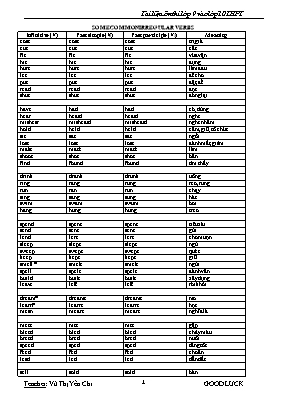
SOME COMMON IRREGULAR VERBS Infinitive (V) Past simple(V2) Past participle (V3) Meaning cost cost cost trị giá cut cut cut cắt fit fit fit vừa vặn hit hit hit đụng hurt hurt hurt làm đau let let let để cho put put put đặt, để read read read đọc shut shut shut đóng lại have had had có; dùng hear heard heard nghe mishear misheard misheard nghe nhầm hold held held cầm, giữ; tổ chức sit sat sat ngồi lose lost lost đánh mất; giảm make made made làm shoot shot shot bắn find found found tìm thấy drink drank drunk uống ring rang rung reo, rung run ran run chạy sing sang sung hát swim swam swum bơi hang hung hung treo spend spent spent tiêu xài send sent sent gửi lend lent lent cho mượn sleep slept slept ngủ sweep swept swept quét keep kept kept giữ smell * smelt smelt ngửi spell spelt spelt đánh vần build built built xây dựng leave left left rời khỏi dream* dreamt dreamt mơ learn* learnt learnt học mean meant meant nghĩa là meet met met gặp bleed bled bled chảy máu breed bred bred nuôi speed sped sped tăng tốc feed fed fed cho ăn lead led led dẫn dắt sell sold sold bán tell told told bảo, kể bring brought brought mang fight fought fought đánh nhau think thought thought suy nghĩ buy bought bought mua catch caught caught bắt được teach taught taught dạy arise arose arisen xuất hiện rise rose risen nhô, mọc lên drive drove driven lái xe ride rode ridden cưỡi xe đạp write wrote written viết awake awoke awoken thức dậy wake woke woken đánh thức break broke broken làm vỡ speak spoke spoken nói freeze froze frozen đông lạnh choose chose chosen chọn lựa beat beat beaten đánh đập bite bit bitten cắn eat ate eaten ăn fall fell fallen té xuống forget forgot forgot(ten) quên get got got(ten) đạt được forgive forgave forgiven tha thứ give gave given cho shake shook shaken lắc take took taken Lấy đưa đi blow blew blown thổi fly flew flown bay grow grew grown mọc know knew known biết throw threw thrown ném draw drew drawn vẽ stand stood stood đứng understand understood understood hiểu bear bore born sinh ra tear tore torn xé rách wear wore worn mặc, đeo, đội become became become trở nên come came come đến overcome overcame overcome vượt qua lay laid laid đặt, để pay paid paid trả tiền say said said nói be was/were been thì, là, ở go went gone đi do did done làm CHUYÊN ĐỀ I Tenses ( Thêi cña ®éng tõ) 1, Present Simple (HiÖn t¹i ®¬n) 1. Form a. Kh¼ng ®Þnh - I, you, we , they + V - He, she , it + V+s / V+es * Notes : - C¸c ®éng tõ kÕt thóc lµ sh, ch, ss, o, x th× sang ng«i he, she , it thªm es Eg : I wash ® He washes I watch ® He watches I go ® He goes I miss ® He misses - Sau c¸c phô ©m k, p, t s ®îc ®äc lµ /s/ - Sau c¸c trêng hîp cßn l¹i s ®îc ®äc lµ /z/ - Sau c¸c phô ©m sh, ch, ss, x ®u«i es ®îc ®äc lµ iz - Nh÷ng ®éng tõ tËn cïng lµ phô ©m + y th× sang ng«i he, she, it y ®æi thµnh i tríc khi thªm es. Eg : I study ® He studies - Nh÷ng ®éng tõ tËn cïng lµ nguyªn ©m + y, biÕn ®æi b×nh thêng khi sang ng«i he, she, it. Eg: I play, he plays .... b. Phñ ®Þnh - I, we, you, they don't + V - He, she , it doesn't + V c. Nghi vÊn - Do I / you/ we / they + V ? - Does he/ she/ it + V ? 2. The use. a. DiÔn t¶ møc ®é thêng xuyªn diÔn ra cña hµnh ®éng ë hiÖn t¹i. Thêng ®i víi always, usually, often , sometimes, occasionally (thØnh tho¶ng), rarely, seldom (hiÕm khi), never, everyday, every week.... once twice / 2 times 3 times a week/ a month/year .... mét lÇn hai lÇn mét tuÇn/ mét th¸ng/ mét n¨m ... ba lÇn Eg : - He usually goes to the cinema. - We clean our house everyday. - Lan washes clothes twice a week. b. DiÔn t¶ ®iÒu lu«n lu«n ®óng (sù thËt), hoÆc ®· ®óng trong mét kho¶ng thêi gian dµi. Eg : - Some animals don't eat during winter. ( Mét vµi loµi ®éng vËt kh«ng ¨n vµo mïa ®«ng) - We are Vietnamese. We speak Vietnamese. - He works in a bank . 2, Present Continuous (HiÖn t¹i tiÕp diÔn) 1. Form a. Kh¼ng ®Þnh I am You/ We/ They are + V-ing He/ she/ it is b. Phñ ®Þnh S + to be + not + V-ing c. Nghi vÊn To be + S + V-ing ? *Notes : - Nh÷ng ®éng tõ kÕt thóc lµ mét nguyªn ©m e, tríc khi thªm ing ta bá e. Eg : have ® having write ® writing - Nh÷ng ®éng tõ 1 ©m tiÕt, 1 nguyªn ©m, kÕt thóc lµ mét phô ©m, tríc khi thªm ing ta gÊp ®«i phô ©m cuèi. Eg : - sit ® sitting - swim ® swimming - C¸c ®éng tõ: die, lie, tie ... biÕn ®æi nh sau: die ® dying, lie ® lying, tie ® tying 2. The use a. DiÔn t¶ hµnh ®éng ®ang diÔn ra ë hiÖn t¹i, thêng ®i víi at the moment, at present, now ( b©y giê , vµo lóc nµy ) Eg : - I'm cooking at the moment. b. DiÔn t¶ hµnh ®éng t¬ng lai ®· ®îc s¾p xÕp s½n He is meeting his brother at the station tonight. (Anh ta sÏ ®ãn anh trai ë nhµ ga vµo tèi nay.) c. Thêi hiÖn t¹i TD ®i víi always khi ta muèn phµn nµn vÒ mét hµnh ®éng lÆp ®i lÆp l¹i. Eg : He's always losing his keys. (Anh ta cø lu«n ®¸nh mÊt ch×a khãa) * Notes : Mét sè ®éng tõ kh«ng thêng dïng ë d¹ng tiÕp diÔn : be, understand, think (cho r»ng), know, hear, love, like , stop , feel, smell, taste, sound .... Exercise 4: Chia ®éng tõ trong ngoÆc ë ®óng thêi 1/ Hello, this is Dr Smith's office. Who (speak) ? 2/ Hurry up ! The train (come). 3/ It is a lovely day. The sun (shine) and the birds (sing). 4/ The Earth (go) round the Sun. 5/ Some animals (not eat) during the winter. 6/ - What Oanh (do) at the moment ? - She (cook). She usually (cook) dinner for her family. 7/ In the evening he often (play) chess with his door neighbour. 8/ They (build) a new hospital in my town now. 9/ My father always (have) a rest after lunch. 10/ She's very lazy. She never (wash) the floor. 11/ Look at those boys ! They (hurry) home after school. 12/ Your mother usually (catch) the 8.10 bus ? 13/ Your sister (wait) for her friend at the station now? 14/ He usually (smile) at his wife when he (come) home. 15/ - Mrs Lan (use) the computer now ? - Yes, she usually (use) it for her work. 16/ Minh sometimes (miss) his bus. 17/ My uncle often (watch) TV in the evening. But right now he (write) a letter . 18/- They (have) breakfast now ? - No, they (sleep) 19/ My father always (relax) at the weekend. 20/ You can't see Tom now. He (have) a bath. 21/ Tom can't have the newspaper now because his aunt (read) it. 22/ I'm busy at the moment. I (redecorate) the room. 23/ The kettle (boil) now. Shall I make the tea ? 24/ I don't want to go out now because it (rain) and I (not have) an umbrella. 3, Simple Past (Qu¸ khø ®¬n) 1. Form a. Kh¼ng ®Þnh - §éng tõ cã qui t¾c : V-ed Eg : - work ® worked - clean ® cleaned * Notes : - Nh÷ng ®éng tõ mét ©m tiÕt, mét nguyªn ©m, kÕt thóc lµ mét phô ©m th× tríc khi thªm ed ta gÊp ®«i phô ©m cuèi. Eg : -stop ® stopped - drop ® dropped - Nh÷ng ®éng tõ kÕt thóc lµ phô ©m + y , tríc khi thªm ed ta ®æi y thµnh i. Eg : - study - studied - Nh÷ng ®éng tõ kÕt thóc lµ nguyªn ©m + y, biÕn ®æi b×nh thêng. Eg: - play - played - Nh÷ng ®éng tõ kÕt thóc lµ e th× chØ thªm d : Eg : - arrive ® arrived *C¸ch ®äc ®u«i ed : - §u«i ed ®îc ®äc lµ /id/ khi ®øng sau t vµ d : Eg : wanted needed - §u«i ed ®îc ®äc lµ / t / khi ®øng sau k, p, sh, ch, ss, x Eg : - stopped, washed, watched, missed, fixed, cooked ... - §u«i ed ®îc ®äc lµ d sau c¸c trêng hîp cßn l¹i - §éng tõ bÊt qui t¾c : - see ® saw - get ® got - do ® did - have ® had - be ® was / were b.Phñ ®Þnh : S + didn't + V c. Nghi vÊn : Did + S + V ? 2. The use * Thêi qu¸ khø ®¬n diÔn t¶ hµnh ®éng x¶y ra trong qu¸ khø cã thêi ®iÓm râ rµng : - yesterday - last night (tèi h«m qua ) week ( tuÇn tríc ) month ( th¸ng tríc ) year ( n¨m tríc ) - 2 ... days ago (hai ... ngµy/ tuÇn .... tríc ®©y) weeks Eg: - We played football yesterday. * §i víi when trong c©u hái vÒ hµnh ®éng trong qu¸ khø Eg : - When did you see him ? - I saw him this morning. 4, Past Continuous (Qu¸ khø tiÕp diÔn) 1. Form a. Kh¼ng ®Þnh : S + was + V-ing were b. Phñ ®Þnh: S + wasn't + V-ing weren't c. Nghi vÊn : Was + S + V-ing ? Were 2. The use a. DiÔn t¶ hµnh ®éng ®ang diÔn ra t¹i mét thêi ®iÓm trong qu¸ khø. Thêng ®i víi at 2 o'clock / at this time ...... yesterday (Vµo lóc 2 giê / thêi ®iÓm ...... nµy ngµy h«m qua ) Eg : - They were swimming at 8 a.m yesterday. b. DiÔn t¶ hµnh ®éng ®ang diÔn ra trong qu¸ khø th× cã mét hµnh ®éng kh¸c (thêi qu¸ khø ®¬n) x¶y tíi. Trong c¸c c©u nµy thêng cã While , As (Trong khi), When (Khi, trong khi) Eg : - While I was going home, I saw an accident. (T«i thÊy tai n¹n trong khi ®ang vÒ nhµ) As When - Mai was cooking when I came. (Khi t«i ®Õn Mai ®ang nÊu níng) - When I came Mai was cooking. c. §i víi all yesterday morning.... Eg : - They were dancing all yesterday morning. (Hä khiªu vò c¶ buæi s¸ng) d. While ®îc sö dông trong c©u cã 2 hµnh ®éng ë thêi qu¸ khø tiÕp diÔn Eg : While I was reading, my sister was listening to music. ( Trong khi t«i ®ang ®äc s¸ch th× chÞ t«i l¹i nghe nh¹c) Exercise : Chia ®éng tõ trong ngoÆc ë ®óng thêi 1/ When I (arrive) at his house, he still (sleep) . 2/ The light (go) out while we (have) dinner. 3/ The last time I (see) him, he (wear) a grey suit. 4/ Just as I (leave) , a student (stop) me in the hall 5/ Nam (play) football when he (break) his leg. 6/ We (drink) a lot of beer at the party the day before yesterday. 7/ They (build) a new bridge when I was there 2 months ago. 8/ He (sit) in a cafe when I saw him. 9/ My company (make) a lot of profits 5 years ago. 10/ What you (do) when I phoned you on Monday ? 11/ While the two thieves (argue), someone (steal) their car. 12/ When he was a boy at school, Edison (ask) a lot of questions. The teacher (think) he was stupid and she (send) him home. Edison's mother (teach) her son at home and he (begin) to carry out a lot of experiments. 13/ - You (visit) the zoo yesterday ? - Yes, I did. When I (go) there, I (see) our teacher. 14/ Who (invent) the radio ? 5, Present Perfect (HiÖn t¹i hoµn thµnh) 1. Form a. Kh¼ng ®Þnh : I / you / we / they + have + PII He / she / it + has b. Phñ ®Þnh : S + haven't + PII hasn't c. Nghi vÊn : Have + S + PII ? Has * PII : Ph©n tõ 2 (ph©n tõ qu¸ khø): - Lµ d¹ng qu¸ khø ®¬n cña ®éng tõ cã qui t¾c. - §éng tõ bÊt qui t¾c : Eg : - go - went - gone - do - did - done 2. The use a. DiÔn t¶ hµnh ®éng võa míi x¶y ra, ®i víi just Eg : - I've just cleaned my house. (T«i võa míi lau nhµ) b. DiÔn t¶ hµnh ®éng ®· x¶y ra trong qu¸ khø nhng kh«ng nh¾c tíi thêi ®iÓm x¶y ra cña hµnh ®éng. Eg : - I've lost my key. (T«i ®· bÞ mÊt ch×a khãa) Kh¸c víi c©u I lost my key yesterday. (T«i ®· mÊt ch×a khãa h«m qua ) c.DiÔn t¶ hµnh ®éng ®· diÔn ra trong kho¶ng thêi gian vÉn cßn lµ hiÖn t¹i today, this week / month... Eg : - Have you seen Lan today ? - No, I haven't. - There have been 3 accidents here this month. (§· cã 3 tai n¹n ë ®©y vµo th¸ng nµy) d. DiÔn t¶ hµnh ®éng ®· x¶y ra trong qu¸ khø nhng thêi ®iÓm kh«ng râ rµng, ®i víi already (®· råi), recently, lately (gÇn ®©y), before (tríc kia). Eg : - He's already done his homework. - I've seen this film 3 times before. (T«i ®· 3 lÇn xem bé phim nµy tríc ®©y) e. Dïng víi yet (cha, vÉn cha) trong c©u hái vµ c©u phñ ®Þnh. Eg : - Have you met your new teacher yet ? - No, we haven't met her yet. f. DiÔn t¶ hµnh ®éng b¾t ®Çu trong qu¸ khø vµ kÐo dµi ®Õn hiÖn t¹i , ®i víi since, for, up to now , so far (cho tíi b©y giê), - for + kho¶ng thêi gian Eg : - My brother has been a doctor for ten years now. (Anh t«i ®· lµ b¸c sÜ ®îc 10 n¨m) - since + mèc thêi gian Eg : - We haven't met each other since we left school. (Chóng t«i ®· kh«ng gÆp nhau kÓ tõ khi chóng t«i ra trêng ) -Up to now / So far we have visited 3 countries in the world. (Cho tíi b©y giê chóng t«i ®· th¨m 3 níc trªn thÕ giíi.) g. Thêi hiÖn t¹i hoµn thµnh dïng víi ever (®· tõng), never (cha bao giê) - ever ®i víi c©u hái vµ c©u kh¼ng ®Þnh Eg : - Have you ever read this book ? ( CËu ®· tõng ®äc cuèn s¸ch nµy cha ?) -No, I've never read it. (T«i cha bao giê ®äc nã) - This is the most interesting film I've ever seen.( §©y lµ bé phim hay nhÊt mµ t«i ®· tõng xem) h. Thêi hiÖn t¹i hoµn thµnh dïng víi in the past 2/ 3 .... years/ months .... ( Trong 2/3 th¸ng/ n¨m qua) . for last Eg : -There have been a lot of changes in our town in the last 2 years. (§· cã nhiÒu ®æi thay ë thÞ trÊn chóng t«i trong 2 n¨m qua) i. Thêi hiÖn t¹i hoµn thµnh dïng víi This is the first, second, third ...... time ( §©y lµ lÇn ®Çu tiªn, lÇn thø hai ......) Eg : - This is the first time I've tasted this food. (§©y lµ lÇn ®Çu tiªn t«i ®îc nÕm mãn ¨n nµy) = I've never tasted this food before. (Tríc ®©y t«i cha bao giê ¨n mãn nµy) k. Thêi hiÖn t¹i hoµn thµnh dïng víi ages for months (®· l©u råi) a long time Eg : - I haven't seen my sister for ages. (§· l©u råi t«i kh«ng gÆp chÞ g¸i t«i) = It's ages since I last saw my sister. (§· l©u råi kÓ tõ lÇn cuèi cïng t«i gÆp chÞ g¸i t«i) Exercise : Chia ®éng tõ trong ngoÆc ë ®óng thêi 1/ My wife and I (be) there several times in the past. 2/ We (study) almost every lesson in this book so far. 3/ He (visit) his friends recently. 4/ - You (see) her today ? - No, I haven't seen her yet. 5/ She (do) her homework already. 6/ They never (go) to the cinema in their life. 7/ Tom, I (not see) you for ages ! Where have you been ? 8/ He is the most kind-hearted man I ever (meet). 9/ There (be) 3 accidents on this street in the past 3 days. 10/ Is this the first time you (visit) our beautiful country ? 11/ Scientists (find) cures for many illnesses in the last 50 years. 12/ My uncle's health (improve) since he (leave) India. 13/ I (buy) a new shirt last week but I (not wear) it yet. 14/ I (not see ) Lan since we (leave) school. 15/ We just (move) to a new house but we (be) dissatisfied with it. 6. Present Perfect Continuous (HiÖn t¹i hoµn thµnh tiÕp diÔn) 1. Form a. Kh¼ng ®Þnh : S + have/ has + been + V-ing b. Phñ ®Þnh : S + haven't / hasn't + been + V-ing c. Nghi vÊn : Have / Has + S + been + V-ing ? 2. The use a. Thêi hiÖn t¹i hoµn thµnh tiÕp diÔn diÔn t¶ hµnh ®éng b¾t ®Çu tõ trong qu¸ khø kÐo dµi liªn tôc cho tíi hiÖn t¹i vµ võa chÊm døt ë ®ã . Eg : - He's very tired now. He has been walking for 2 hours. (B©y giê anh Êy rÊt mÖt. Anh Êy ®· ®i bé 2 tiÕng ®ång hå) b. Thêi hiÖn t¹i hoµn thµnh tiÕp diÔn diÔn t¶ hµnh ®éng b¾t ®Çu tõ trong qu¸ khø kÐo dµi liªn tôc cho tíi hiÖn t¹i vµ cßn diÔn ra trong t¬ng lai. - I've been waiting for my friend since 2 o'clock. He hasn't arrived yet. (T«i ®· ®îi b¹n tõ lóc 2 giê. CËu Êy vÉn cha ®Õn) c. Thêi hiÖn t¹i hoµn thµnh tiÕp diÔn dïng ví c©u hái How long, Since when Eg : - How long have you been living here ? (Anh ®· sèng ë ®©y ®îc bao l©u råi ?) - I've been living here for 12 years. = I started living here 12 years ago. (T«i b¾t ®Çu sèng ë ®©y 12 n¨m tríc ®©y.) Exercise 1: Chia ®éng tõ trong ngoÆc ë ®óng thêi 1/ - How long you (learn) English ? - I (learn) English for 5 years. 2/ - Where is Peter ? - He (be) in his room. He (sleep). He (sleep) since 2 o'clock. 3/ They (live) here for 20 years now. 4/ Look ! Her eyes are red and wet. She (cry). 5/ The boy is tired. He (run) for two hours. 6/ You look tired! Yes I (work) _____very hard. 7/ Where's the magazine I gave you? What (you do) _____________________ with it? 8/ We (have) ____ the same car for twelve years. 9/ This room was white. Now it is blue. He (paint) _____________________ it. 10/ This is the first time I (drive) _____________ a car. Thanks for lending me your car. 11/ These shoes are nice and clean. (you clean) _____________________ them? 12/ Sorry I'm late. (you wait) __________ long? 13/ Somebody (steal) _____________________ my keys. They are not on the table. 14/ Mary is still watching TV. She (watch) _____________________ TV all day. 15/ Look! Somebody (spill) ______________ wine on the floor. 7, Past Perfect (Qu¸ khø hoµn thµnh) 1. Form a. Kh¼ng ®Þnh : S + had + V(p.p) b. Phñ ®Þnh : S + hadn't + V(p.p) c. Nghi vÊn : Had + S + V(p.p) ? 2. The use * Thêi qu¸ khø hoµn thµnh diÔn t¶ hµnh ®éng x¶y ra tríc mét hµnh ®éng qu¸ khø hoÆc mét thêi ®iÓm qu¸ khø kh¸c . Thêng ®i víi after, before, when, by the time (cho tíi khi), as soon as ( ngay sau khi) Eg : - After he had done his homework, he went to the cinema. ( Sau khi nã lµm xong bµi tËp, nã ®i xem phim.) = Before he went to the cinema, he had done his homework. - When I got there, they had gone home. (Khi mµ t«i tíi ®ã, hä ®· vÒ nhµ råi.) - When he had sung his song, he sat down. (Khi anh ta h¸t xong, anh ta ngåi xuèng) - By the time we got to the station, the train had already left. ( Cho tíi khi chóng t«i tíi ga, tµu ®· ch¹y råi) Exercise : Chia ®éng tõ trong ngoÆc ë ®óng thêi 1/ After her husband (get) home, she started to wash the clothes. 2/ When they reached France, they (visit) 13 countries. 3/ When she (arrive) at his house, she (find) that he (leave) a few minutes before. 4/ Before Mr Ron met me, he (do) nothing. 5/ Yesterday I was sorry that I (hurt) him. 6/ They (tell) her that they (not meet ) her before. 7/ When she (realise) her mistakes, she apologised. 8/ When I (meet) my cousin 2 weeks ago, he told me that he just (return) from the South. 8, SIMPLE FUTURE TENSE ( Thêi t¬ng lai ®¬n )(will/ shall) 1. Form a. Kh¼ng ®Þnh S + will / shall + V b. Phñ ®Þnh S + won't / shan't + V c. C©u hái Will/ Shall + S + V ? * Notes : - Will ®îc dïng víi tÊt c¶ c¸c ng«i. Shall thêng dïng víi ng«i I , we. 2. The use : - Thêi t¬ng lai ®¬n diÔn t¶ hµnh ®éng t¬ng lai ®¬n thuÇn. Eg : - I'll do it tomorow. (I'll = I will) ( T«i sÏ lµm viÖc nµy vµo ngµy mai) - He'll come here soon. (Ch¼ng mÊy chèc nã sÏ tíi ®©y) - Our exam will be in two weeks. (Kú thi cña chóng t«i sÏ diÔn ra trong 2 tuÇn n÷a) - They won't help you. - Will you buy it ? - Yes, I will/ No, I won't. * Will cßn ®îc sö dông trong lêi yªu cÇu, lêi mêi Eg : - Will you please get it for me ? (Yªu cÇu) - Yes, certainly/ OK / of course. - Will you come to my party ? (Lêi mêi) * Will ®îc sö dông khi ®a ra lêi høa Eg : - I will pay you tomorrow. ( T«i sÏ tr¶ cËu vµo ngµy mai) * Shall ®îc sö dông trong lêi gîi ý Eg : - Shall we go to the zoo this afternoon ? ( ChiÒu nay chóng ta ®i vên thó chø ?) * Shall ®îc dïng trong lêi ®Ò nghÞ gióp ®ì Eg : - Shall I do it for you ? ( §Ó t«i gióp cËu nhÐ) 9, NEAR FUTURE (Thêi t¬ng lai gÇn, t¬ng lai dù ®Þnh (Be going to)) 1. Form a. Kh¼ng ®Þnh S + be going to + V b. Phñ ®Þnh S + be + not + going to + V c. Nghi vÊn Be + S + going to + V ? - Are you going to work in France next month ? - Yes, I am / No, I'm not. 2. The use a. DiÔn t¶ hµnh ®éng t¬ng lai ®· lªn kÕ ho¹ch tõ tríc. Eg : - He's going to get married next month.(Anh Êy sÏ cíi vî vµo th¸ng sau) b.DiÔn t¶ hµnh ®éng s¾p x¶y ra trong t¬ng lai gÇn .Eg : - Look at those clouds ! It's going to rain. (Nh×n nh÷ng ®¸m m©y k×a ! Trêi s¾p ma ®Êy !) * So s¸nh Will vµ Be going to - Be going to chØ hµnh ®éng t¬ng lai cã dù ®Þnh. Eg : - I'm going to England for my holiday next week. - Will chØ hµnh ®éng t¬ng lai bÊt chît, kh«ng ®îc dù tÝnh tõ tríc. Eg : - Our teacher is ill. (ThÇy gi¸o bÞ èm ®Êy) - Is he ? I'll visit him this afternoon (ThÕ µ ? ChiÒu nay tí sÏ th¨m thÇy. ) Exercise 1: Chia ®éng tõ trong ngoÆc ë ®óng thêi 1/ - Hai has just been taken to hospital with a broken leg. - I'm sorry to hear that. I (visit) him. 2/ Look at those clouds. It (rain). 3/ What are you going to do with that dress ? - I (
Tài liệu đính kèm:
 tai_lieu_on_thi_vao_lop_10_mon_tieng_anh.docx
Đề thi liên quan
 Đề ôn tập kiểm tra học kì I Tiếng anh khối 9
 Lượt xem: 845
 Lượt tải: 0
- Đề ôn học kỳ I môn Tiếng Anh Lớp 9
Lượt xem: 665
Lượt tải: 0
 Đề thi thử học kì I Tiếng anh lớp 9 - Năm học 2016-2017
Lượt xem: 785
Lượt tải: 0
Đề thi thử học kì I Tiếng anh lớp 9 - Năm học 2016-2017
Lượt xem: 785
Lượt tải: 0- 2 Đề ôn luyện vào Lớp 10 THPT môn Tiếng Anh năm 2017 (Có đáp án)
Lượt xem: 55
Lượt tải: 0
- Đề thi học sinh giỏi cấp tỉnh Tiếng anh 9 (Có đáp án) - Năm học 2015-2016 - Sở GD & ĐT Bắc Ninh
Lượt xem: 2857
Lượt tải: 2
- Đề thi thử vào Lớp 10 môn Tiếng Anh
Lượt xem: 85
Lượt tải: 0
- Đề luyện thi vào Lớp 10 THPT môn Tiếng Anh - Đề 7
Lượt xem: 794
Lượt tải: 0
- Bộ đề thi học sinh giỏi môn Tiếng Anh Lớp 9 - Năm học 2011-2012
Lượt xem: 740
Lượt tải: 0
- Đề kiểm tra học kỳ 1 môn Tiếng Anh Lớp 9 - Đề số 2
Lượt xem: 699
Lượt tải: 0
- Đề luyện thi học sinh giỏi môn Tiếng Anh 9
Lượt xem: 859
Lượt tải: 3
Copyright © 2026 ThuVienDeThi.com, Thư viện đề thi mới nhất, Đề kiểm tra, Đề thi thử

