
Đề thi tuyển sinh vào Lớp 10 THPT chuyên môn Tiếng Anh - Năm học 2017-2018 - Sở GD & ĐT Vĩnh Phúc


Bạn đang xem tài liệu "Đề thi tuyển sinh vào Lớp 10 THPT chuyên môn Tiếng Anh - Năm học 2017-2018 - Sở GD & ĐT Vĩnh Phúc", để tải tài liệu gốc về máy bạn click vào nút DOWNLOAD ở trên
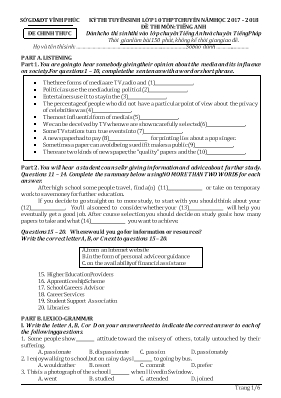
SỞ GD&ĐT VĨNH PHÚC
ĐỀ CHÍNH THỨC
KỲ THI TUYỂN SINH LỚP 10 THPT CHUYÊN NĂM HỌC 2017 - 2018
ĐỀ THI MÔN: TIẾNG ANH
Dành cho thí sinh thi vào lớp chuyên Tiếng Anh và chuyên Tiếng Pháp
Thời gian làm bài 150 phút, không kể thời gian giao đề.
Họ và tên thí sinh:.. Số báo danh:..
PART A. LISTENING
Part 1. You are going to hear somebody giving their opinion about the media and its influence on society. For questions 1 – 10, complete the sentences with a word or short phrase.
The three forms of media are TV, radio and (1)___________________.
Politicians use the media during political (2)___________________.
Entertainers use it to stay in the (3)___________________.
The percentage of people who did not have a particular point of view about the privacy of celebrities was (4)___________________.
The most influential form of media is (5)___________________.
We can be deceived by TV when we are shown carefully selected (6)___________________.
Some TV stations turn true events into (7)___________________.
A newspaper had to pay (8)___________________ for printing lies about a pop singer.
Sometimes a paper can avoid being sued if it makes a public (9)___________________.
There are two kinds of newspaper; the “quality” papers and the (10)___________________.
Part 2. You will hear a student counsellor giving information and advice about further study. Questions 11 – 14. Complete the summary below using NO MORE THAN TWO WORDS for each answer.
After high school some people travel, find a(n) (11)_________________ or take on temporary work to save money for further education.
If you decide to go straight on to more study, to start with you should think about your (12)_________________. You’ll also need to consider whether your (13)_________________ will help you eventually get a good job. After course selection, you should decide on study goals: how many papers to take and what (14)_________________ you want to achieve.
Questions 15 – 20. Where would you go for information or resources?
Write the correct letter A, B, or C next to questions 15 – 20.
A. from an Internet website
B. in the form of personal advice or guidance
C. on the availability of financial assistance
15. Higher Education Providers
16. Apprenticeship Scheme
17. School Careers Advisor
18. Career Services
19. Student Support Association
20. Libraries
PART B. LEXICO-GRAMMAR
I. Write the letter A, B, C or D on your answer sheet to indicate the correct answer to each of the following questions.
1. Some people show_________ attitude toward the misery of others, totally untouched by their suffering.
	A. passionate 	B. dispassionate 	C. passion 	D. passionately
2. I enjoy walking to school, but on rainy days I_________ to going by bus.
	A. would rather	B. resort	C. commit	D. prefer
3. This is a photograph of the school I_________ when I lived in Swindow.
	A. went	B. studied	C. attended	D. joined
4. The train was_________ by a heavy snowfall.
	A. held out	B. held off	C. held up	D. held back
5. The people in my class, _________ are very friendly.
	A. most of international students	B. the most international students
	C. almost international students	D. mostly international students
6. Doctors advise people who are deficient_________ Vitamin C to eat more fruit and vegetables.
	A. from	B. for	C. of	D. in
7. The teacher made a difficult question, but at last, Joe_________ a good answer.
	A. came up against	B. came up with	C. came up to	D. came up for
8. _________ at his lessons, still he couldn't catch up with his classmates.
	A. Hard as he was	B. Hard as he does
	C. Hardly as he worked	D. Hard as he worked
9. He refused to give up work, _________ he had won a million dollars.
	A. despite	B. even though	C. however	D. as though
10. Jane wasn't in when I arrived. I suppose she_________ I was coming.
	A. may forget	B. can't have forgotten
	C. must forget	D. must have forgotten
11. Not for a moment_________ the truth of the case.
	A. he doubted	B. was he doubting	C. he did doubt	D. did he doubt
12. The student_________ the highest score will be awarded a scholarship.
	A. receives	B. who is receiving	C. who receive	D. receiving
13. On leaving prison, Vic decided to turn over a new_________ and to give up his old life of crime.
	A. leaf	B. book	C. chapter	D. page
14. He's been very sick. His doctor insisted that he_________ in bed this week.
	A. stays	B. stay	C. would stay	D. will stay
15. According to some historians, if Napoleon had not invaded Russia, he_________ the rest of the world.
	A. would have conquered	B. conquered
	C. had conquered	D. would conquer
16. He was so mean that he could not bear to_________ the smallest sum of money for the charity appeal.
	A. part with	B. let out	C. give in	D. pay off
17. We_________ for three hours and are very tired.
	A. have been walking	 B. are walking	C. were walking	D. had been walking
18. _________ weather! We can't go out for a walk now.
	A. What a terrible	B. How a terrible	C. What terrible	D. How terrible
19. Susan: "How much do you earn, Joe?" 	Joe: “I'd ________________".
	A. rather don't say	B. rather not say	C. better not to say	D. prefer not say
20. Anna: "You don't have to go to school this afternoon, do you?" 	Bob: “_____________”.
	A. No, I needn't	B. What does that mean?
	C. Yes, I don't have to	D. That's OK
II. Write the letter A, B, C, or D on your answer sheet to indicate the underlined part that needs correcting.
1. Nobody had known before the presentation that Sue and her sister will receive the awards for outstanding scholarship.
A. had known	B. the 	C. will receive	D. scholarship
2. Many of the characters portrayed by writer Joyce Carol Oates is mentally ill.
 	A. Many of	B. portrayed	C. is	D. mentally
3. The extent to which an individual is a product of either heredity or environment cannot proven, but several theories have been proposed.
A. to which	B. cannot proven	C. several theories	D. have been
4. An octopus has three hearts to pump blood throughout their body.
A. An	B. to pump	C. throughout	D. their
5. Since vitamins are contained in a wide variety of foods, people seldom lack of most of them.
 	A. are	B. in a	C. variety of 	D. lack of
III. Complete the following passage with the correct form of the word given in CAPITALS.
MY FAVORITE PLACE
This may be a surprising choice as it’s not comfortable or obviously (1. APPEAL)___________. I’m sure many people gravitate towards the (2. GRAND)___________ of Venice or the beauty of Sydney but the place that does it for me is a remote valley in Iceland. Far from anything man-made, it was created by a (3. VIOLENCE)___________ catastrophe. It would have been a challenging place to live under any circumstances but thousands of years ago a volcanic (4. ERUPT)___________ under a glacier caused a flood that carved out a huge canyon. (5. TOWER)___________ walls of rock on either side protect the valley from the (6. STRONG)___________ of the ferocious Arctic winds. Here a forest has grown up in a (7. SHELTER)___________ area of calm. I find that it has its own (8. ATMOSPHERE)___________ identity, which some may find (9. PLEASE)___________ or even threatening. However, it draws me back time after time. I stay in the campsite and it gives me new perspective on my everyday life. It makes me appreciate the formidable power and (10.ESCAPE)___________ force of nature.
PART C. READING
I. Read the following passage and write the letter A, B, C or D on your answer sheet to indicate the correct answer to each of the following questions.
In 1900, the United States had only three cities with more than a million residents- New York, Chicago, and Philadelphia. By 1930, it had ten giant metropolises. The newer ones experienced remarkable growth, which reflected basic changes in the economy. The population of Los Angeles (114,000 in 1900) rose spectacularly in the early decades of the twentieth century, increasing a dramatic 1,400 percent from 1900 to 1930.
A number of circumstances contributed to the meteoric rise of Los Angeles. The agricultural potential of the area was enormous if water for irrigation could be found, and the city founders had the vision and dating to obtain it by constructing a 225-mile aqueduct, completed in 1913, to tap the water of the Owens River. The city had a superb natural harbor, as well as excellent rail connections. The climate made it possible to shoot motion pictures year-round; hence Hollywood. Hollywood not only supplied jobs; it disseminated an image of the good life in Southern California on screens all across the nation. The most important single industry powering the growth of Los Angeles, however, was directly linked to the automobile. The demand for petroleum to fuel gasoline engines led to the opening of the Southern California oil fields, and made Los Angeles North America's greatest refining center.
Los Angeles was a product of the auto age in another sense as well: its distinctive spatial organization depended on widespread private ownership of automobiles. Los Angeles was a decentralized metropolis, sprawling across the desert landscape over an area of 400 square miles. It was a city without a real center. The downtown business district did not grow apace with the city as a whole, and the rapid transit system designed to link the center with outlying areas withered away from disuse. Approximately 800,000 cars were registered in Los Angeles County in 1930, one per 2.7 residents. Some visitors from the east coast were dismayed at the endless urban sprawl and dismissed Los Angeles as a mere collection of suburbs in search of a city. But the freedom and mobility of a city built on wheels attracted floods of migrants to the city.
1. According to the passage, the initial success of Hollywood's motion picture industry was due largely to the_________.
	A. beauty of the countryside	B. region's reputation for luxurious lifestyles
	C. region's climate and good weather	D. availability of many skilled workers
2. What is the passage mainly about?
	A. The development of the Southern California oil fields
	B. Factors contributing to the growth of Los Angeles
	C. The growth of cities in the United States in the early 1900's
	D. Industry and city planning in Los Angeles
3. The author characterizes the growth of new large cities in the United States after 1900 as resulting primarily from_________.
	A. new economic conditions	B. images of cities shown in movies
	C. a large migrant population	D. new agricultural techniques
4. The word "it" in paragraph 2 refers to_________.
	A. vision	B. agricultural potential	C. aqueduct	D. water
5. According to the passage, the Southern California oil fields were initially exploited due to_________.
	A. an increase in the use of gasoline engines in North America
	B. a desire to put unproductive desert land to good use
	C. the fuel requirements of Los Angeles' rail system
	D. innovative planning on the part of the city founders
6. The phrase "apace with" in paragraph 3 is closest in meaning to_________.
	A. apart from	B. a new with	C. as fast as	D. at the middle of
7. The word "meteoric" in paragraph 2 is closest in meaning to_________.
	A. controversial	B. famous	C. methodical	D. rapid
8. The visitors from the east coast mentioned in the passage thought that Los Angeles_________.
	A. was not really a single city
	B. lacked good suburban areas in which to live
	C. had an excessively large population
	D. was not accurately portrayed by Hollywood images
9. It can be inferred from the passage that the spatial organization of Los Angeles contributed to the relative decline there of_________.
	A. suburban neighborhoods	B. oil fields
	C. industrial areas	D. public transportation
10. According to the passage, the most important factor in the development of agriculture around Los Angeles was the_________.
	A. development of new connections to the city's natural harbor
	B. construction of an aqueduct
	C. influx of new residents to agricultural areas near the city
	D. expansion of transportation facilities
II. You are going to read an article in which four crime writers talk about other authors they like. For questions 1–10, choose from the crime writers (A–D). The writers may be chosen more than once.
Which writer
1. ________
enjoys the slow pace of the book?
2. ________
feels overshadowed by this author?
3. ________
appreciates the author’s precise style of writing?
4. ________
mentions a detective with an unusual background?
5. ________
believes a previous job influences the author’s work?
6. ________
had not expected to enjoy the books?
7. ________
likes the way the books reflect what’s going on in the world?
8. ________
admires the way the author is not influenced by what is expected?
9. ________
prefers books that show the feelings of the author?
10. ______
is impressed by the consistent high standard of an author’s books?
A. John Harvey on Peter Temple
I started reading Temple’s books about 10 years ago, and at the time it was fairly straightforward crime fiction set in Australia, a lot of it with a horse-racing background. The books were OK, but not exceptional. Then suddenly with The Broken Shore, he just hit something quite different and moved up a level. He is writing the kind of books I‘ve spent 20 years trying to write, and writing them better than I do. He’s using crime fiction not just to tell a story, but to say something about today’s society. He really gets the connections between politics, the police and the media right. I love the writing – it‘s really taut and a lesson in how to say a lot without being too wordy.
B. Sara Paretsky on Liza Cody
There is a lot of good, stylish writing out there that puts me off because it’s unfelt. I’m looking for someone who has a gift for storytelling, and who is willing to do the hard work of digging into the emotional aspect of life. Liza Cody does that, and she takes a lot of risks. She doesn’t just do the easy thing to be recognized in the marketplace; she goes where the story and emotion takes her. For instance, she had to self-publish her most recent book, Ballad of A Dead Nobody, because no one in the industry was willing to. These days, you’re told you have to create a brand or a series, with a recognizable link. She is willing to turn her back on that and focus on what her inner voice is telling her.
C. Mark Billingham on Michael Connelly
The first Connelly book I read was The Poet, his first standalone novel and a big breakthrough for him. By then, he had written four books in his Harry Bosch series, which I went back to read. He has maintained a level of quality through a long-running series – an incredibly difficult thing to achieve. People talk about how you create suspense, tricks such as cliffhangers and reveals, but actually the real secret is to create characters the readers care about. Bosch, a detective in the Los Angeles Police Department, is a character who has grown and changed, who you come to know and care about. All that aside, he is a fantastic storyteller, probably the best in modern mystery fiction. I think his days as a journalist – he was a crime reporter on the Los Angeles Times – stood him in good stead because he never forgets the story.
D. Ann Cleeves on Johan Theorin
I read Theorin’s first novel, Echoes from the Dead, after my Swedish editor had said: ‘There’s this Swedish author writing four books set on an island in the Baltic – I wonder if he stole the idea from you?’ because I’ve written novels set in the Shetlands. I was a bit annoyed – although I’m sure it was coincidental – so I wasn’t prepared to like it. But I really loved it. He has this interesting detective who is elderly and lives in a sheltered housing complex, so he can’t be out there doing car chases. One of the books is about this crumbling house by the shore and you’re not sure if there’s a supernatural element. It has the most wonderful climax. Theorin is prepared to take his time over the telling of the story, which is unusual these days. If you look at the bestsellers, they usually move quite rapidly. There is nothing wrong with that, but Theorin writes in a much deeper, literary way.
III. Read the article below about the illegal international trade of whale meat. Six sentences have been removed from the article. Choose from the sentences A – F the one which fits each gap 1 - 5. There is one extra sentence which you do not need to use.
EATING ENDANGERED SPECIES?
The International Whaling Commission was established in 1946 to manage dwindling stocks of whales. Quotas were set to limit the number of whales that could be killed each year for commercial use, but these were often ignored and whale numbers continued to decrease. In 1975, the Convention on International Trade in Endangered Species of Wild Flora and Fauna (CITES) gave full protection to several species including the blue, grey, humpback and right whales. International pressure on the IWC continued and in 1986 it finally put a limit on commercial whaling.
(1)__________. This is achieved by issuing scientific research permits, as killing whales for research is not forbidden. The stated aim of the Japanese research programme is to establish sustainable whaling in the Antarctic Ocean. Both Japan and South Korea are also permitted to trade, within their own countries, whale meat from animals killed as an incidental result of other fishing. (2)__________. Also, in an attempt to control hunting, individual whales are logged on a DNA register so that they can be identified.
The value of “lethal sampling”, that is, the practice of killing whales in order to study them, is highly contentious issue. (3)__________. On the other hand, opponents say this information is not strictly necessary, and moreover, there are better ways to get it. The selling of whale meat from the lethal sampling to fish markets is purportedly to help fund the research. This claim, however, is disrupted by opponents as being a cover for illegal whaling. Now there is evidence to support their views.
A team of scientists, led by Professor Scott Baker, have used DNA to analyse samples of sushi from restaurants in Los Angeles and Seoul. The sushi was found to be made from the illegally-traded meat of protected whale species. The results of the study were handed over to local and national authorities and have since resulted in criminal proceedings against the Los Angeles restaurant.
The researcher used DNA sequencing to identify the species of whale and then used DNA profiling – the same technique used to identify human individuals in criminal forensics – to identify the source of the meat. (4)__________. In addition, some of the meat purchased in Seoul came from Antarctic minke whales, a species which is not local to South Korea and must have therefore also been traded illegally.
Although Japanese authorities keep a DNA register of each whale destined to be sold commercially, this information is not available for monitoring purposes. (5)__________. As the authors state, “The illegal trade of products from protected species of whales, presumably taken under a national permit for scientific research, is a timely reminder of the need for independent, transparent and robust monitoring of any future whaling”.
A.
The DNA results showed that the whale meat in the Los Angeles restaurant had almost certainly originated in Japanese “scientific” whale hunts.
B.
However, the export of any whale meat from these countries to the U.S.A. is strictly prohibited.
C.
The researchers suggest that urgent action is needed in making this information available to scientists to further monitoring and analysis of commercially available whale meat can take place.
D.
Despite the 1986 ban, Japan has continued to hunt whales legally.
E.
Some claim that it is required in order to learn ab
Tài liệu đính kèm:
 de_thi_tuyen_sinh_vao_lop_10_thpt_chuyen_mon_tieng_anh_nam_h.docx
Đề thi liên quan
 Các dạng bài tập ôn tập kiểm tra Tiếng anh lớp 9
 Lượt xem: 886
 Lượt tải: 0
 Ma trận và đề kiểm tra học kì I Tiếng anh lớp 9 - Năm học 2016-2017 - Trường THCS Cự Khê
Lượt xem: 771
Lượt tải: 0
Ma trận và đề kiểm tra học kì I Tiếng anh lớp 9 - Năm học 2016-2017 - Trường THCS Cự Khê
Lượt xem: 771
Lượt tải: 0- Bộ đề thi thử tuyển sinh vào Lớp 10 THPT môn Tiếng Anh - Sở GD & ĐT Bình Định (Có đáp án)
Lượt xem: 52
Lượt tải: 0
- Đề và đáp án kiểm tra một tiết môn Tiếng anh lớp 9
Lượt xem: 873
Lượt tải: 0
- Đề kiểm tra học sinh giỏi cấp huyện Tiếng anh lớp 9 - Năm học 2016-2017 - Phòng GD & ĐT Hạ Hòa
Lượt xem: 1230
Lượt tải: 1
- Bài tập luyện nghe học sinh giỏi môn Tiếng Anh Lớp 9 - Bài: The bathroom
Lượt xem: 889
Lượt tải: 0
- Bộ đề thi thử lần 2 Tiếng anh lớp 9 - Năm học 2015-2016 - Phòng GD & ĐT Yên Phong
Lượt xem: 951
Lượt tải: 0
- Tổng hợp word form English 9
Lượt xem: 943
Lượt tải: 0
- Đề thi tuyển sinh lớp 10 THPT môn Tiếng anh lớp 9 - Năm học 2016-2017 - Sở GD & ĐT Thanh Hóa
Lượt xem: 952
Lượt tải: 0
- Đề kiểm tra một tiết số 3 môn Tiếng anh lớp 9
Lượt xem: 759
Lượt tải: 0
Copyright © 2026 ThuVienDeThi.com, Thư viện đề thi mới nhất, Đề kiểm tra, Đề thi thử

