
Đề cương ôn tập Unit 1 môn Tiếng Anh Lớp 6


Bạn đang xem tài liệu "Đề cương ôn tập Unit 1 môn Tiếng Anh Lớp 6", để tải tài liệu gốc về máy bạn click vào nút DOWNLOAD ở trên
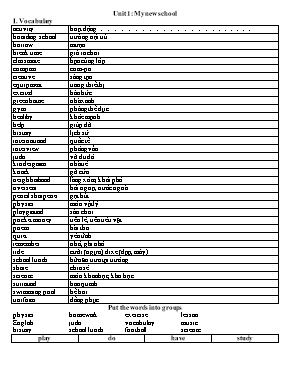
Unit 1: My new school
I. Vocabulary
activity
hoạt động ..
boarding school
trường nội trú
borrow
mượn
break time
giờ ra chơi
classmate
bạn cùng lớp
compass
com-pa
creative
sáng tạo
equipment
trang thiết bị
excited
háo hức
greenhouse
nhà xanh
gym
phòng thể dục
healthy
khỏe mạnh
help
giúp đỡ
history
lịch sử
international
quốc tế
interview
phỏng vấn
judo
võ du đô
kindergarten
nhà trẻ
knock
gõ cửa
neighborhood
làng xóm, khối phố
overseas
hải ngoại, nước ngoài
pencil sharpener
gọt bút
physics
môn vật lý
playground
sân chơi
pocket money
tiền lẻ, tiền tiêu vặt
poem
bài thơ
quiet
yên tĩnh
remember
nhớ, ghi nhớ
ride
cưỡi (ngựa), đi xe (đạp, máy)
school lunch
bữa ăn trưa tại trưởng
share
chia sẻ
science
môn khoa học, kho học
surround
bao quanh
swimming pool
bể bơi
uniform
đồng phục
Put the words into groups
physics
English
history
homework
judo
school lunch
exercise
vocabulary
football
lesson
music
science
play
do
have
study
Put one of the words in each blank
lessons
science
homework
football
judo
1. I do .. with my friend, Vy
2. Duy play .. for the school team (đội)
3. All the .. at my new school are interesting
4. They are healthy (khỏe). They do .. every day.
5. I study maths, English and .. on Mondays.
Pronunciation
əʊ: judo, going, homework, open, rode, don’t, hope, post
ʌ: brother, Monday, mother, month, some, come, one
Write the words
compass, clock, bicycle, calulator, rubber, notebook, textbook, pencil case, schoolbag, ruler
.
.
..
..
.
.
.
Grammar (ngữ pháp)
Subjects pronouns in English ( Đại từ chủ ngữ trong tiếng Anh)
I (tôi), We (chúng tôi, chúng ta),
You (bạn, các bạn), They (họ, chúng, chúng nó),
He (cậu ấy, anh ấy, nó, ông ấy), She (cô ấy, bạn ấy, bà ấy, chị ấy), It (nó, điều đó).
Pronouns equivalent (chủ ngữ thay thế)
Lan = She, Hùng = he, a book = it, a cat = it, Three cats = they (chúng), these pens = they (chúng), Nam and Lan = They (họ), Nam and I = we, Hung and I = we.
Present tense of TO BE (Động từ TO BE ở hiện tại)
Present tense of TO BE has (có) three forms (dạng): am, is, are
I am
we are, you are, they are
she is, he is, it is
Form:
(+) S + am/is/are ..	 (-) S + am/is are not .	(?) Am/Is/Are + S + ..?
 (Yes, I am.	 Yes, we/you/they are.	Yes, he/she/it is.
No, I’m not.	 No, we/you/they aren’t. 	No, she/he/it isn’t.)
Grammar exercise (Bài tập ngữ pháp)
Fill in “am” “is” “are”
Hello, I _________ Mai.
_________ you a student?
This _________ my mother.
It _________ a book.
That _________ an eraser.
How old _________ you?
They _________ rulers.
What _________ your name?
Her name _________ Nga.
These books _________ red.
How _________ Lan?
She _________ a nurse.
Ba _________ an engineer.
Nam and Bao _________ students.
We _________ doctors.
My father _________ a teacher.
My mother _________ a nurse.
_________ your father a doctor?
_________ they your pens?
_________ it her desk?
Chuyển sang câu phủ định và nghi vấn (trong câu nghi vấn: I – you, my – your)
I’m Lan (-) I’m not Lan. (?) Are you Lan?
I am a student. .
This is Nam. .
You are tall.
My father is a doctor. .
They are teachers. .
There are three dogs. .
Thu’s school is small. .
These are erasers. .
I am eleven.
10. That’s an apple. ..
THÌ HIỆN TẠI TIẾP DIỄN
(PRESENT CONTINOUS TENSE)
I- CẤU TRÚC CỦA THÌ HIỆN TẠI TIẾP DIỄN
1. Khẳng định: S + am/ is/ are + V-ing
S (subject): Chủ ngữ	V-ing: là động từ thêm “–ing”	Ví dụ:
- I am playing football with my friends . (Tôi đang chơi bóng đá với bạn của tôi.)
- She is cooking with her mother. (Cô ấy đang nấu ăn với mẹ của cô ấy.)
- We are studying English. (Chúng tôi đang học Tiếng Anh.)
 2. Phủ định: S + am/ is/ are + not + V-ing
 CHÚ Ý:
- I am not = I’m not	- is not = isn’t	- are not = aren’t	Ví dụ:
- I’m not listening to music at the moment. (Lúc này tôi đang không nghe nhạc.)
- My sister isn’t working now. (Chị gái tôi đang không làm việc.)
- They aren’t watching the TV at present. (Hiện tại tôi đang không xem ti vi.)
Đối với câu phủ định của thì hiện tại tiếp diễn ta chỉ cần thêm “not” vào sau động từ “to be” rồi cộng động từ đuôi “–ing”.
3. Câu hỏi: 	Am/ Is/ Are + S + V-ing   ?
Trả lời: Yes, I am. 	– Yes, he/ she/ it is. 	– Yes, we/ you/ they are.
                      No, I’m not. 	– No, he/ she/ it isn’t. 	– No, we/ you/ they aren’t.
Ví dụ: Are you doing your homework? (Bạn đang làm bài tập về nhà phải không?)
Yes, I am./ No, I am not.
- Is he going out with you? (Anh ấy đang đi chơi cùng bạn có phải không?)
            Yes, he is./ No, he isn’t.
II- CÁCH SỬ DỤNG CỦA THÌ HIỆN TẠI TIẾP DIỄN
1. Diễn tả một hành động đang xảy ra ngay tại thời điểm nói. Ví dụ:
- We are studying Maths now. (Bây giờ chúng tôi đang học toán)
- She is walking to school at the moment. (Lúc này cô ấy đang đi bộ tới trường.)
2. Diễn tả sự việc đang diễn ra xung quanh thời điểm nói. Ví dụ:
- I am looking for a job. (Tôi đang tìm kiếm một công việc.)
- I am working for HDC company. (Tôi đang làm việc cho công ty HDC)
3. Diễn tả một sự việc sẽ xảy ra trong tương lai theo một kế hoạch đã được lên lịch cố định.
Ví dụ:  I bought the ticket yesterday. I am flying to New York tomorrow. (tôi đã mua vé hôm qua. Tôi sẽ bay tới NY vào ngày mai)
III- DẤU HIỆU NHẬN BIẾT THÌ HIỆN TẠI TIẾP DIỄN- các trạng từ chỉ thời gian:
- Now: bây giờ
- Right now: Ngay bây giờ
- At the moment: lúc này
- At present: hiện tại
- At + giờ cụ thể (at 12 o’lock)
+ Trong câu có các động từ như:
- Look! (Nhìn kìa!)
- Listen! (Hãy nghe này!)
- Keep silent! (Hãy im lặng)
Ví dụ:
- Now my sister is going shopping with my mother. (Bây giờ em gái tôi đang đi mua sắm với mẹ)
- Look! The train is coming. (Nhìn kia! tàu đang đến.)
- Listen! Someone is crying. (Nghe này! Ai đó đang khóc.)
- Keep silent! The baby is sleeping. (Hãy im lặng! Em bé đang ngủ.)
IV- QUY TẮC THÊM “- ING” SAU ĐỘNG TỪ.
Thông thường ta chỉ cần cộng thêm “-ing” vào sau động từ. Nhưng có một số chú ý như sau:
1. Với động từ tận cùng là MỘT chữ “e”:
- Ta bỏ “e” rồi thêm “-ing”.
Ví dụ:             write – writing                      type – typing             come – coming
- Tận cùng là HAI CHỮ “e” ta không bỏ “e” mà vẫn thêm “-ing” bình thường. Ví dụ: see - seeing
 2. Với động từ có MỘT âm tiết, tận cùng là MỘT PHỤ ÂM, trước là MỘT NGUYÊN ÂM
- Ta nhân đôi phụ âm cuối rồi thêm “-ing”.
Ví dụ:             stop – stopping                     get – getting              put – putting
V- BÀI LUYỆN TẬP THÌ HIỆN TẠI TIẾP DIỄN
Bài 1: Cho dạng đúng của động từ trong ngoặc.
1. Look! The car (go) so fast.
2. Listen! Someone (cry) in the next room.
3. Your brother (sit) next to the beautiful girl over there at present?
4. Now they (try) to pass the examination.
5. It’s 12 o’clock, and my parents (cook) lunch in the kitchen.
6. Keep silent! You (talk) so loudly.
7. I (not stay) at home at the moment.
8. Now she (lie) to her mother about her bad marks.
9. At present they (travel) to New York.
10. He (not work) in his office now.
Bài 2: Xây dựng câu sử dụng thì hiện tại tiếp diễm dựa vào các từ gợi ý cho sẵn.
1. My/ father/ water/ some plants/ the/ garden.
2. My/ mother/ clean/ floor/.
3. Mary/ have/ lunch/ her/ friends/ a/ restaurant.
4. They/ ask/ a/ man/ about/ the/ way/ the/ rainway/ station.
5. My/ student/ draw/ a/ beautiful/ picture .
Viết lại câu cho đúng:
1. (she / go home now) ...........................................................................................................................
2. (I / read a great book)..........................................................................................................................
3. (she / not / wash her hair) ..........................................................................................................................
4. (the cat / chase mice?) .......................................................................................................................
5. (she / cry?) .............................................................................................................................................
6. (he / not / study Latin).........................................................................................................................
7. (we / drive to London?) .......................................................................................................................
8. (they / watch TV?) ............................................................................................................................
9. (where / she / go now?) ......................................................................
THÌ HIỆN TẠI TIẾP DIỄN
(+) S + am/ is/ are + V-ing	 (-) S + am/ is/ are + not + V-ing	(?) Am/ Is/ Are + S + V-ing   ?
Present simple - Thì hiện tại đơn
Form
(+) I/We/You/They + V .	He/She/It + Vs,es .
(-) I/We/You/They don’t + V .	He/She/It doesn’t + V.
(?) Do I/we/you/they + V..	Does he/she/it + V ..?
(Yes, I/we/you/they do. No, I/we/you/they don’t)	(Yes, he/she/it does. No, he/she/it doesn’t)
Trong câu khẳng định, khi V đi sau he, she, it có chữ cái tận cùng là o, z, ch, x, sh, ss ta thường thêm “es”. eg: I box –He boxes,They finish – He finishes, We watch – Lan watches
V kết thúc là Y trước Y là phụ âm, ta bỏ Y thêm IES. eg: I study – He studies
Use: Diễn tả
Thói quen: I get up early every day (Hằng ngày tôi dậy sớm)
Hành động lặp đi lặp lại: He smokes a lot when he works (Anh ấy hút nhiều thuốc khi làm việc)
Thời khóa biểu: We have English on Monday ( Chúng tớ học tiếng Anh vào thứ hai)
Hành động có tính ổn định: I live in Hue (Tôi sống ở Huế)
Chân lí, điều luôn luôn đúng: The sun rises in the east (Mặt trời mọc ở đàng đông)
Signals (dấu hiệu nhận biết thì hiện tại đơn) trạng từ chỉ tần xuất như :
- always (luôn luôn), usually (thường thường), often (thường xuyên), sometimes (thỉnh thoảng), seldom (hiếm khi), rarely (hiếm khi), never (không bao giờ)
- every morning (mỗi sáng), every day (mỗi ngày, hằng ngày), every month / year
- once a week (tuần 1 lần), twice a month (hai lần mỗi tháng), three times a year (ba lần một năm)..
Exercises
I (do/does) my homework.
He (have/has) a car and a house.
Lan (do/does) judo every day.
Minh (play/plays) football in the afternoon
Ha and Na (eat/eats) in the school canteen.
We (study/studies) English on Friday.
Where (do/does) you live?
Where (do/does) Mai live?
I (live/lives) in Hue.
She (live/lives) in Ha Noi.
Minh (watchs/watches) TV every night.
Anh (go/goes/gos) to school on foot.
The girls (come/comes) home early.
Nam (washs/washes) his hand before lunch
Work in pairs, ask and answer
you/go to school by bike. 	A: Do you go to school by bike? 	B: Yes, I do.
he/cook in the afternoon.	A: Does he cook in the afternoon? 	B: No, he doesn’t.
you/ride your bicycle to school .
Mai/go to school with you.
you/ read in the library.
your friends/play football.
you/talk with friends at break time.
you/like your new school.
Hung/do judo after school.
you/study physics well.
DẤU HIỆU NHẬN BIẾT THÌ HIỆN TẠI TIẾP DIỄN- các trạng từ chỉ thời gian:
Now: bây giờ, Right now: Ngay bây giờ, At the moment: lúc này, At present: hiện tại, At + giờ cụ thể (at 12 o’lock), Look! (Nhìn kìa!), Listen! (Hãy nghe này!), Keep silent! (Hãy im lặng)
Signals (dấu hiệu nhận biết thì hiện tại đơn) trạng từ chỉ tần xuất như :
- always (luôn luôn), usually (thường thường), often (thường xuyên), sometimes (thỉnh thoảng), seldom (hiếm khi), rarely (hiếm khi), never (không bao giờ)
- every morning (mỗi sáng), every day (mỗi ngày, hằng ngày), every month / year
- once a week (tuần 1 lần), twice a month (hai lần mỗi tháng), three times a year (ba lần một năm)..
Choose the best answers
Listen! Someone (knocks/is knocking) at the door.
I (have/am having lunch) with my friends at the school canteen now
Minh (wears/is wearing) school uniform every day.
Phong and Vy (ride/are riding) their bicycles to school at the moment.
He usually (smokes/is smoking) when he gets up.
I never (forget/is forgeting) my homework.
Bài 3: Điền dạng đúng của từ trong ngoặc
She (not study) . on Saturday.
He (have) . a new haircut?
I usually (have) .breakfast at 6.30.
Peter (not study) .very hard. He never gets high scores.
My mother often (teach) .me English on Saturday evenings.
I like Math and she (like) .Literature.
My sister (wash) .dishes every day?
They (not have) .breakfast every morning.
Present simple or present continuous
School (fisnish)  at 4.30 every day
You often (eat) lunch in the school canteen?
Where (be)  you, Phong?
I’m upstairs (trên gác). I (do)  my homework.
It’s warm today. I (not want)  to stay at home. What about going swimming in the river?
Listen! They (sing)  in the classroom?
My family (like)  spending our summer holiday at the seaside.
Fill each blank with a word or phrase given
ball games, housework (việc nhà), have, subjects (môn học),
English lessons, share (chia sẻ), international (quốc tế), study
Do you have on Monday? No, on Tuesday.
My brother wants to film and photography.
Children like to play .
My sister sometimes helps my mother to do the
What do you usually for breakfast? Bread and milk.
A good friend is ready to things with his/her classmate.
There are schools in Ha Noi and HCM city.
We have some new in this school year: physics, computer science.
Find the word having a different sound
funny	lunch	sun	computer
photo	going	brother	home
school	teaching	chess	chalk
cold	volleyball	telephone	open
meat	reading	bread	seat
cat	car	man	hand
Odd one out
nurse	father	teacher	engineer
studying	singing	morning	listening
notebook	compass	schoolbag	basketball
English	Vietnam	maths	geography
canteen	library	classroom	bedroom
lunch	dinner	eat	breakfast
Fill each blank with a word or phrase given
their (của họ), on, begins (bắt đầu), go, off, school, all (tất cả), learn (học)
In England, when the schoolchildren come to school, they first . to the cloakroom. They take off their coats, raincoats, caps and their hats and then go to  classroom. Some of the students go to the laboratories and workshops where they .. physics, chemistry and art. When a student is . duty, he comes to  very early. He has to open the windows, water the flowers and clean the blackboard so everything is ready for the first lesson. At seven thirty the teacher comes in to the room and the lesson
Add more words to the groups
Seasons: spring, summer, ..
School subjects: physics, maths,
School things: pen, ruler, ..
Sports and games: football, judo, ..
Lanuages: English, Chinese,
COMMUNICATION (P11)
Game: Making friends
Gợi ý trả lời các câu hỏi
Are you from around here? (Yes, I am/ No, I’m not)
Do you like pop music? (Yes, I do/ No, I don’t)
How much pocket money do you get? (I have some/ I don’t have any/I have ten thousand dong/)
What’s your favourite subject at school? (I like maths/English/Literature// It’s../ My favorite subject is ..)
Are you hungry? (Yes, I am/ No, I’m not)
Do you play football? (yes, I do/ No, I don’t)
How do you get/go to school everyday? (I go to school by bike/motorbike/car/on foot.)
Where do you go shopping? (I go shopping on PDP street/ in Coopmart/ in Ha Tinh market.)
more questions
Do you listen to music? (Bbạn có nghe nhạc ko?)
What do you do at break time? (Giờ ra chơi bạn làm gì?)
SKILLS 1 (P12)
1. read the text again.
2. Now find these words in the text. What do they mean?
boarding: staying at school, study and live there, sometimes going home
international: including two or more countries
surrounded: enclosed by all sides
creative: imaginative
3. Complete the sentences using “boarding, English speaking teachers, Sydney, Vinabrita, mountains”
1. Students live and study in a .. school. They only go home at weekends.
2. . has an art club.
3. There are girls’s schools in .
4. Around An Lac school, there are green fields and .
5. At Vinabrita school, students learn English with ..
1. Rearrange the letters
1. booktxet	..	2. denttus .
3. ntookboe ..	4. pssamoc ..
5. torcucalal ..	6. aopni
2. match the words
study	the piano
do	Vietnamese
play 	exercise
have	breakfast
4. simple present
1. He (come) from Da Nang.
2. Do you study English? No, I (do, not) ..
3. She (walk) to school with her friends. ..
4. I (do) my homework after school.
5. Mr Vo (teach) English at my school.
6. The team (play) football on Sundays.
5. Present continuous
1. They (do) judo in the gym. .
2. My friends (ride) to school with me .
3. .. he . (study) vocabulary?
4. Mr Lee (have) lunch with his students. .
5. I (walk) to class with my friends .
6. Ms Huong (teach) the class maths .
Verbs form
Hoang (live) . in a small house in the centre of the village. His house (be) .. near his new school. Everyday, he (have) .. breakfast at six. Now he (walk) . to school with his friends. They (go) .to school together everyday. Hoang and his friends (study)  in grade 6 at An Son lower secondary school. This week, they (work) .. on a project about their neighbourhood. Hoang (love) his new school.
Match
How many classes are there in your school?
How is your first week at school?
Does Mai live near her school?
What do you do in the evening?
Oh, wonderful.
sixteen
Yes, she does.
I do my homework and watch TV
Exercises
I (do/does) my homework.
He (have/has) a car and a house.
Lan (do/does) judo every day.
Minh (play/plays) football in the afternoon
Ha and Na (eat/eats) in the school canteen.
We (study/studies) English on Friday.
Where (do/does) you live?
Where (do/does) Mai live?
I (live/lives) in Hue.
She (live/lives) in Ha Noi.
Minh (watchs/watches) TV every night.
Anh (go/goes/gos) to school on foot.
The girls (come/comes) home early.
Nam (washs/washes) his hand before lunch
Work in pairs, ask and answer
you/go to school by bike. 	A: Do you go to school by bike? 	B: Yes, I do.
he/cook in the afternoon.	A: Does he cook in the afternoon? 	B: No, he doesn’t.
you/ride your bicycle to school .
Mai/go to school with you.
you/ read in the library.
your friends/play football.
you/talk with friends at break time.
you/like your new school.
Hung/do judo after school.
you/study physics well.
Choose the best answers
Listen! Someone (knocks/is knocking) at the door.
I (have/am having lunch) with my friends at the school canteen now
Minh (wears/is wearing) school uniform every day.
Phong and Vy (ride/are riding) their bicycles to school at the moment.
He usually (smokes/is smoking) when he gets up.
I never (forget/is forgeting) my homework.
Bài 3: Điền dạng đúng của từ trong ngoặc
She (not study) . on Saturday.
He (have) . a new haircut today?
I usually (have) .breakfast at 6.30.
Peter (not study) .very hard. He never gets high scores.
My mother often (teach) .me English on Saturday evenings.
I like Math and she (like) .Literature.
My sister (wash) .dishes every day?
They (not have) .breakfast every morning.
Present simple or present continuous
School (fisnish)  at 4.30 every day
You often (eat) lunch in the school canteen?
Where (be)  you, Phong?
I’m upstairs (trên gác). I (do)  my homework.
It’s warm today. I (not want)  to stay at home. What about going swimming in the river?
Listen! They (sing)  in the classroom?
My family (like)  spending our summer holiday at the seaside.
PRONUNCIATION
Bài tập 1: Hãy chọn từ có phần gạch chân phát âm khác với các từ còn lại.
Click the word which has the underlined part pronounced differently from the rest.
1. A. color	B. money	C. wonder	D. joke
2. A. cope	B. cover	C. focus	D. froze
3. A. though	B. rough	C. young	D. trouble
4. A. couple	B. southern	C. soul	D. touch
5 A. number	B. ugly	C. usage	D. butter
6 A. ghost	B. broke	C. propose	D. won
7 A. among	B. honeymoon	C. stone	D. become
8 A. photograph	B. October	C. showed	D. sh
Tài liệu đính kèm:
 de_cuong_on_tap_unit_1_mon_tieng_anh_lop_6.doc
Đề thi liên quan
 2 Đề thi học sinh giỏi môn Tiếng Anh Lớp 6
 Lượt xem: 653
 Lượt tải: 0
- Đề thi học kỳ II môn Tiếng Anh Lớp 6 - Đề 1 - Năm học 2016-2017 - Trường THCS Sơn Vọng (Có đáp án)
Lượt xem: 150
Lượt tải: 0
 Đề kiểm tra học kì II môn Tiếng anh lớp 6 - Năm học 2014-2015
Lượt xem: 740
Lượt tải: 0
Đề kiểm tra học kì II môn Tiếng anh lớp 6 - Năm học 2014-2015
Lượt xem: 740
Lượt tải: 0- Đề khảo sát năng lực học sinh giỏi môn Tiếng anh lớp 6
Lượt xem: 748
Lượt tải: 0
- Đề kiểm tra học kỳ I môn Tiếng Anh Lớp 6 - Đề số 7 (Có đáp án)
Lượt xem: 684
Lượt tải: 0
- Bài tập ôn luyện bài 13 môn Tiếng anh lớp 6
Lượt xem: 821
Lượt tải: 0
- Đề kiểm tra chất lượng học kỳ II môn Tiếng Anh Lớp 6 - Năm học 2016-2017 - Phòng GD & ĐT Kim Sơn (Có đáp án)
Lượt xem: 185
Lượt tải: 0
- Đề kiểm tra một tiết số 4 Tiếng anh lớp 6 - Trường THCS Phương Trung
Lượt xem: 790
Lượt tải: 0
- Đề kiểm tra 1 tiết môn Tiếng Anh Lớp 6 (Thí điểm) - Đề 2
Lượt xem: 724
Lượt tải: 0
- Đề kiểm tra định kỳ lần 1 học kỳ I môn Tiếng Anh Lớp 6 - Đề 1 - Năm học 2014-2015 - Trường THCS Phan Chu Trinh
Lượt xem: 602
Lượt tải: 0
Copyright © 2026 ThuVienDeThi.com, Thư viện đề thi mới nhất, Đề kiểm tra, Đề thi thử

