
Lý thuyết và bài tập thì Hiện tại tiếp diễn


Bạn đang xem tài liệu "Lý thuyết và bài tập thì Hiện tại tiếp diễn", để tải tài liệu gốc về máy bạn click vào nút DOWNLOAD ở trên
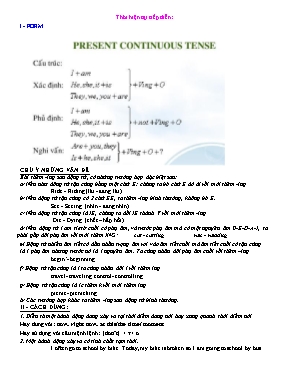
Thời hiện tại tiếp diễn:
I - FORM
CHÚ Ý NHỮNG VẤN ĐỀ
Khi thêm -ing sau động từ, có những trường hợp đặc biệt sau:
a/ Nếu như đông từ tận cùng bằng một chữ E: chúng ta bỏ chữ E đó đi rồi mới thêm -ing.
	Ride - Riding (lái - đang lái)
b/ Nếu động từ tận cùng có 2 chữ EE, ta thêm -ing bình thường, không bỏ E.
	 	See - Seeing. (nhìn - đang nhìn).
c/ Nếu động từ tận cùng là IE, chúng ta đổi IE thành Y rồi mới thêm -ing
	 Die - Dying. (chết – hấp hối).
 d/ Nếu động từ 1 am tiet ở cuối có phụ âm, và trước phụ âm mà có một nguyên âm U-E-O-A-I, ta phải gấp đôi phụ âm rồi mới thêm ING:          cut - cutting                    run - running
e/ Động từ nhiều âm tiết có dấu nhấn trọng âm rơi vào âm tiết cuối mà âm tiết cuối có tận cùng là 1 phụ âm nhưng trước nó là 1 nguyên âm. Ta cũng nhân đôi phụ âm cuối rồi thêm –ing
	begin’- beginning
f/ Động từ tận cùng là l ta cũng nhân đôi l rồi thêm ing
	travel- traveling; control- controlling
g/ Động từ tận cùng là ic thêm k rồi mới thêm ing
	picnic- picnicking
h/ Các trường hợp khác ta thêm -ing sau động từ bình thường.
II - CÁCH DÙNG:
1. Diễn tả một hành động đang xảy ra tại thời điểm đang nói hay xung quanh thời điểm nói
Hay dung với: now; right now; at this/the time/ moment
Hay sử dụng với câu mệnh lệnh: [ don’t] + v+ o
2. Một hành động xảy ra có tính chất tạm thời.
	I often go to school by bike. Today, my bike is broken so I am going to school by bus
3. Một hành động lặp đi lặp lại gây ra sự bực mình, khó chịu cho người nghe. (thường có thêm usually, always... trong câu).
 	I am usually losing the keys.
 4. Chỉ việc xảy ra trong tương lai (khi có trạng từ chỉ tương lai).
I am going to Ha Noi tomorrow
CHÚ Ý: không sử dụng các động từ sau ơ các thì tiếp diễn
1. Some verbs that are not usually used in continuous ( progressive )tenses.
Verbs of senses or liking verbs: be, feel, hear, look, see, smell, sound, taste, notice,.
Verbs of feeling or emotion: like, dislike, hate, love, want, prefer, wish, need,..
Verbs of thinking: believe, know, think, understand, forget, remember, agree,..
Verbs of possession: have (có), own, possess, contain, belong to,
Notes: - I think (that) you should pay attention to your work.
 - I’m thinking about you.
 - I have a lot of time to study.
 - I was having breakfast when I saw Tom.
 - You look ill. What’s the matter with you?
 - Why are you looking at me like that?
2. Progressive tenses are often used with :
Future plan with : go, arrive, come, leave,.
Continuous activity : sleep, study, work, cook, wash the dishes/clothes, play, listen, read, watch, wait, have breakfast / lunch/ dinner / meals / coffee / a bath / a walk / a good time / a party
GRAMMAR
I. Put the verb into the correct form.
1. “ You (work)........................ hard today.” - Yes, I have a lot to do
2. I (look) .................. Christine. Do you know where she is?
3. It ( get) ........................ dark. Shall I turn on the light?
4. They don’t have any where to live at the moment. They (stay) ....with frends until they find somewhere.
5. Things aren’t so good at work. The company (lose) ......................... money.
6. Have you got an umberlla? It ( start) ........................... to rain.
7. You ( make) ................. alot of noise. Can you be quieter? I ( try ) ............... to concentrate.
8. Why are all these people here? What ( happen).........................?
9. Please don’t make so much noise. I ( try) ..................... to work.
10. Let’s go out now. It ( rain)................... any more.
11. You can turn off the radio.I ( not listen) ............. to it.
12. Kate phoned me last night. She is on holiday in France. She (have) ............. a great time and doesn’t want to come back.
13. I want to lose weight, so this week I ( not eat) ................ lunch.
14. Andrew has just started evening classes. He ( learn) ................. German.
15. Paul and Sally have an argument. They ( speak) .................. to each other.
16. I (get) ....................... tired. I need a rest.
18. Tim ( work) ...................... this week. He is on holiday.
19. Listen! Sam( play) ................ the piano.
20. They ( build) ................... a new hotel in the city center.
21. Look! Somebody ( swim) .................... in the river.
22. The phone (not ring)............................
23. (it start)............................... to rain?
24. Sue (study)......................... to become a doctor?
25. (you take) .................................your daughter with you?
26. (the dog play)............................. with the kids?
 27. (they come) ......................................tonight?
28. Be quiet! The baby ( sleep)..................................
29. Look! A man ( run) .......................after the train. He ( want)............... to catch it
30. I ( do) .......................an exercise on the present tenses at this moment
31. My father ( work)............................. in the garden and it (rain) ....................now
32. Mai (cook).........................some food at present. She always (cook).............. in the morning
33. The students ( do)......................the test right now?
34. Now She ( wait ) ...........................for her husband in the rain
35. His brother ( write)........................ a novel at the moment?
36. The children ( not play) ............................in the kitchen at present
 37. Lan ( not speak)........................... to the English teacher now
38. They ( prepare) ...................................the Christmas dinner at present
39. John ( drive)........................... that car now
40. The workers ( build) ................................a new house right now
41. Tom ( write)............................. two poems at the moment?
42. The chief engineer ( instruct).................................... all the workers of the plant now
43. He ( not paint) .......................... his pictures at the moment
44. We ( not plant) ...............................the herbs in the garden at present
45. They ( make)........................ the artificial flowers of silk now?
46. Your father ( repair) ...............................your motorbike at the moment
47. Look! The man ( take)......................... the children to the cinema
48. Listen! The teacher ( explain) .......................a new lesson to us
49. Be careful! You ( bring)......................... ten glass bottles?
50. Ba ( study)............................Math very hard now
51. We ( have) ..........................dinner in a restaurant right now
51. I ( watch) ...................TV with my parents in the living room now
52. Some people( not drink)....................... coffee now
53. At present, he ( compose)............................ a piece of music
54. My father (listen) to the radio now.
55. Where is your mother? - She ........ (have) dinner in the kitchen.
56. Mr. Nam (not work)  at the moment.
57. The students (not, be) .......in class at present.
58. The children (play)... in the park at the moment.
59. Look! The bus (come) ............................................
CLOZE READING
Jack London (1876 – 1916) is an American writer whose work combined powerful realism and humanitarian sentiment. He was (16) ........ in San Francisco. After finishing grammar (17) ..........., Jack London worked at various jobs and in 1897 and 1898 he participated (18)........... the Alaska Gold Rush. Upon his return to the San Francisco area, he began to (19) ............ about his experiences. A collection of his short stories, The Son of the Golf, was (20) ............ in 1900. Jack’s colourful life, during which he wrote more than 50 books and which included enormous popular successes as an (21) .........., ended in his suicide at the (22) ........... of 40.
Many of his stories including his masterpiece The Call of the Wild deal with the reversion of a civilized creature to the primitive state. Jack London’s style – brutal, vivid and exciting – (23) ........... him enormously popular outside the United States; His (24) ........ were translated into many languages. Jack’s important works include People of the Abyss about the poor in London; the Sea Wolf, a novel based on the author’s experiences on a seal hunting ship; John Barleycorn , an autobiographical novel about Jack’s struggle (25)............. alcoholism.
1: A. grown	B. born	C. developed	D. lived
2: A. lessons	B. course	C. notes	D. school
3: A. in	B. to	C. at	D. of
4: A. speak	B. read	C. talk	D. write
5: A. printed	B. ordered	C. sold	D. published
6: A. architect	B. author	C. actor	D. orator
7: A. moment	B. age	C. time	D. year
8: A. gave	B. let	C. made	D. did
9: A. speeches	B. sayings	C. words	D. works
10: A. to	B. for	C. against	D. of
READING COPREHENSION
I. Read the following passage and do exercise below it
	Air pollution is caused of ill health in human beings. In a lot of countries, there are laws limiting the amount of smoke which factories can produce although there is not enough information on the effects of smoke on the atmosphere. Doctors have proved that air pollution causes lung diseases. The gases from the exhausts of cars have also increased air pollution in most cities. The lead in petrol produces a poisonous gas, which is often collected in busy streets circled by high buildings. Children who live in areas where there is a lot of lead in the atmosphere cannot think as quickly as other children, and are clumsy when they use their hands.
*Questions
1. What does the air pollution cause?
2. Who has proved that air pollution causes lung diseases?
3. Is there air pollution in the city? Why or why not?
4. What happens to the children who live in areas where there is a lot of lead in the atmosphere?
 II. Read the following passage and do the exercises.( 2,5m)
 	There are many celebrations throughout the year in Vietnam, but Tet or the Lunar New Year is the most important celebration for Vietnamese people . Tet usually occurs in late January or early February. A few days before Tet is the time for people to clean and decorate their homes. During Tet, people, old and young, enjoy special food cooked on the occasion of Tet. It is also the time for family members to be together.
 1. Write TRUE or FALSE after the statements about the passage. (2.0m)
 a/ The Lunar New Year is another name for Tet.
 b/ Tet may begin in early January.
 c/ People often try to make their houses nice and new for Tet.
 d/ Tet is the time for family reunions
INFINITIVE AND GERUND
V + to-V
- hope: hy vọng	 - offer: đề nghị 	- expect: mong đợi
- plan: lên kế họach	- refuse: từ chối	- want: muốn
- promise: hứa	- pretend: giả vờ	- fail: thất bại, hỏng
- attempt: cố gắng, nỗ lực	- tend: có khuynh hướng	- threaten: đe dọa
- intend: định	- seem: dường như	- decide: quyết định
- manage: xoay sở, cố gắng	- agree: đồng ý	- ask: yêu cầu
- afford: đáp ứng	- arrange: sắp xếp	- tell: bảo
- appear: hình như	- learn: học/ học cách	- invite: mời
- would like	- offer: cho, tặng, đề nghị
V + V-ing
	- mention: đề cập đến	- quit: từ bỏ	- risk: có nguy cơ
- fancy: thích	- deny: phủ nhận	- involve: liên quan
- detest: ghét	- encourage: khích lệ	- consider: xem xét
- imagine: tưởng tượng	- miss: bỏ lỡ	- It is no use: không có ích
- It is no good: không tốt	- postpone: hoãn lại	- suggest: đề nghị
- practice: luyện tập	- finish	- admit: thừa nhận
- avoid: tránh	- mind: ngại	- delay: hoãn
- hate: ghét
 	- waste / spend: lãng phí, bỏ ra (thời gian, tiền bạc)
	- have difficulty / trouble: gặp khó khăn/trở ngại
	- can’t help: không thể không
	- can’t stand / can’t bear: không chịu đựng nỗi
	- feel like: cảm thấy thích
	- look forward to: mong chờ, mong đợi
	- It is (not) worth: đáng / không đáng
	- keep / keep on: tiếp tục
	- be busy: :bận rộn
	- be used to / get used to
* Choose the best answer:
1. I have difficulty ............... and ................... English.
	A. speaking – writing	B. speak – writing	C. to speak – to write	D. speak - write
2. They offered ...................... her but she refused.
	A. to help	B. helping 	C. help	D. being helped
3. I don’t mind ...................... you ...................... the washing up.
	A. help – do	B. helping – doing	C. helping – do	D. to help- to do
4. I’d like ...................... when I am sixty years old.
	A. to rest	B. to stop 	C. to retire 	D. to relax
5. We hope the students themselves will enjoy taking ...................... in outdoor activities.
	A. part	B. note	C. notice 	D. advantage
6. The children are looking forward to ...................... on holiday.
	A. go	B. going	C. be going 	D. have gone
7. You must try not to ...................... so many mistakes again.
	A. make	B. do	C. say	D. tell
8. Her advice made him ...................... his mind.
A. change 	B. to change 	C. changing 	D. changed
9. Ms. Lan enjoys ...................... because she loves working with children.
	A. to teach 	B. to be taught 	C. teaching 	D. teach
10. My father doesn’t allow me ...................... in his room.
	A. to smoke 	B. smoking 	C. smoke 	D. not smoke
11. It’s very ...................... me with money.
	A. kind for you to help	B. kind to you helping
	C. kind of you helping 	D. kind of you to help
12. It’s better to avoid ...................... during the rush hour.
	A. travelling 	B. to travel 	C. travel	D. travelled
13. It was a nice day, so we decided ...................... for awalk.
	A. to have 	B. to go 	C. going	D. having
14. Would you ...................... looking after my children for a while?
	A. mind	B. agree 	C. stand 	D. care
15. Students should encourage ...................... questions in class.
	A. raise 	B. raising 	C. to raise 	D. being raised
16. It is compulsory for students in shools ...................... uniforms.
	A. to wear 	B. wear	C. wearing	D. worn
17. This class needs ...................... . It’s very dirty.
	A. clean 	B. cleaning 	C. to clean 	D. cleaned
18. At school, students usually take part in ...................... money for charity.
	A. raised 	B. to raise 	C. raising 	D. raise
19. May I ...................... in?
	A. to come 	B. coming 	C. came 	D. come
20. Let’s ...................... for a walk.
	A. go 	B. to go 	C. going 	D. went
21. Do you enjoy ...................... cartoon?
	A. watching 	B. to watch 	C. watch 	D. watched
22. They want ...................... by air because it is much faster than other means of transfort.
	A. travel 	B. travelling 	C. travelled 	D. to travel
23. Why don’t you consider ......................... me? I really look forward to ...................... you.
	A. visiting – see	B. to visit – to see	C. to be visited – saw	D. visit – see
24. It’s impolite ...................... people about their salary.
	A. asked 	B. to ask	C. asking 	D. ask
25. Don’t ...................... in class, students!
	A. talking 	B. to talk 	C. talk 	D. talked
26. Who ...................... you English?
	A. do teach 	B. teaches 	C. teach	D. does teach
27. You had better ...................... harder.
	A. to work 	B. working 	C. worked	D. work
28. ...................... is my hobby.
	A. Playing 	B. Play	C. Played 	D. To play
29. We should read different kinds of books ...................... our general knowledge.
	A. to widen 	B. widen 	C. widened 	D. widening
30. It’s not good to avoid ...................... the teacher’s questions in class.
	A. answer	B. answering	C. answered 	D. to answer
31. Students are interested in ...................... a party.
	A. to have 	B. have 	C. having 	D. had
32. ..................... the exams, students have to learn hard.
	A. To pass 	B. Passed 	C. Pass 	D. Passing
33. The girl denied ..................... the news.
	A. tell	B. told	C. to tell 	D. telling
34. I can’t bear people ..................... at me.
	A. shout 	B. shouting 	C. shouted 	D. to shout
35. Would you like ..................... your holiday with my family in Brazil?
	A. spend 	B. to spend 	C. spending 	D. spent
36. My father is very keen ..................... classical music.
	A. to listen 	B. to listen to 	C. on listening to 	D. on listening
37. I remember ..................... next door to you when we were in Australia.
	A. to live 	B. living 	C. live 	D. have lived
38. My sister is good at ..................... tennis.
	A. play	B. playing 	C. to play	D. staying
39. Do you hope ..................... your father again this weekend?
	A. meet	B. meeting 	C. met 	D. to meet
40. Never let children ..................... alone in the street.
	A. play 	B. to play	C. playing	D. played
Tài liệu đính kèm:
 ly_thuyet_va_bai_tap_thi_hien_tai_tiep_dien.doc
Đề thi liên quan
 Đề kiểm tra cuối năm môn Tiếng Anh 8
 Lượt xem: 120
 Lượt tải: 0
 Đề và đáp án kiểm tra một tiết số 1 môn Tiếng anh lớp 8
Lượt xem: 825
Lượt tải: 1
Đề và đáp án kiểm tra một tiết số 1 môn Tiếng anh lớp 8
Lượt xem: 825
Lượt tải: 1- Đề ôn thi học kỳ 1 môn Tiếng Anh Lớp 8
Lượt xem: 701
Lượt tải: 1
- Đề kiểm tra 1 tiết lần 1 môn Tiếng Anh Lớp 8 (Thí điểm) (Có đáp án)
Lượt xem: 834
Lượt tải: 0
- Đề kiểm tra một tiết học kỳ I Tiếng anh lớp 8
Lượt xem: 712
Lượt tải: 0
- Bài tập Unit 12 môn Tiếng Anh 8
Lượt xem: 123
Lượt tải: 0
- Đề đề xuất kiểm tra chất lượng học kỳ II môn Tiếng Anh Lớp 8 - Năm học 2015-2016 - Phòng GD & ĐT Sa Đéc (Có đáp án)
Lượt xem: 58
Lượt tải: 0
- Đề kiểm tra học kỳ I môn Tiếng Anh Lớp 8 - Năm học 2014-2015 - Sở GD & ĐT Bình Dương
Lượt xem: 795
Lượt tải: 0
- Giáo án Tiếng Anh 8 - Tiết 18 (Bản đẹp 3 cột)
Lượt xem: 63
Lượt tải: 0
- Đề kiểm tra học kỳ I môn Tiếng Anh Lớp 8 - Đề số 3 (Có đáp án)
Lượt xem: 616
Lượt tải: 0
Copyright © 2026 ThuVienDeThi.com, Thư viện đề thi mới nhất, Đề kiểm tra, Đề thi thử

