
Giáo án Tiếng Anh Lớp 6 - Unit 5: Things I do - Lesson 2: A3, A4 - Bùi Thị Khánh


Bạn đang xem tài liệu "Giáo án Tiếng Anh Lớp 6 - Unit 5: Things I do - Lesson 2: A3, A4 - Bùi Thị Khánh", để tải tài liệu gốc về máy bạn click vào nút DOWNLOAD ở trên
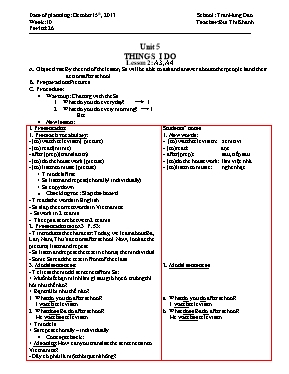
Date of planning: October 15th, 2013th 	 School: Tran Hung Dao
Week: 10	 Teacher: Bui Thi Khanh
Period: 26
Unit 5
 THINGS I DO
Lesson 2: A3, A4
A. Objectives: By the end of the lesson, Ss will be able to ask and answer about other people’s and their
 actions after school.
B. Preparations: Pictures.
C. Procedure:
Warm up: Chatting with the Ss.
What do you do everyday? I..
What do you do every morning? I.
 Etc.
New lesson:
I. Presentation:
1. Pre teach vocabulary:
Students’ notes
1. New words:
- (to) watch television ( picture)
- (to) read (mime)
- after (prep) (translation)
- (to) do the housework (picture)
- (to) listen to music (picture)
- (to) watch television: xem ti vi
- (to) read: đọc
- after (prep): sau, tiếp sau
- (to) do the housework: làm việc nhà
- (to) listen to music: nghe nhạc
+ T models first.
+ Ss listen and repeat (chorally/ individually)
 + Ss copy down.
Checking voc: Slap the board
- T reads the words in English.
- Ss slap the correct words in Vietnamese.
 - Ss work in 2 teams.
- T keeps a score between 2 teams.
2. Presentation text A3 P.53:
- T introduces the character: Today, we learn about Ba, Lan, Nam, Thu’s actions after school. Now, look at the pictures, listen and repeat.
- Ss listen and repeat the text in chorus, then individual.
- Some Ss read the text in front of the class.
3. Model sentences:
2. Model sentences:
- T elicits the model sentences from Ss:
+ Muốn biết bạn mình làm gì sau giờ học ở trường thì hỏi như thế nào?
+ Bạn trả lời như thế nào?
1. What do you do after school?
 I watch television.
a. What do you do after school?
 I watch television.
2. What does Ba do after school?
 He watches television.
b. What does Ba do after school?
 He watches television.
+ T models.
+ Ss repeat chorally – individually.
Concept check:
+ Meaning: How can you translate the sentences into Vietnamese?
- Đây có phải là một thói quen không?
- Giữa câu 1 và câu 2 có gì khác nhau?
+ Form:
+ Form:
 What + do / does + S + do +after school?
 S + V-inf... / V – (s / es)
What + do / does + S + do +after school?
 S + V-inf / V – (s / es)
+ Use: Hỏi / đáp ai đó làm gì sau giờ học ở trường.
+ Use: Hỏi / đáp ai đó làm gì sau giờ học ở
 trường.
II. Practice:
* Picture cue drill:
3. Practice: A3, A4
- First, practice the verbs after “I”.
- T models the first cue; Ss listen and repeat in chorus.
 - Work in pairs (Open pairs – close pairs)
* Example exchange:
- What do you do after school?
 I watch TV.
- What do you do after school?
 I do the housework.
- What do you do after school?
 I listen to music.
- What do you do after school?
 I read.
- What do you do after school?
 I watch TV.
- What do you do after school?
 I do the housework.
- What do you do after school?
 I listen to music.
- What do you do after school?
 I read.
- Second, Ss practice the verbs after “ Ba, Lan, Nam, Thu”
(The same procedure)
* Example exchange:
- What does Ba do after school?
 He watches TV.
- T goes round and monitors.
- What does Ba do after school?
 He watches TV.
III. Further practice:
* Noughts and crosses
- Divide the class into 2 teams.
- Each team will take turn to choose the number, make questions and answer.
- T keeps a score between 2 teams.
- The first team that has 3 Xs or Os in a line on the grid will win the game.
(1) Ba / play
 games
(2) you / do the
 housework
(3) Thu/ do the
 housework
(4) Nam / listen
 to music
(5) Lan / read
(6) She / brush
 her teeth
(7) you /go to
 school
(8) He /wash
 his face
(9) Nga / have
 breakfast
* Example exchange:
- What does Ba do after school?
 He plays games.
Homework
Homework
Ask Ss to do the home assignment
* Make questions and answers:
1. You / every morning? / go to school.
2. Lan / after school? / do the housework.
3. They / after school? / play games.
Tài liệu đính kèm:
 giao_an_tieng_anh_lop_6_unit_5_things_i_do_lesson_2_a3_a4_bu.doc
Đề thi liên quan
 The first semester examination subject : English 6
 Lượt xem: 2360
 Lượt tải: 2
- Cách nói/đọc giờ trong tiếng Anh
Lượt xem: 838
Lượt tải: 0
 Đề kiểm tra năng lực môn Tiếng Anh Lớp 6 - Đề 16
Lượt xem: 182
Lượt tải: 0
Đề kiểm tra năng lực môn Tiếng Anh Lớp 6 - Đề 16
Lượt xem: 182
Lượt tải: 0- Đề thi khảo sát môn Tiếng Anh Lớp 6 - Năm học 2014-2015
Lượt xem: 157
Lượt tải: 0
- Đề kiểm tra số 4 Tiếng anh lớp 6 - Trường THCS Minh Lương
Lượt xem: 774
Lượt tải: 0
- Đề kiểm tra 45 phút số 1 môn Tiếng Anh Lớp 6 (Thí điểm) - Năm học 2016-2017 - Trường THCS Xuân Hòa (Có đáp án)
Lượt xem: 721
Lượt tải: 1
- Đề kiểm tra 15 phút lần 2 môn Tiếng Anh Lớp 6 (Thí điểm)
Lượt xem: 675
Lượt tải: 1
- Bộ đề kiểm tra Tiếng Anh 6 cả năm
Lượt xem: 2606
Lượt tải: 6
- Đề thi học kỳ I - Năm học 2016 - 2017 môn tiếng Anh – Khối lớp 7 - Đề B
Lượt xem: 1256
Lượt tải: 0
- Đề kiểm tra định kỳ lần 2 học kì I năm học 2014 – 2015 môn: Tiếng Anh 6
Lượt xem: 1457
Lượt tải: 5
Copyright © 2026 ThuVienDeThi.com, Thư viện đề thi mới nhất, Đề kiểm tra, Đề thi thử

