
Giáo án Tiếng Anh Lớp 6 - Unit 5: Things I do - Lesson 1: A1, A2 - Bùi Thị Khánh


Bạn đang xem tài liệu "Giáo án Tiếng Anh Lớp 6 - Unit 5: Things I do - Lesson 1: A1, A2 - Bùi Thị Khánh", để tải tài liệu gốc về máy bạn click vào nút DOWNLOAD ở trên
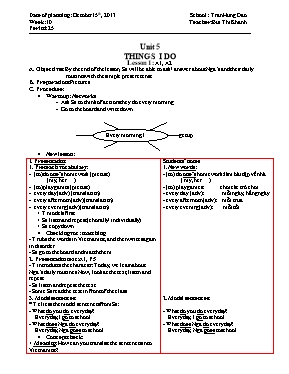
Date of planning: October 15th, 2013th 	 School: Tran Hung Dao
Week: 10	 Teacher: Bui Thi Khanh
Period: 25
Unit 5
 THINGS I DO
Lesson 1: A1, A2
A. Objectives: By the end of the lesson, Ss will be able to ask / answer about Nga’s and their daily
 routines with the simple present tense.
B. Preparations: Pictures.
C. Procedure:
Warm up: Networks
 - Ask Ss to think of actions they do every morning.
 - Go to the board and write down.
Every morning, I
 get up
New lesson:
I. Presentation:
1. Pre teach vocabulary:
Students’ notes
1. New words:
- (to) do one’s homework (picture)
 (my, her )
- (to) play games (picture)
- every day (adv) (translation)
- every afternoon (adv) (translation)
- every evening (adv) (translation)
- (to) do one’s homework: làm bài tập về nhà
 ( my, her )
- (to) play games: chơi các trò chơi
- every day (adv): mỗi ngày, hằng ngày
- every afternoon (adv): mỗi trưa
- every evening (adv): mỗi tối
+ T models first.
+ Ss listen and repeat (chorally/ individually)
 + Ss copy down.
Checking voc: matching
- T rubs the words in Vietnamese, and then writes again in disorder.
- Ss go to the board and match them.
2. Presentation text :A1, P5
- T introduces the character: Today, we learn about Nga’s daily routines. Now, look at the text, listen and repeat.
- Ss listen and repeat the text.
- Some Ss read the text in front of the class.
3. Model sentences:
2. Model sentences:
* T elicits the model sentences from Ss:
- What do you do everyday?
- What do you do everyday?
 Everyday, I go to school.
 Everyday, I go to school.
- What does Nga do everyday?
 Everyday, Nga goes to school.
- What does Nga do everyday?
 Everyday, Nga goes to school.
Concept check:
+ Meaning: How can you translate the sentences into Vietnamese?
- Đây có phải là hoạt động hằng ngày không?
- Có sự khác nhau gì giữa động từ với ngôi “I” và ngôi “She” Không? Khác nhau như thế nào?
* The simple present tense.
* The simple present tense:
+ Form (Affirmative form):
+ Form (Affirmative form):
- I, you, we, they + V- inf
- He, she, It, Nga + V -(s / es).
- I, you, we, they + V- inf
- He, she, It, Nga + V -(s / es).
+ Notes: The verbs ending with: o, s, x, z, ch, sh we add “es”.
+ Notes: Thêm “es” sau các động từ tận cùng bằng: o, s, x, z, ch, sh.
+ Use: Thì hiện tại đơn dùng để diễn tả một thói quen, hay các hành động xảy ra thường xuyên hay lặp đi lặp lại.
+ Use: Thì hiện tại đơn dùng để diễn tả một thói quen, hay các hành động xảy ra thường xuyên hay lặp đi lặp lại.
* Check grammar:
- Nga go to school goes
- She play games plays
- I gets up. get.
II. Practice:
3. Practice: A1, A2.
1. Substitution drill.
a. A1
a. T: Everyday, I get up at six.
->Ss: Everyday, Nga gets up at 6.
b. T: I brush my teeth.
-> Ss: Nga brushes her teeth.
c. T: I wash my face.
-> Ss: She washes her face.
d. T: I have breakfast.
-> Ss: She has breakfast. Etc.
2. Comprehension questions: A2 P.53
b. A2
- Ss read the text again, work in pairs, ask and answer the questions A2 P.53.
- Open pairs – closed pairs.
* Answer keys:
a. Everyday, Nga gets up at six.
b. Every morning, she goes to school.
c. Every afternoon, she plays games.
d. Every evening, she does her homework
a. Everyday, Nga gets up at six.
b. Every morning, she goes to school.
c. Every afternoon, she plays games.
d. Every evening, she does her homework
III. Production:
- Ss work in groups of four, write about their daily routines.
- Take out some groups to correct.
Homework
Homework
Ask Ss to do the home assignment.
* Use the correct verb form:
1. Every morning, Hoa (go) to school.
2. Everyday, I (brush) my teeth.
3. He (do) his homework every evening.
4. Nga (wash) her face everyday.
5. Ba (have) hunch at 11.30 evening.
6. We (go) to school every afternoon.
7. Nam (get) up at six every day.
Tài liệu đính kèm:
 giao_an_tieng_anh_lop_6_unit_5_things_i_do_lesson_1_a1_a2_bu.doc
Đề thi liên quan
 100 Baì tập chia động từ - Môn Tiếng Anh Lớp 6
 Lượt xem: 171
 Lượt tải: 0
 Đề kiểm tra 45p học kì I Tiếng anh lớp 6
Lượt xem: 979
Lượt tải: 0
Đề kiểm tra 45p học kì I Tiếng anh lớp 6
Lượt xem: 979
Lượt tải: 0- Đề ôn tập Unit 8 môn Tiếng Anh Lớp 6 (Thí điểm)
Lượt xem: 838
Lượt tải: 0
- Đề kiểm tra môn Tiếng anh khối 6
Lượt xem: 882
Lượt tải: 0
- 2 Đề kiểm tra giữa học kỳ II môn Tiếng Anh Lớp 6 - Trường THCS Nhân Hòa (Có đáp án)
Lượt xem: 706
Lượt tải: 0
- Đề kiểm tra học kỳ II môn Tiếng Anh Lớp 6 - Năm học 2016-2017 - Phòng GD & ĐT Đất Đỏ (Có đáp án)
Lượt xem: 122
Lượt tải: 0
 121 Bài tập Tiếng Anh 6 thí điểm - Minh Phạm
Lượt xem: 818
Lượt tải: 3
121 Bài tập Tiếng Anh 6 thí điểm - Minh Phạm
Lượt xem: 818
Lượt tải: 3- Đề kiểm tra 45 phút số 1 môn Tiếng Anh Lớp 6 (Thí điểm) - Năm học 2016-2017 - Trường THCS Xuân Hòa (Có đáp án)
Lượt xem: 725
Lượt tải: 1
- Đề và đáp án kiểm tra 15p Tiếng anh lớp 6
Lượt xem: 1189
Lượt tải: 0
- Đề khảo sát tuyển sinh Lớp 6 Trung học phổ thông chuyên Trần Đại Nghĩa môn Tiếng Anh (Tự luận) - Năm học 2017-2018 - Sở GD & ĐT Thành phố Hồ Chí Minh
Lượt xem: 200
Lượt tải: 0
Copyright © 2026 ThuVienDeThi.com, Thư viện đề thi mới nhất, Đề kiểm tra, Đề thi thử

