
Giáo án Tiếng Anh Lớp 12 (Buổi chiều)


Bạn đang xem 20 trang mẫu của tài liệu "Giáo án Tiếng Anh Lớp 12 (Buổi chiều)", để tải tài liệu gốc về máy bạn click vào nút DOWNLOAD ở trên
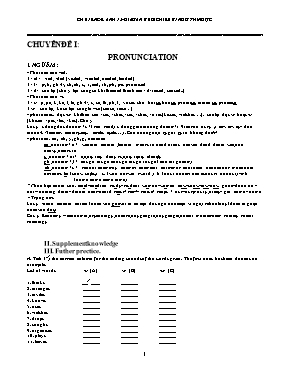
CHUYấN ĐỀ I:
PRONUNCIATION
I. NGỮ ÂM:
- Phỏt õm của –ed:
+ / id / : -ted, -ded (visited, wanted, needed, landed)
+ / t / : p, k, gh /f/, sh, ch, s, x, ced, th, ph, pe. practised
+ / d/ : cũn lại (chỳ ý: tận cựng se khi thờm ed thành õm / d/ raised, caused..)
- Phỏt õm của -s
+ / s/ : p, pe, k, ke, t, te, gh /f/, c, ce, th, ph, f, và cỏc chữ: horse, house, practise, increase, promise
+ /z/ : cũn lại, kể cả tận cựng là –se (cause, raise)
- phỏt õm es: đọc /iz/ khi theo sau: -ses, -shes, -ces, -ches, -oxes (kisses, watches.). cũn lại đọc /z/ hoặc /s/ (khi sau: -pes, -tes, -kes). Chỳ ý:
Lưu ý: s đứng đầu đọc õm / s / ( see, send), s đứng giữa thường đọc õm/ z /(reason, busy), ce-, ci-, cy- đọc thành /s / (center, century,city, circle, cycle). Cỏc trường hợp: sugar, sure: khụng đọc /s/
- phỏt õm : ea, ch, y, gh, g, õm cõm
ea phỏt õm / e / : weather, leather, feather, measure, head, break, heaven, dead, death, weapon,
heavy, pleasure
y phỏt õm / ai / : apply, rely, deny, supply, reply, identify
gh phỏt õm / f / : cough, laugh, enough, tough, rough,( cũn lại gh cõm)
 ch phỏt õm / k / : school, chemistry, chemist, chemical, christmas, character, ache,chaos, mache nic
õm cõm: kn (know, knife..), w (who, answer, sword, ), h (hour, honest, heir,exhaust, honour),- mb (bomb,comb,climb, lamb)
* Phõn biệt cỏc từ sau: child-children; study- student; woman- women; now-know-low-how; gone- done; no - not – nothing; diner- dinner;hear- heard;status/ stei-/- statue/ stổtju:/; bus-busy- bury; pretty- get; come - home
 - Trọng õm:
Lưu ý: -ation, teacher, enrich (nhấn vần gốc với từ cú tiếp đầu ngữ hoặc tiếp vĩ ngữ), schoolboy (danh từ ghộp nhấn vần đầu)
Chỳ ý: Economy – economic, psychology, philosophy, geography, geographical, mathematics, society, social, sociology
II. Supplement knowledge
III. Futher prectice.
A. Tick (ỹ) the correct column for the ending sounds of the words given. The first ones has been done as an example.
List of words	/s/ (A)	/z/ (B)	/iz/ (C)
1. thinks	__ỹ___	______	______
2. arranges	______	______	______
3. invites	______	______	______
4. knows	______	______	______
5. uses	______	______	______
6. watches	______	______	______
7. drops	______	______	______
8. coughs	______	______	______
9. organises	______	______	______
10. plays	______	______	______
11. leaves	______	______	______
12. hats	______	______	______
13. goes	______	______	______
14. depths	______	______	______
15. clothes	______	______	______
16. washes	______	______	______
17. dates	______	______	______
18. photographs	______	______	______
19. learns	______	______	______
20. boxes	______	______	______
B. Tick (ệ) the correct sound of the past ending in the following words. The first one has been done as an example.
 /t/ (A)	/d/ (B)	/id/ (C)
moved	ă	ỵ	ă
carried	ă	ă	ă
educated	ă	ă	ă
watched	ă	ă	ă
confided	ă	ă	ă
concerned	ă	ă	ă
attracted	ă	ă	ă
agreed	ă	ă	ă
coughed	ă	ă	ă
changed	ă	ă	ă
hoped	ă	ă	ă
waited	ă	ă	ă
called	ă	ă	ă
ranged	ă	ă	ă
invited	ă	ă	ă
employed	ă	ă	ă
decided	ă	ă	ă
wished	ă	ă	ă
searched	ă	ă	ă
guessed	ă	ă	ă
produced	ă	ă	ă
C. Choose the best answer to each question by cicling the corresponding letter.
Which of the following verbs has its past ending pronounced /t/?
	A. waited	B. burned	C. produced
Which of the following verbs has its past ending pronounced differently from the others?
	A. wished	B. ranged	C. tipped
Which of the following verbs does not have its past ending pronounced /ɪd/?
	A. relieved	B. decided	C. invited
Which of the following verbs has its past ending pronounced /d/?
	A. guessed	B. operated	C. employed
Which of the following verbs has its past ending pronounced /ɪd/?
	A. called	B. affected	C. searched
F. Group into the same column.
F1:
/t/: .......................................................................................................................................................................
/d/: ..
/id/:
1. booked	6. aged	11. loved	16. kicked
2. ended	7. roofed	12. dogged	17. needed
3. naked	8. played	13. missed	18. smiled
4. washed	9. prepared	14. raised	19. complained
5. opened	10. mixed	15. laughed	20. wanted
F2:
/s/:..
/z/:.
/iz/:
1. pens	6. changes	11. baths	16. washes
2. ships	7. laughs	12. legs	17. animals
3. places	8. friends	13. likes	18. watches
4. rooms	9. classes	14. teachers	19. roofs
5. cats	10.books	15. boxes	20. plays
F3:
/I/:
/i:/:
1. kick	6. key	11. agree	16. ambitious
2. read	7. dip	12. begin	17. referee
3. interest	8. bit	13. typical	18. stimulate
4. little	9. seat	14. exhibition	19. eaten
5. ease	10. vitae	15. breed	20. heat
F4:
/e/: .
/ổ/: .........................................................................................................................................................................
1. damage	6. tragic	11. bank	16. man
2. passive	7. deaf	12. background	17. said
3. better	8. semester	13. profession	18. send
4. defence	9. marital	14. death	19. family
5. leftovers	10. harrow	15. sand	20. many
F5:
/^/: ..
/a:/: .
1. cousin	6. father	11. come	16. fasten
2. far	7. study	12. garden	17. month
3. love	8. target	13. lunch	18. farmer
4. marvellous	9. subject	14. last	19. brother
5. wonderful	10. dance	15. under	20. shark
F6:
/ɒ/:
/ɔ:/: ...................................................................................................................................................................
1. top	6. call	11. talk	16. clock
2. mpre	7. four	12. boss	17. resort
3. doctor	8. job	13. alternate	18. not
4. box	9. wrong	14. shop	19. warm
5. sport	10. walk	15. corner	20. stop
F7:
/u:/: ..
/u/: ..
1. too	6. sugar	11. woman	16. good
2. put	7. push	12. clue	17. include
3. through	8. threw	13. pull	18. rude
4. shoe	9. food	14. blue	19. cook
5. full	10. cushion	15. wolf	20. zoo
F8:
/ɜ:/: ..
/ə/:
1. ago	6. together 	11. bird	16. early
2. teacher	7. workship	12. purpose	17. welcome
3. work	8. world	13. second	18. term
4. worse	9. today	14. church	19. shirt
5. about	10. introduce	15. police	20. further
IV. Homework
G. Choose the word whose underlined part is pronounced differently from others.
1.	a. village	b. dangerous	c. gossip	d. passenger
2.	a. which	b. changeable	c. each	d. characteristic
3. 	a. pasture	b. acquaintance	c. constant	d. talkative
4.	a. uncertain	b. tell	c. pursuit	d. picture
5.	a. chore	b. machine	c. much	d. such
6.	a. game	b. bridge	c. against	d. garage
7.	a. generous	b. gene	c. generally	d. giving
8. 	a. cheese	b. children	c. chemical	d. teacher
9.	a. machinery	b. march	c. cheerfully	d. merchant
10.	a. page	b. message	c. danger	d. ringer
11.	a. language	b. happen	c. experience	d. know
12. 	a. sing	b. glance	c. turn	d. sneaky
13. 	a. note	b. next	c. finger	d. expensive
14.	a. money	b. link	c. down	d. point
15. 	a. around	b. hand	c. nothing	d. autumn
16.	a. happy	b. husband	c. have	d. hour
17.	a. iron	b. celebrate	c. parents	d. restaurant
18. 	a. who	b. how	c. which	d. whose
19.	a. friend	b. anniversary	c. birthday	d. cream
20. 	a. children	b. divorce	c. married	d. present
21.	a. her	b. honour	c. hold	d. home
22. 	a. bring	b. every	c. remember	d. party
23.	a. girl	b. card	c. for	d. pretty
24.	a. when	b. whom 	c. whole	d. whoever
25.	a. rhyme	b. behind	c. hundred	d. here
26.	a. invited	b. attended	c. celebrated	d. displayed
27.	a. neighbors	b. friends	c. relatives	d. photographs
28.	a. happy	b. house	c. hour	d. hold
29.	a. childless	b. watching	c. machine	d. choose
30.	a. none	b. ink	c. blown	d. Brand
31.	a. war	b. work	c. world	d. whom
32.	a. use	b. umbrella	c. under	d. utter
33. 	a. winter	b. answer	c. award	d. towards
34. 	a. lawn	b. allow	c. drawing	d. swimmer
35. 	a. student	b. education	c. united	d. truck
36.	a. sword	b. sweat	c. swing	d. swallow
37. 	a. mow	b. know	c. dawn	d. window
38. 	a. summer	b. club	c. computer	d. but
39.	a. suffer	b. unhappy	c. cup	d. uniform
40.	a. who	b. where	c. when	d. why
41.	a. campaign	b. people	c. population	d. pneumonia
42.	a. number	b. able	c. climber	d. about
43. 	a. psychology	b. prepare	c. problem	d. promote
44.	a. comb	b. combine	c. combat	d. combust
45.	a. job	b. bomb	c. back	d. before
46. 	a. two	b. twenty	c. twist	d. twice
47.	a. competition	b. competitor	c. contest	d. question
48.	a. twinkle	b. twelve	c. twin	d. twofold
49. 	a. sponsored	b. answered	c. enjoyed	d. competed
50. 	a. smoothly	b. three	c. enthusiasm	d. think
V. The key
A.
1. A 2. C3. A4. B5. C6. C7. A8. A9. C10. B11. B12. A13. B14. A15. B16. C17. A18. A19. B20. C
B.
B2. C3. A4. C5. B6 C7. B8. A9. B10. A11.C12.B13B14C15B16C17A18A19A20A
C.
1. C2. B3. A4. C5. B
F.
F1.	/t/: 1,4,7,10,13,15,16
	/d/: 5,8,9,11,14,18,19
	/id/: 2,3,6,12,17,20
F2.	/s/: 2,5,7,10,11,13,19
	/z/: 1,4,8,12,14,17,20
	/iz/: 3,6,9,15,16,18
F3. 	/I/: 1,3,4,7,8,12,13,14,16,18
	/i:/: 2,5,6,9,10,11,15,17,19,20
F4. 	/e/: 3,4,5,7,8,13,14,17,18,20
	/ổ/: 1,2,6,9,10,11,12,15,16,19
F5. 	/^/: 1,3,5,7,9,11,13,15,17,19
	/a:/: 2,4,6,8,10,12,14,16,18,20
F6.	/ɒ/: 1,3,4,8,9,12,14,16,18,20
	/ɔ/: 2,5,6,7,10,11,13,15,17,19
F7. 	/ʊ/: 2,5,6,7,10,11,13,15,16,19
	/u:/: 1,3,4,8,9,12,14,17,18,20
F8. 	/ə/: 1,2,5,6,9,10,12,13,15,17
	/ɜ/: 3,4,7,8,11,14,16,18,19,20
G.
1.	C
2.	D
3. 	A
4.	D
5.	B
6.	B
7.	D
8. 	C
9.	A
10.	D
11.	A
12. 	A
13. 	C
14.	B
15. 	D
16.	D
17.	A
18. 	C
19.	C
20. 	B
21.	B
22. 	D
23.	D
24.	A
25.	A
26.	D
27.	D
28.	C
29.	C
30.	B
31.	D
32.	A
33. 	B
34. 	D
35. 	D
36.	A
37. 	D
38. 	C
39.	D
40.	A
41.	D
42.	C
43. 	A
44.	A
45.	B
46. 	A
47.	A
48.	D
49. 	D
50. 	A
CHUYấN ĐỀ II:
TENSES
The Present Simple Tense
 I. Basic knowledge: After lesson Sts can know more about present simple
 Practice doing exercises.
I. the simple present;
A. formation;
Khẳng định;
+) I, you, we, they +V (inf. )
 He, she, it + V ( s/es)
 Ex; I work in a factory
 She lives in Tuyen Quang
Phủ định;
-) I(you/ we/they ) DO NOT + V (inf)
 She (he/it ) DOES NOT + V (inf)
Ex: We don’t like coffe with suger
 It doesn’t rain today
Nghi vấn;
?) DO I (you/we/they) +V (inf )?
 DOES she (he/it ) + V (inf )?
Nghi vấn phủ định;
?) DON’T I (you/we/they ) + V (inf. )?
 DOESNOT he/she/it + V (inf. )?
B.usage;
Dựng để diễn tả một hành động lập đi lập lại, một thúi quen.
Một chõn lý hay một sự thật hiển nhiờn thường kốm theo cỏc phú từ năng diễn ; always, forever, usually, often, sometime, never, rarely, everyday, everyweek
Ex; The English usually drink tea in the afternoon.
II. present continous;
A. formation;
 +) S + + V- ing
 -) S + + NOT +V-ing
 ?) + S +V-ing ?
 Ex; He is reading a book.
 He is not reading a book.
B. usage; Diễn tả một hành động đang xảy ra vào thời điểm đang núi. Thường đi kốm với “now”, “at this moment “
 Ex; He is reading a book now.
III. simple past:
A. formation;
1. Regular verb;
S + V –ed
S + DID NOT + V (inf.)
DID + S + V( inf. ).?
DIDN’T + S + V (inf. )..?
 Ex; He played
 He did not play
 Did he play?
 Didn’t he play.?
2. Irregular verb ;
S + v
S + DID NOT + V (inf.)
DID + S + V (inf.)?
DIDN’T +S + V (inf.)?
B. usage; Dựng để diễn tả 1 hành động đẫ xảy ra và kết thỳc trong quỏ khứ, thời gian quỏ khứ, dứt điểm khụng liờn quan tới hiện tại.
 Thường đi kốm với cỏc trạng từ chỉ thời gian; yesterday, last week, last mounth, last year, ago,in 1945
 Ex; Yesterday I went home late.
 I stopped smoking a month ago.
VI. Put the verb in the correct form of the past ( positive,negative,or question)
I played (play) tennis yesterday but I didn’t win (not/win)
We(wait)a long time for the bus but it(not/come)
That’s a nice shirt. Where (you/buy)..it ?
She (see)..me but she (not/speak)..to me.
(it/rain).yersterday? ‘No, it was a nice day’
That was a stupid thing to do. Why (you/do)it?
II. Supplement knowledge
III. Futher prectice.
1. Are the underlined verbs right or wrong? Correct the verbs that are wrong.
Water boils at 100 degrees Celsius. 	________
The water boils. Can you turn it off?	________
Look! That man tries to open the door of your car. 	________
Can you hear those people? What do they talk about?	________
The moon goes around the earth. 	________
I must go now. It gets late. 	________
I usually go to work by car. 	________
‘Hurry up! It’s time to leave.’ ‘Ok, I come.’
The key:
T
F: is boiling
F; is trying
F: are they talking
5.T
6 F: is getting
7. T
8 F: am coming
A. Use the correct form of verbs in brackets.
In all the world, there (be) __________ only 14 mountains that (reach) __________above 8,000 meters.
He sometimes (come) __________ to see his parents.
When I (come) __________, she (leave) __________for Dalat ten minutes ago.
My grandfather never (fly) __________ in an airplane, and he has no intention of ever doing so.
We just (decide) __________ that we (undertake) the job.
He told me that he (take) __________ a trip to California the following week.
I knew that this road (be) __________ too narrow.
Right now I (attend) __________ class. Yesterday at this time I (attend) __________class.
Tomorrow I’m going to leave for home. When I (arrive) __________at the airport, Mary (wait) for me.
Margaret was born in 1950. By the year 2005, she (live) __________on this earth for 55 years .
The key
are - reach
comes
came - had left
has never flown
have just decided -would undertake
would take
was
am attending - was attending
arrive -will be waiting
had lived
IV. Homework
B. Choose the best answer among A, B, C, or D.
1. When I last saw him, he _____ in London.
A. has lived	B. is living	C. was living	D. has been living
 2. We _______ Dorothy since last Saturday.
	A. don’t see	B. haven’t seen	C. didn’t see	D. hadn’t seen
 3. The train ______ half an hour ago.
	A. has been leaving	B. left
C. has left	D. had left
 4. Jack ______ the door.
	A. has just painted	B. paint
	C. will have painted	D. painting
 5. My sister ________ for you since yesterday.
	A. is looking	B. was looking	C. has been looking D. looked
 6. I ______ Texas State University now.
	A. am attending	B. attend	C. was attendingD. attended
 7. He has been selling motorbikes ________.
	A. ten years ago	B. since ten years
	C. for ten years ago	D. for ten years
 8. Christopher Columbus _______ American more than 500 years ago.
	A. discovered 	B. has discovered
	C. had discovered	D. had been discovering
 9. He fell down when he ______ towards the church.
	A. run	B. runs	C. was running	D. had run
 10. We _______ there when our father died.
	A. still lived 	B. lived still
	C. was still lived 	D. were still living
 11. They ______ table tennis when their father comes back home.
	A. will play	B. will be playing
	C. play	D. would play
 12. By Christmas, I _______ for Mr. Smith for six years.
	A. shall have been working	B. shall work
	C. have been working	D. shall be working
 13. I _______ in the room right now.
	A. am being	B. was being	C. have been being	D. am
 14. I ______ to New York three times this year.
	A. have been	B. was	C. were	D. had been
 15. I’ll come and see you before I _______ for the States.
	A. leave	B. will leave	C. have left	D. shall leave
 16. The little girl asked what _______ to her friend.
	A. has happened	B. happened
	C. had happened 	D. would have been happened
 17. John ______ a book when I saw him.
	A. is reading	B. read 	C. was reading	D. reading
 18. He said he _______ return later.
	A. will 	B. would	C. can	D. would be
 19. Jack ________ the door.
	A. has just opened	B. open
	C. will have opened	D. opening
 20. I have been waiting for you ______ .
A. since early morning	B. since 9a.m
C. for two hours	D. All are correct
21. Almost everyone _______ for home by the time we arrived.
A. leave	B. left	C. leaves	D. had left
22. By the age of 25, he ______ two famous novels.
A. wrote	B. writes	C. has written	D. had written
23. While her husband was in the army, Mary ______ to him twice a week.
A. was reading	B. wrote	C. was written	D. had written
24. I couldn’t cut the grass because the lawn mower ______ a few days previously.
A. broke down	B. has been broken
C. had broken down	D. breaks down
24. I have never played badminton before. This is the first time I _____ to play.
A. try	B. tried	C. have tried	D. am trying
25. Since _______, I have heard nothing from him.
A. he had left 	B. he left	C. he has left	D. he was left
26. After I _______ lunch, I looked for my bag.
A. had 	B. had had 	C. have has 	D. have had
27. By the end of next year, George _______ English for two years.
A. will have learned 	B. will learn
C. has learned 	D. would learn
28. The man got out of the car, ________ round to the back and opened the book.
A. walking	B. walked	C. walks	D. walk
29. Henry _______ into the restaurant when the writer was having dinner.
A. was going	B. went	C. has gone	D. did go
30. He will take the dog out for a walk as soon as he ______ dinner.
A. finish	B. finishes	C. will finish	D. finishing
31. I shall be glad when he _______.
A. had gone	B. did go	C. went	D. has gone
32 Ask her to come and see me when she _______ her work.
A. finish	B. has finished	C. finished	D. finishing
33. Turn off the gas. Don’t you see the kettle ________ ?
A. boil	B. boils	C. is boiling	D. boiled
34. Tom and Mary ______ for Vietnam tomorrow.
A. leave	B. are leaving	C. leaving	D. are left
35. He always ________ for a walk in the evening.
A. go	B. is going	C. goes	D. going
36. Her brother ______ in Canada at present.
A. working	B. works	C. is working	D. work
37. I ______ to the same barber since last year.
A. am going	B. have been goingC. go	D. had gone
38. Her father ______ when she was a small girl.
A. dies	B. died	C. has died	D. had died
39. Last week, my professor promised that he ________ today.
A. would come	B. will come	C. comes	D. coming
40. Pasteur ______ in the 19th century.
A. was living	B. lived	C. had lived 	D. has lived
The key
1. C
2. B
3. B
4. A
5. C
6. A
7. D
8. A
9. C
10. A
11. B
12. A
13. D
14. A
15. A
16. C
17. C
18. B
19. A
20. D
21. D
22. D
23. B
24. C
25. B
26. B
27. A
28. B
29. B
30. B
31. D
32. B
33. C
34. B
35. C
36c
37b
38b
39a
40b
CHUYấN ĐỀ III:
TENSES (Continue)
 I. Basic knowledge: After lesson Sts can know more about present simple
 Practice doing exercises.
IV. PAST COTINUOUS;
A. formation;
S + + V -ing
S + +NOT +V -ing
 +S + V-ing..?
 + S + V –ing .?
Ex; She was doing her homework .
 She wasn’t doing her homework.
B. usage:
1. Dựng để diễn tả 1 hành động đang xẩy ra ở một mốc điiểm thời gian xỏc định trong quỏ khứ.
 Ex; We were watching TV at 8 o’clock last night.
2.Dựng để diễn tả 1 hành độnh đang xảy ra (quỏ khứ tiếp diễn ), thỡ 1 hành động khỏc xảy đến (dựng quỏ khứ thường ). Hai hành động này được nối liền bằng liờn từ “when”
 Ex; The door bell rang when I was having my dinner.
 When I was watching in the park, I saw two men fighting.
VII. THE PRESENT PERFECT;
A. formation;
I(we, you, they ) + Have + past participle
He(she, it) +has + past participle
I(we,you, they ) +Haven’t + past participle
He(she, it ) +hasn’t + past participle
Have +I(we, you, they ) + past participle
Has + He( she, it) + past participle
Haven’t + I(we,you,they ) + past participle
Hasn’t +He(she,it ) + past participle
 B. usage;
1. Diễn tả 1 viờc vừa mới xảy ra trong quỏ khứ, thường đi kốm với cỏc từ; just, recently
2. Diễn tả 1 việc đó xảy ra trong quỏ khứ nhưng khụng nhớ rừ thời gian,thường đi kốm với cỏc từ ; notyet, yet, never, ever, already, before,
3. Diễn tả 1 việc xảy ra trong quỏ khứ nhưng cũn tiếp tục tới hiện tại, hoặc tỏc động tới hiện tại, thường đi kốm với cỏc từ; since, for.
 Ex; The train has just left the station.
 We haven’t done our homework yet.
 I have already seen that film.
II. Supplement knowledge
III. Futher prectice.
VIV. Put the verb in the present perfect (I have
Tài liệu đính kèm:
 giao_an_tieng_anh_lop_12_buoi_chieu.doc
Đề thi liên quan
 Đề thi thử tuyển sinh Đại học môn Tiếng Anh Khối D năm 2010 - Mã đề 701
 Lượt xem: 767
 Lượt tải: 0
 Đề thi khảo sát chất lượng các lớp Chuyên đề lần I môn Tiếng Anh Lớp 12 - Mã đề 209 - Năm học 2016-2017 - Trường THPT Nguyễn Thị Giang
Lượt xem: 789
Lượt tải: 0
Đề thi khảo sát chất lượng các lớp Chuyên đề lần I môn Tiếng Anh Lớp 12 - Mã đề 209 - Năm học 2016-2017 - Trường THPT Nguyễn Thị Giang
Lượt xem: 789
Lượt tải: 0- Đề khảo sát chất lượng THPT Quốc gia môn Tiếng Anh Lớp 12 - Mã đề 370 - Năm học 2016-2017 - Sở GD và ĐT Vĩnh Phúc
Lượt xem: 706
Lượt tải: 0
- Đề thi THPT Quốc gia môn Tiếng Anh năm 2017 - Mã đề 02 - Trường THPT Hoàng Văn Thụ
Lượt xem: 725
Lượt tải: 0
- Đề thi khảo sát chất lượng các lớp Chuyên đề lần I môn Tiếng Anh Lớp 12 - Mã đề 357 - Năm học 2016-2017 - Trường THPT Nguyễn Thị Giang
Lượt xem: 654
Lượt tải: 0
- Đề kiểm tra 15 phút số 1 môn Tiếng Anh Lớp 12 - Mã đề 357 - Trường THPT Thiên Hồ Dương
Lượt xem: 675
Lượt tải: 0
- Một số bài tập về Mệnh đề quan hệ (Relative clause)
Lượt xem: 987
Lượt tải: 0
- Bài tập ôn luyện bài 5 Tiếng anh lớp 12 - Lê Công Đức
Lượt xem: 967
Lượt tải: 0
 Đề kiểm tra chất lượng ôn thi THPT Quốc gia môn Tiếng Anh năm 2017 - Đề số 81 - Đỗ Bình (Có đáp án)
Lượt xem: 720
Lượt tải: 0
Đề kiểm tra chất lượng ôn thi THPT Quốc gia môn Tiếng Anh năm 2017 - Đề số 81 - Đỗ Bình (Có đáp án)
Lượt xem: 720
Lượt tải: 0- Đề thi thử Trung học phổ thông Quốc gia môn Tiếng Anh năm 2017 - Đề 4 - Trường THPT Nguyễn Trãi (Có đáp án)
Lượt xem: 884
Lượt tải: 0
Copyright © 2026 ThuVienDeThi.com, Thư viện đề thi mới nhất, Đề kiểm tra, Đề thi thử

