
Giáo án Bồi dưỡng học sinh giỏi môn Tiếng Anh Lớp 7 - Tuần 1 - Năm học 2017-2018


Bạn đang xem tài liệu "Giáo án Bồi dưỡng học sinh giỏi môn Tiếng Anh Lớp 7 - Tuần 1 - Năm học 2017-2018", để tải tài liệu gốc về máy bạn click vào nút DOWNLOAD ở trên
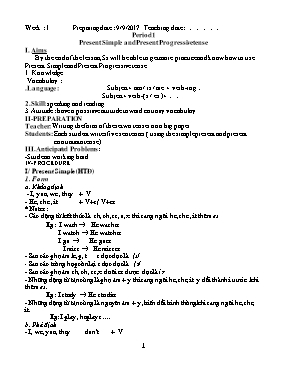
Week : 1 Preparing date : 9/9/2017 Teaching date : Period 1 Present Simple and Present Progressive tense I. Aims By the end of the lesson, Ss will be able to get more practice and know how to use Present Simple and Present Progressive tense. 1. Knowledge .Vocabulary : .Language : Subject + am / is / are + verb-ing. Subject + verb-( s / es )+......... 2.Skill: speaking and reading 3.Attitude : have a possitive attitude to ward country vocabulary II-PREPARATION Teacher: Writing the form of these two tenses on a big paper. Students: Each student writes five sentences ( using the simple present and present continuous tense) III.Anticipated Problems : -Students working hard IV-PROCEDURE I/ Present Simple (HTĐ) 1. Form a. Khẳng định - I, you, we , they + V - He, she , it + V+s / V+es * Notes : - Các động từ kết thúc là sh, ch, ss, o, x thì sang ngôi he, she , it thêm es Eg : I wash đ He washes I watch đ He watches I go đ He goes I miss đ He misses - Sau các phụ âm k, p, t s đ ợc đọc là /s/ - Sau các tr ờng hợp còn lại s đ ợc đọc là /z/ - Sau các phụ âm sh, ch, ss, x đuôi es được đọc là iz - Những động từ tận cùng là phụ âm + y thì sang ngôi he, she, it y đổi thành i trước khi thêm es. Eg : I study đ He studies - Những động từ tận cùng là nguyên âm + y, biến đổi bình th ờng khi sang ngôi he, she, it. Eg: I play, he plays .... b. Phủ định - I, we, you, they don't + V - He, she , it doesn't + V c. Nghi vấn - Do I / you/ we / they + V ? - Does he/ she/ it + V ? 2. The use. a. Diễn tả mức độ thường xuyờn diễn ra của hành động ở hiện tại. Thường đi với always, usually, often , sometimes, occasionally (thỉnh thoảng), rarely, seldom (hiếm khi), never, everyday, every week.... once twice / 2 times 3 times a week/ a month/year .... một lần hai lần một tuần/ một tháng/ một năm ... ba lần Eg : - He usually goes to the cinema. - We clean our house everyday. - Lan washes clothes twice a week. b. Diễn tả điều luôn luôn đúng (sự thật), hoặc đã đúng trong một khoảng thời gian dài. Eg : - Some animals don't eat during winter. ( Một vài loài động vật không ăn vào mùa đông) - We are Vietnamese. We speak Vietnamese. - He works in a bank. II/ Present Continuous (Hiện tại tiếp diễn) 1. Form a. Khẳng định I am You/ We/ They are + V-ing He/ she/ it is b. Phủ định S + to be + not + V-ing c. Nghi vấn To be + S + V-ing ? *Notes : - Những động từ kết thúc là một nguyên âm e, tr ớc khi thêm ing ta bỏ e. Eg : have đ having write đ writing - Những động từ 1 âm tiết, 1 nguyên âm, kết thúc là một phụ âm, tr ớc khi thêm ing ta gấp đôi phụ âm cuối. Eg : - sit đ sitting - swim đ swimming - Các động từ: die, lie, tie ... biến đổi nh sau: die đ dying, lie đ lying, tie đ tying 2. The use i lặp lại. Eg : He's always losing his keys. (Anh ta cứ luôn đánh mất chìa khóa) * Notes : cỏc động từ trạng thỏi (stative verb) ở bảng sau khụng được chia ở thể tiếp diễn (bất cứ thời nào) khi chỳng là những động từ tĩnh diễn đạt trạng thỏi cảm giỏc của hoạt động tinh thần hoặc tớnh chất của sự vật, sự việc. know believe hear see smell wish think understand hate love like want sound stop have need appear seem taste own feel Nhưng khi chỳng quay sang hướng động từ hành động thỡ chỳng lại được phộp dựng ở thể tiếp diễn. He has a lot of books. He is having dinner now. (Động từ hành động: ăn tối) I think they will come in time. I'm thinking of my test tomorrow. (Động từ hành động: Đang nghĩ về) Feed back : . . Week : 1 Preparing date : 10/9/2017 Teaching date : Period 2 Present Simple and Present Progressive tense ( con’t ) I. Aims By the end of the lesson, Ss will be able to get more practice and know how to use Present Simple and Present Progressive tense. 1. Knowledge .Vocabulary : .Language : Subject + am / is / are + verb-ing. Subject + verb-( s / es )+......... 2.Skill: speaking and reading 3.Attitude : have a possitive attitude to ward country vocabulary II-PREPARATION Teacher: Writing the form of these two tenses on a big paper. Students: Each student writes five sentences ( using the simple present and present continuous tense) III.Anticipated Problems : -Students working hard IV-PROCEDURE Exercise 1: Chia động từ trong ngoặc: 1. They (go). on holiday every winter. 2. The days (be) longer in summer. 3. She often (talk) . to herself. 4. Oak trees (grow) .very slowly. 5 My dog (not eat) . vegetables. 6. My brother (not like) animals. Answer kyes : 1: goes 2: is 3: talks 4: grows 5: does not eat 6 : doesn’t like 2. Exercise 2: Đọc đoạn văn sau, dùng từ gợi ý đặt câu hỏi và trả lời Hans Huser is a ski-instructor. He is Swiss and he lives in Villars, a village in the mountains. In summer he works in a sports shop and in winter he teaches skiing. He speaks 4 languages : French, German, Italian and English. He is married and has two children. He plays football with them in his free time. He's happy with his family. 1/ What / Hans Huser / do ? 2/ Where/ he / come / from ? 3/ he / live / city ? 4/ Where / he / work / summer ? 5/ What / do / winter ? Answer Keys : What does Hans Hunser do ? He is a ski-instructor . Where does He come from ? -He is comes from Villars . Does He live in the city ? - No, He doesn’t . Where does He work in the summer ? -He works in a sports shop in the summer . What does He do in the winter ? -He teaches skiing in the winter . Feed back : . .
Tài liệu đính kèm:
 giao_an_boi_duong_hoc_sinh_gioi_mon_tieng_anh_lop_7_tuan_1_n.docx
Đề thi liên quan
 Đề kiểm tra chất lượng học kỳ I môn Tiếng Anh Lớp 7 (Chương trình Thí điểm) - Năm học 2016-2017 - Sở GD & ĐT Bắc Giang (Có đáp án)
 Lượt xem: 1405
 Lượt tải: 0
- Đề khảo sát chất lượng học kì I môn Tiếng Anh Lớp 7 - Năm học 2014-2015
Lượt xem: 639
Lượt tải: 0
 Đề và đáp án kiểm tra một tiết số 2 môn Tiếng anh lớp 7
Lượt xem: 851
Lượt tải: 0
Đề và đáp án kiểm tra một tiết số 2 môn Tiếng anh lớp 7
Lượt xem: 851
Lượt tải: 0- Đề kiểm tra Unit 1 môn Tiếng Anh Khối 7
Lượt xem: 740
Lượt tải: 0
- Đề và đáp án kiểm tra cuối năm Tiếng anh lớp 7 - Trường THCS Liễn Sơn
Lượt xem: 756
Lượt tải: 0
- Đề thi chọn học sinh giỏi cấp huyện Tiếng anh lớp 7 - Năm học 2009-2010
Lượt xem: 818
Lượt tải: 0
- Đề kiểm tra số 4 môn Tiếng anh lớp 7
Lượt xem: 852
Lượt tải: 1
- Bộ đề kiểm tra 45 phút số 4 môn Tiếng Anh Lớp 7 (Thí điểm)
Lượt xem: 865
Lượt tải: 0
- Đề kiểm tra 45 phút số 1 môn Tiếng Anh 7 (Có đáp án)
Lượt xem: 647
Lượt tải: 0
- Đề cương ôn tập cuối năm môn Tiếng Anh Lớp 7
Lượt xem: 135
Lượt tải: 0
Copyright © 2026 ThuVienDeThi.com, Thư viện đề thi mới nhất, Đề kiểm tra, Đề thi thử

