
Đề thi thử THPT Quốc gia cho học sinh Lớp 12 THPT, BT THPT môn Tiếng Anh - Mã đề 218 - Năm học 2016-2017 - Sở GD & ĐT Ninh Bình (Có đáp án)


Bạn đang xem tài liệu "Đề thi thử THPT Quốc gia cho học sinh Lớp 12 THPT, BT THPT môn Tiếng Anh - Mã đề 218 - Năm học 2016-2017 - Sở GD & ĐT Ninh Bình (Có đáp án)", để tải tài liệu gốc về máy bạn click vào nút DOWNLOAD ở trên
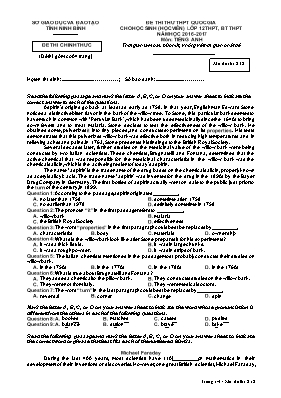
ĐỀ THI CHÍNH THỨC
Mó đề thi 218
SỞ GIÁO DỤC VÀ ĐÀO TẠO TỈNH NINH BèNH
(Đề thi gồm cú 04 trang)
ĐỀ THI THỬ THPT QUỐC GIA
CHO HỌC SINH (HỌC VIấN) LỚP 12 THPT, BT THPT
NĂM HỌC 2016-2017
Mụn: TIẾNG ANH
Thời gian làm bài: 60 phỳt, khụng kể thời gian phỏt đề
Họ tờn thớ sinh: ............................................; Số bỏo danh: ......................................
Read the following passage and mark the letter A, B, C, or D on your answer sheet to indicate the correct answer to each of the questions.
Aspirin’s origins go back at least as early as 1758. In that year, Englishman Edward Stone noticed a distinctive bitter flavor in the bark of the willow tree. To Stone, this particular bark seemed to have much in common with “Peruvian Bark”, which had been used medicinally since the 1640s to bring down fevers and to treat malaria. Stone decided to test the effectiveness of the willow bark. He obtained some, pulverized it into tiny pieces, and conducted experiments on its properties. His tests demonstrated that this pulverized willow bark was effective both in reducing high temperatures and in relieving aches and pains. In 1763, Stone presented his findings to the British Royal Society.
Several decades later, further studies on the medicinal value of the willow bark were being conducted by two Italian scientists. These chemists, Brugnatelli and Fontana, determined that the active chemical that was responsible for the medicinal characteristics in the willow bark was the chemical salicin, which is the active ingredient of today’s aspirin.
The name “aspirin” is the trade name of the drug based on the chemical salicin, properly known as acetylsalicylic acid. The trade name “aspirin” was invented for the drug in the 1890s by the Bayer Drug Company in Germany. The first bottles of aspirin actually went on sale to the public just prior to the turn of the century, in 1899.
Question 1: According to the passage, aspirin originated_________.
A. no later than 1758	B. sometime after 1758
C. no earlier than 1978	D. definitely sometime in 1758
Question 2: The pronoun “it” in the first passage refers to _________.
A. willow bark	B. malaria
C. the British Royal Society	D. effectiveness
Question 3: The word “properties” in the first paragraph could best be replaced by_________.
A. characteristics	B. body	C. materials	D. ownership
Question 4: What did the willow bark look like after Stone prepared it for his experiments?
A. it was a thick liquid.	B. It was in large chunks.
C. it was a rough powder.	D. It was in strips of bark.
Question 5: The Italian chemists mentioned in the passage most probably conducted their studies on willow bark.
A. in the 1750s	B. in the 1770s	C. in the 1780s	D. in the 1760s
Question 6: What is true about Brugnatelli and Fontana?
A. They added a chemical to the pillow bark.	B. They conducted studies on the willow bark.
C. They were not from Italy.	D. They were medical doctors.
Question 7: The word “turn” in the last paragraph could best be replaced by_________.
A. reversal	B. corner	C. change	D. spin
Mark the letter A, B, C, or D on your answer sheet to indicate the word whose pronunciation is different from the others in each of the following questions.
Question 8: A. booked	B. matched	C. caused	D. pushed
Question 9: A. balance	B. station	C. brave	D. bake
Read the following passage and mark the letter A, B, C, or D on your answer sheet to indicate the correct word or phrase that best fits each of the numbered blanks.
Michael Faraday
During the last 400 years, most scientists have (10)_________on mathematics in their development of their inventions or discoveries. However, one great British scientist, Michael Faraday, did not make (11)__________of mathematics. Faraday, the son of a poor blacksmith, was born in London in 1791 and had no education beyond reading and writing.
In 1812 Faraday was hired as a bottle washer by the great chemist Humphry Davy. Later, Faraday became a greater scientist than Davy, making the last years of Davy's life embittered (12)__________ jealousy. Faraday made the first electric motor in 1821, a device that used electricity to produce movement. Then Faraday became interested in the relationship between electricity and magnetism. In 1831, he (13)__________ that when a magnet is moved near a wire, electricity flows in the wire. With this discovery, he produced a machine for making electricity called dynamo. Faraday
then went on to show how electricity affects chemical substances.
 	Because Faraday believed that money should be given to the poor, when he grew old, he was very poor. However, Queen Victoria (14)__________ him for his discoveries by giving him a stipend and a house. He died in 1867.
Question 10: A. relied	B. elaborated	C. based	D. insisted
Question 11: A. utilization	B. usage	C. advantage	D. use
Question 12: A. from	B. at	C. with	D. by
Question 13: A. created	B. discovered	C. believed	D. invented
Question 14: A. awarded	B. prized	C. rewarded	D. supplied
Mark the letter A, B, C, or D on your answer sheet to show the underlined part that needs correction in each of the following questions.
Question 15: Every country has its own traditions, some of them have existed for centuries.
 A B C D
Question 16: The shocking news in newspapers are what people are talking about this morning.
	 A	 B	 C D
Question 17: Most vacationers can't stand travelling in packed cars or stay in dirty hotel rooms.
 A	 B	 C	 D
Mark the letter A, B, C or D on your answer sheet to indicate the sentence that best combines the pair of sentences given in each of the following questions.
Question 18: She suddenly left the job. We were all surprised at this.
A. Although she suddenly left the job, we weren’t all surprised.
B. She suddenly left the job in order to surprise us all.
C. As we were all surprised, she suddenly left the job.
D. That she suddenly left the job surprised us all.
Question 19: The new restaurant looks good. However, it seems to have few customers.
A. In order to get more business, the new restaurant should improve its appearance.
B. The new restaurant would have more customers if it looked better.
C. However good the new restaurant looks, it does not appear to attract many customers.
D. If it had a few more customers, the new restaurant would look better.
Mark the letter A, B, C, o r D on your answer sheet to indicate the most suitable response to complete each of the following exchanges.
Question 20: Brian wants to borrow Andrew’s cellphone for a while.
- Brian: “Do you mind if I use your cellphone for a while?”
- Andrew: “_________.”
A. Not at all. Feel free	B. Certainly, it’s true
C. Yes, you can use it	D. You can say that again
Question 21: Alice and Sarah are talking about their study at school.
- Sarah: “I think that your study result is much better.”
- Alice: “_________.”
A. No, thanks. I think I can do it	B. Yes, please. Just a little
C. You’ve got to be kidding. I think it is bad	D. Thank you. I’d love to
Mark the letter A, B, C, o r D on your answer sheet to indicate the word that differs from the rest in the position of the main stress in each of the following questions.
Question 22: A. cultural	B. informal	C. determine	D. tradition
Question 23: A. attract	B. person	C. signal	D. instance
Mark the letter A, B, C, or D on your answer sheet to indicate the word or phrase that is CLOSEST in meaning to the underlined part in each of the following questions.
Question 24: Life on Earth is disappearing fast and will continue to do so unless urgent action is taken.
A. damaging	B. polluting	C. destroying	D. vanishing
Question 25: Think about the interviewer’s comments because they may help you prepare better when you are called for the next job interview.
A. characters	B. remarks	C. behaviours	D. compliments
Mark the letter A, B, C, or D on your answer sheet to indicate the sentence that is closest in meaning to each of the following questions.
Question 26: “Would you like a cup of coffee?” he said.
A. He wanted me to drink a cup of coffee.	B. He offered me a cup of coffee.
C. He wondered if I wanted a cup of coffee.	D. He asked me if I would like a cup of coffee.
Question 27: It is certain that he didn’t finish his homework last night because he spent all night playing computer game.
A. He shouldn’t have finished his homework last night because he spent all night playing computer game.
B. He needn’t have finished his homework last night because he spent all night playing computer game.
C. He mustn’t have finished his homework last night because he spent all night playing computer game.
D. He can’t have finished his homework last night because he spent all night playing computer game.
Question 28: Mary lost the ticket. She didn’t go to the concert.
A. If Mary hadn’t lost the ticket, she would go to the concert.
B. Had Mary not lost the ticket, she would have gone to the concert.
C. If Mary had lost the ticket, she would have gone to the concert.
D. Hadn’t Mary lost the ticket, she would have gone to the concert.
Read the following passage and mark the letter A, B, C, or D on your answer sheet to indicate the correct answer to each of the questions.
Basic to any understanding of Canada in the 20 years after the Second World War is the country’s impressive population growth. For every three Canadians in 1945, there were over five in 1966. In September 1966 Canada’s population passed the 20 million mark. Most of his surging growth came from natural increase. The depression of the 1930’s and the war had held back marriages, and the catching-up process began after 1945. The baby boom continued through the decade of the 1950’s, producing a population increase of nearly fifteen percent in the five years from 1951 to 1956. This rate of increase had been exceeded only once before settled. Undoubtedly, the good economic condition of the 1950’s supported a growth in the population, but the expansion also derived from a trend toward earlier marriages and an increase in the average size of families. In 1957 the Canadian birth rate stood at 28 per thousand, one of the highest in the world.
	After the peak year of 1957, the birth rate in Canada began to decline. It continued failing until in 1966 it stood at the lowest level in 25 years. Partly this decline reflected the low level of births during the depression and the war, but it was also caused by changes in Canadian society. Young people were staying at school longer; more women were working; young married couples were buying automobiles or houses before starting families; rising living standards were cutting down the size of families.
	It appeared that Canada was once more falling in step with the trend toward smaller families that had occurred all through the Western world since the time of the Industrial Revolution.
	Although the growth in Canada’s population had slowed down by 1966 ( the increase in the first half of the 1960’s was only nine percent), another large population wave was coming over the horizon. It would be composed of the children who were born during the period of the high birth rate prior to 1957.
Question 29: What does the passage mainly discuss?
A. Educational changes in Canadian society.	B. Canada during the Second World war.
C. Standards of living in Canada.	D. Population trends in postwar Canada.
Question 30: According to the passage, when did Canada’s baby boom begin?
A. During the depression of the 1930’s	B. After 1945
C. In the decade after 1911	D. In 1966
Question 31: The word “five” refers to_________.
A. years	B. Canadians	C. marriages	D. decades
Question 32: The word “surging” is closest in meaning to_________.
A. extra	B. surprising	C. new	D. accelerating
Question 33: The author suggests that in Canada during the 1950’s_________.
A. the birth rate was very high	B. economic conditions were poor
C. the urban population decreased rapidly	D. fewer people married
Question 34: The word “peak” is closest in meaning to_________.
A. pointed	B. maximum	C. dismal	D. mountain
Question 35: The author mentions all of the following as causes of declines in population growth after 1957 EXCEPT_________.
A. people being better educated	B. better standards of living
C. couples buying houses	D. people getting married earlier
Question 36: It can be inferred from the passage that before the Industrial Revolution_________.
A. economic conditions were bad	 B. the population grew steadily
C. population statistics were unreliable	D. families were larger
Mark the letter A, B, C, or D on your answer sheet to indicate the word or phrase that is OPPOSITE in meaning to the underlined part in each of the following questions.
Question 37: Sorry, I can’t come to your party. I am snowed under with work at the moment.
A. busy with	B. free from	C. interested in	D. relaxed about
Question 38: The consequences of the typhoon were disastrous due to the lack of effective measures.
A. meaningful	B. damaging	C. excited	D. beneficial
Mark the letter A, B, C, or D on your answer sheet to indicate the correct answer to each of the following questions.
Question 39: Because I was short _________ money to buy a book yesterday, I had to borrow some from my friend.
A. at	B. of	C. on	D. in
Question 40: My sister is _________ seafood, so she never tries these delicious dishes.
A. keen on	B. preferable to	C. tired of	D. allergic to
Question 41: We’d better _________ early so as to avoid the heavy traffic.
A. set off	B. take up	C. go about	D. come apart
Question 42: The suspect is believed_________ by the police some days ago.
A. to have been released	B. to being released
C. to be released	D. having released
Question 43: It was one of _________ I’ve ever seen.
A. the film more borings	B. the more boring films	C. most boring films	D. the most boring films
Question 44: Learning English isn’t so difficult once you _________.
A. get off it	B. get on it	C. get down with it	D. get down to it
Question 45: Many plants and animals are now under threat of _________.
A. expulsion	B. extension	C. extinction	D. expression
Question 46: When you come out of the lift, you will see two doors, a red one and a blue one. My door is _________ blue.
A. an	B. the	C. ứ	D. a
Question 47: By the end of next year, George _________ Japanese for 2 months.
A. will have	B. would learn	C. will have learnt	D. has learnt
Question 48: In American culture, people avoid asking someone about age, _________, and salary because this is considered impolite.
A. marriage	B. married	C. marrying	D. marry
Question 49: The policeman wanted to know where he _________.
A. was last night	B. had been the last night
C. was the night before	D. had been the previous night
Question 50: It never _________ his mind that his dishonesty would be discovered.
A. came	B. crossed	C. spunk	D. passed
----------THE END----------
Tài liệu đính kèm:
 de_thi_thu_thpt_quoc_gia_cho_hoc_sinh_lop_12_thpt_bt_thpt_mo.doc
- Dap an.doc
Đề thi liên quan
 Đề thi THPT Quốc gia môn Tiếng Anh năm 2017 - Đề 4 - Trường THPT Chu Văn An (Có đáp án)
 Lượt xem: 780
 Lượt tải: 0
 Đề thi Tốt nghiệp THPT môn Tiếng Anh năm 2014 - Mã đề 182
Lượt xem: 720
Lượt tải: 0
Đề thi Tốt nghiệp THPT môn Tiếng Anh năm 2014 - Mã đề 182
Lượt xem: 720
Lượt tải: 0 Đề kiểm tra chất lượng ôn thi THPT Quốc gia môn Tiếng Anh năm 2017 - Đề số 20 - Đỗ Bình (Có đáp án)
Lượt xem: 826
Lượt tải: 0
Đề kiểm tra chất lượng ôn thi THPT Quốc gia môn Tiếng Anh năm 2017 - Đề số 20 - Đỗ Bình (Có đáp án)
Lượt xem: 826
Lượt tải: 0- Bài tập luyện thi THPT Quốc gia môn Tiếng Anh - Viết lại câu
Lượt xem: 723
Lượt tải: 0
- Đề thi thử Trung học phổ thông Quốc gia lần 1 môn Tiếng Anh năm 2017 - Trường THPT Cửa Tùng (Có đáp án)
Lượt xem: 281
Lượt tải: 0
- 25 Đề kiểm tra chất lượng học kỳ I môn Tiếng Anh Lớp 12
Lượt xem: 880
Lượt tải: 0
- Bài tập Sentence tranformation
Lượt xem: 1204
Lượt tải: 2
- Đề thi thử THPT Quốc gia môn Tiếng Anh năm 2017 - Sở GD & ĐT Hà Nội
Lượt xem: 740
Lượt tải: 0
- Đề thi tuyển sinh Cao đẳng môn Tiếng Anh Khối D năm 2007 - Mã đề 248
Lượt xem: 1242
Lượt tải: 0
- 75 Cấu trúc và cụm từ thông dụng trong Tiếng Anh phổ thông
Lượt xem: 910
Lượt tải: 0
Copyright © 2026 ThuVienDeThi.com, Thư viện đề thi mới nhất, Đề kiểm tra, Đề thi thử

