
Đề thi kết thúc học phần Anh 2 - Mã đề 357 - Trường Cao đẳng Bách Việt


Bạn đang xem tài liệu "Đề thi kết thúc học phần Anh 2 - Mã đề 357 - Trường Cao đẳng Bách Việt", để tải tài liệu gốc về máy bạn click vào nút DOWNLOAD ở trên
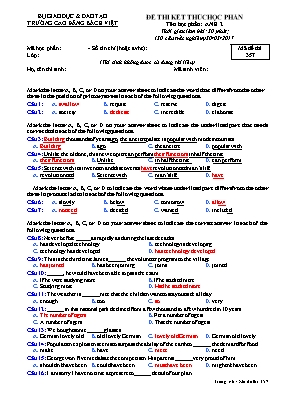
BỘ GIÁO DỤC & ĐÀO TẠO
TRƯỜNG CAO ĐẲNG BÁCH VIỆT
ĐỀ THI KẾT THÚC HỌC PHẦN
Tên học phần: ANH 2
Thời gian làm bài: 30 phút;
(50 câu trắc nghiệm)30/03/2017
Mã học phần: - Số tín chỉ (hoặc đvht):
Lớp:
Mã đề thi 357
(Thí sinh không được sử dụng tài liệu)
Họ, tên thí sinh:..................................................................... Mã sinh viên: .............................
Mark the letter A, B, C, or D on your answer sheet to indicate the word that differs from the other three in the position of primary stress in each of the following questions.
Câu 1: 	A. swallow	B. require	C. reserve	D. digest
Câu 2: 	A. society	B. dedicate	C. incredible	D. elaborate
Mark the letter A, B, C, or D on your answer sheet to indicate the underlined part that needs correction in each of the following questions.
Câu 3: Building thousands of years ago, the ancient palace is popular with modern tourists.
A. Building	B. ago	C. the ancient	D. popular with
Câu 4: Unlike the old one, this new copier can perform their functions in half the time.
A. their functions.	B. Unlike.	C. in half the time.	D. can perform.
Câu 5: Science with its invention and discoveries have revolutionized man’s life.
A. revolutionized	B. Science with	C. man’s life.	D. have
Mark the letter A, B, C, or D to indicate the word whose underlined part differs from the other three in pronunciation in each of the following questions.
Câu 6: 	A. slowly	B. below	C. tomorrow	D. allow
Câu 7: 	A. noticed	B. decided	C. wanted	D. included
Mark the letter A, B, C, or D on your answer sheet to indicate the correct answer in each of the following questions.
Câu 8: Never before _____ as rapidly as during the last decades.
A. has developed technology	B. technology is developing
C. technology has developed	D. has technology developed
Câu 9: This is the third time James ______ the volunteer program to the village.
A. has joined	B. has been joining	C. joins	D. joined
Câu 10: ______, he would have been able to pass the exam.
A. If he were studying more	B. If he studied more
C. Studying more	D. Had he studied more
Câu 11: The weather is ______ nice that the children want to stay outside all day.
A. enough	B. too	C. so	D. very
Câu 12: ______ in this national park declined from a few thousand to a few hundred in 10 years.
A. The number of tigers	B. For a number of tigers
C. A number of tigers	D. That the number of tigers
Câu 13: We bought some______ glasses.
A. German lovely old	B. old lovely German	C. lovely old German	D. German old lovely
Câu 14: Population explosion seems to surpass the ability of the earth to ______ the demand for food.
A. make	B. have	C. meet	D. need
Câu 15: George won five medals at the competition. His parents ______ very proud of him.
A. shouldn’t have been	B. could have been	C. must have been	D. mightn’t have been
Câu 16: I am sorry I have no time at present to______ detail of our plan.
A. bring in	B. go into	C. come in	D. take into
Câu 17: He did not share his secrets with other people, but he ______ in her.
A. confessed	B. concealed	C. confided	D. consented
Câu 18: Poor management drove my father’s company to______ of collapse.
A. the foot	B. the rim	C. the brink	D. the ring
Câu 19: My parents will have celebrated 30 years of ______ by next week.
A. marry	B. marriage	C. marriageable	D. married
Mark the letter A, B, C, or D on your answer sheet to indicate the most suitable response to complete each of the following exchanges.
Câu 20: - Peter: “Why don’t you have some chicken soup first?”
 - John: “______”
A. Not for me, thank you.	B. I am full.
C. Of course not.	D. It’s so cold.
Câu 21: - Andy: “I'd like to change some money.”	 -Barbara:“_________	”
A. What's your account number?	B. Which currency?
C. Five tens,please	D. You haven't signed it.
Mark the letter A, B, C, or D on your answer sheet to indicate the word(s) OPPOSITE in meaning to the underlined word(s) in each of the following questions.
Câu 22: You should pat yourself on the back for having achieved such a high score in the graduation exam.
A. criticize yourself	B. check up your back	C. praise yourself	D. wear a backpack
Câu 23: People sometimes choose partners who compensate for their own shortcomings.
A. disadvantages	B. weaknesses	C. strengths	D. benefits
Mark the letter A, B, C, or D on your answer sheet to indicate the word(s) CLOSEST in meaning to the underlined word(s) in each of the following questions.
Câu 24: Shake a leg or you will miss the train.
A. Slow down	B. Hurry up	C. Watch out	D. Put down
Câu 25: The air is naturally contaminated by foreign matter such as plant pollens and dust.
A. filled	B. concentrated	C. polluted	D. occupied
reading comprehension:
Read the following passage and mark the letter A, B, C, or D on your answer sheet to indicate the correct answer to each of the questions from 43 to 50.
The Japan of the mid-nineteenth century was a shadow of the modern economic juggernaut that is now one of the world’s leading traders. For hundreds of years, Japan had been secluded from the outside world by the strict policies of the rulers of Japan, the Tokugawa shoguns. With the exception of one Dutch ship per year at the port of the Nagasaki, the Japanese refused to deal with foreign ships or nations. Sailors shipwrecked on the Japanese islands were treated harshly and often imprisoned. Passing vessels were refused food, water, and other provisions. With a goal to right these wrongs and to open Japan to trade, in 1853, the United States sent its most capable man, Admiral Matthew Perry, and four warships to open Japan to the rest of the world. The consequences of those actions are still being felt today.
In the seventeenth century, the Japanese had opened their doors briefly to the Dutch and allowed a trading station and Christian enclave in Nagasaki. Guns were imported as part of this trade, and they were one of the reasons for a great upheaval that engulfed Japan for many decades, as a civil war raged between powerful shoguns, or warlords. Finally, Tokugawa emerged as the victor and claimed the lordship of Japan. During these upheavals, the emperor and his family had stood by wielding no power and existed merely as a figurehead. Soon after the civil war, the Japanese abandoned the use of guns and the art of the gun making. When Admiral Perry and his fleet arrived in 1853, they were defenseless against his awesome firepower.
Perry had three main purposes when he arrived in Japan: open the country to American trade, get an agreement to use Japan as a coaling and provisioning station for American vessels, and provide guarantees that Japan would aid shipwrecked American sailors. He wished to deal only with the highest officials and rebuffed Japanese attempts to foster lower-level emissaries on him. He sailed away to examine further the coast of Taiwan as a possible coaling station but returned to Japan the following spring in March 1854. This time, under threat of naval bombardment, the Japanese relented and finally signed the Treaty of Kanagawa on March 31, 1854. In addition to the three main items, the Japanese agreed to allow an American consulate to be established. At first, only Nagasaki was open to American trade, but the treaty stipulated that, after five years, other ports would be opened.
The consequences of these events were far reaching for Japan and the world. Within a few years, foreign currency began to flow to Japan, which upset its economy and caused rising inflation. This was a precursor to the fall of the Tokugawa shoguns and the return of the emperor as the leader of Japanese affairs in 1868. The Emperor Meiji then set a clear path for his nation, not wanting Japan to be under the heel of the foreigners who now clamored at the heel of the foreigners of his land. Meiji sent sailors to England to learn how to build ships and fight a modern naval war, invited German army officers to train his soldiers, and made deals with many companies to modernize Japan’s industry, transportation, and communications. In fact, the efforts were so successful that, by the 1980s, the world began to view Japan as one of the great powers, more so after it defeated both China and Russia on land and at sea in two local wars. The Russian defeat was even more astonishing since the Europeans were unused to losing to those they considered their inferiors.
Japan’s rapid industrialized and militarization had dreadful consequences for Asia, as Meiji’s grandson Hirohito led the nation down the path to world war, which ultimately saw the destruction of much of Japan. The shock of this defeat still echoes through Japanese history, as does the arrival of Perry and his warships so long ago. His efforts opened Japan to the world. Unknowingly, he unleashed a powerful force, with the Japanese not willing to be subjugated to foreign domination. In the long run, Japan has become part of the global culture and has offered more to the world than could have ever been imagined when Perry’s ships first dropped anchor on that fateful day in the past.
Câu 26: According to paragraph 1, all of the following are correct about Japan’s dealings with foreigners in the mid-nineteenth century EXCEPT ______.
A. Ships in need were not helped by Japan.	B. No ships were allowed to visit Japan.
C. They had a very limited foreign trade.	D. Shipwrecked sailors were badly treated.
Câu 27: The world “secluded” in the passage is closest in meaning to _____.
A. removed	B. hidden	C. isolated	D. reserved
Câu 28: According to paragraph 2, during the Tokugawa shogun period, the Japanese emperor _____.
A. was quite unknown to the Japanese people
B. did not challenge the power of the shoguns
C. was a symbol and not the real ruler of Japan
D. shared power with the shoguns but was secondary
Câu 29: It can be inferred from paragraph 2 that the Japanese abandoned gun making because guns _____.
A. went against the Japanese idea of a warrior
B. were difficult and expensive to make in Japan
C. were blamed for helping cause the long civil war
D. were the products of foreigners and thus forbidden
Câu 30: The word “they” in the passage refers to _____.
A. Admiral Perry and his fleet	B. the emperor and his family
C. powerful shoguns	D. the Japanese
Câu 31: According to paragraph 3, Admiral Perry’s mission to Japan eventually ______.
A. failed to achieve any concrete objectives	B. achieved more than he had expected
C. achieved some but not all of his objectives	D. achieved exactly what he wanted
Câu 32: According to paragraph 3, the Treaty of Kanagawa was agreed to by the Japanese ______.
A. because the realized they could not be secluded forever
B. against wishes under the threat of force of arms
C. because they wanted to have relations with American
D. in order to gain an advantage over the Americans
Câu 33: According to paragraph 4, in order to modernize Japan, Emperor Meiji relied on ______.
A. experts from outside of Japan	B. educating his people in new skills
C. the expertise of his own people	D. the capital from trade links
Mark the letter A, B, C, or D on your answer sheet to indicate the sentence that is closest in meaning to each of the following questions.
Câu 34: The way to get the best out of me is to make me work very hard.
A. I work best when I am under pressure.
B. Don't make me work hard or I can’t make the best out of me.
C. My work is under consideration, so I do my best.
D. If you make me work hard, I can't get the best.
Câu 35: I found myself at a loss to understand my closest friend’s words.
A. I found my closest friend's words quite incomprehensible.
B. I lost heart and didn't understand my closest friend's words.
C. I understood my closest friend’s words completely.
D. I found my closest friend's words easy to understand.
Câu 36: People know that English is an international language.
A. It is known English an international language.
B. It is known that English to be an international language.
C. English is known to be an international language.
D. English known is an international language.
Mark the letter A, B, C, or D on your answer sheet to indicate the sentence that best combines each pair of sentences in the following questions.
Câu 37: Mike wrote the text. He selected the illustration as well.
A. If Mike had written the text, he would have selected the illustration.
B. The text Mike wrote was not as good as the illustration he selected.
C. In order to select the illustration, Mike had to write the text.
D. Mike not only wrote the text but also selected the illustration.
Câu 38: The boy is called Duncan. He sits next to me in class.
A. The boy who sits next to me in class is called Duncan.
B. The boy whose is called Duncan sits next to me in class.
C. The boy whom sits next to me in class is called Duncan.
D. The boy to whom he sits next is called Duncan.
reading comprehension:
Read the following passage and mark the letter A, B, C, or D on your answer sheet to indicate the correct answer to each of the questions from 36 to 42.
The period from the late 1930s to the middle 1940s is known as the Golden Age of comic books. The modern comic book came about in the early 1930s in the United States as a giveaway premium to promote the sales of a whole range of household products such as cereal and cleansers. The comic books, which were printed in bright colors to attract the attention of potential customers, proved so popular that some publishers decided to produce comic books that would come out on a monthly basis and would sell for a dime each. Though comic strips had been reproduced in publications prior to this time, the Famous Funnies comic book, which was started in 1934, marked the first occasion that a serialized book of comics was attempted.
Early comic books reprinted already existing comic strips and comics based on known characters; however, publishers soon began introducing original characters developed specially for comic books. Superman was introduced in Action Comics in 1938, and Batman was introduced a year later. The tremendous success of these superhero comic books led to the development of numerous comic books on a variety of topics, though superhero comic books predominated. Astonishingly, by 1945 approximately 160 different comic books were being published in the United States each month, and 90 percent of U.S children were said to read comic books on a regular basis.
 	 (Source: Preparation Course for the Toefl Test)
Câu 39: What is the main focus of this passage?
A. How to produce comic books	B. Batman
C. Superhero comics	D. The history of comic books
Câu 40: The word “premium” is closest in meaning to ______.
A. introduction	B. preparation	C. importance	D. publication
Câu 41: The word “potential” is closest in meaning to ______.
A. able	B. possible	C. continuing	D. developing
Câu 42: The word “which” in paragraph 1 refers to ______.
A. serialized book of comics	B. the Famous Funnies
C. comic trips	D. publications
Câu 43: According to paragraph 2, Batman was introduced in ______.
A. 1945	B. 1939	C. 1940	D. 1938
Câu 44: According to the passage, which of the following is NOT true?
A. Superman was introduced in Action Comics in 1938.
B. The comic books were printed in bright colors.
C. The modern comic book came about in the early 1930s in the United States.
D. The Famous Funnies comic book was the first comic strips.
Câu 45: Which of the following was published after Action Comics?
A. Superhero	B. the Famous Funnies	C. Superman	D. Batman
close text:
Read the following passage and mark the letter A, B, C, or D on your answer sheet to indicate the correct word or phrase that best fits each of the numbered blanks from 31 to 35.
	Here are tips that help succeed in your job interview:
Always arrive early. If you do not know (46) _________ the organization is located, call for exact directions (47) ____________ advance. Leave some extra time for any traffic, parking, or unexpected events. If you are running late, call right away and let someone know. The best time to arrive is approximately 5 - 10 minutes early. Give yourself the time to read your resume one more time, to catch your breath, and to be ready for the interview. Once you are at the office, treat everyone you encounter with respect. Be (48) _____________ to everyone as soon as you walk in the door.
Wear a professional business suit. This point should be emphasized enough. First (49) ____________ are extremely important in the interview process. Women should (50)_________ wearing too much jewelry or make up. Men should avoid flashy suits or wearing too much perfume. It is also important that you feel comfortable. While a suit is the standard interview attire in a business environment, if you think it is an informal environment, call before and ask. Regardless, you can never be overdressed if you are wearing a tailored suit.
Câu 46: 	A. where	B. why	C. when	D. that
Câu 47: 	A. with	B. on	C. in	D. for
Câu 48: 	A. happy	B. pleasant	C. excited	D. disappointed
Câu 49: 	A. attentions	B. pressures	C. attendances	D. impressions
Câu 50: 	A. suggest	B. enjoy	C. mind	D. avoid
-----------------------------------------------
----------- HẾT ----------
Tài liệu đính kèm:
 de_thi_ket_thuc_hoc_phan_anh_2_ma_de_357_truong_cao_dang_bac.doc
Đề thi liên quan
 Đề thi thử Đại học lần VII môn Tiếng Anh - Mã đề 471 - Trường chuyên Đại học Sư phạm Hà Nội
 Lượt xem: 525
 Lượt tải: 0
- Đề thi thử THPT Quốc gia lần 2 môn Tiếng Anh Lớp - Mã đề 111 (Có đáp án)
Lượt xem: 768
Lượt tải: 0
 Đề kiểm tra 1 tiết số 1 môn Tiếng Anh Lớp 12 (Có đáp án)
Lượt xem: 531
Lượt tải: 0
Đề kiểm tra 1 tiết số 1 môn Tiếng Anh Lớp 12 (Có đáp án)
Lượt xem: 531
Lượt tải: 0 Bài tập tổng hợp về mạo từ “a/an/the”
Lượt xem: 1455
Lượt tải: 1
Bài tập tổng hợp về mạo từ “a/an/the”
Lượt xem: 1455
Lượt tải: 1- Đề thi thử Tốt nghiệp và Đại học môn Tiếng Anh - Mã đề 123 - Năm học 2014-2015 - Trường THPT Thanh Hà
Lượt xem: 656
Lượt tải: 0
- Kỳ thi trung học phổ thông quốc gia năm 2015 môn: Tiếng Nhật - Mã đề thi 624
Lượt xem: 1265
Lượt tải: 1
- Đề thi tuyển sinh Đại học môn Tiếng Anh Khối D năm 2013 - Mã đề 637
Lượt xem: 548
Lượt tải: 0
- Đề thi Tốt nghiệp THPT môn Tiếng Anh (Hệ 3 năm) năm 2011 - Mã đề 392
Lượt xem: 543
Lượt tải: 0
- Đề kiểm tra học kỳ I môn Tiếng Anh Lớp 12 - Trường THPT Ninh Hải
Lượt xem: 566
Lượt tải: 0
- Lý thuyết The passive voice
Lượt xem: 565
Lượt tải: 0
Copyright © 2026 ThuVienDeThi.com, Thư viện đề thi mới nhất, Đề kiểm tra, Đề thi thử

