
Đề thi học sinh giỏi tỉnh môn Tiếng Anh Lớp 6


Bạn đang xem tài liệu "Đề thi học sinh giỏi tỉnh môn Tiếng Anh Lớp 6", để tải tài liệu gốc về máy bạn click vào nút DOWNLOAD ở trên
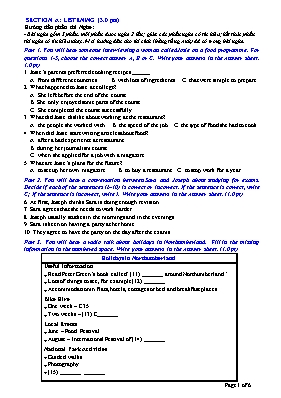
 SECTION A: LISTENING (3.0 pts)
Hướng dẫn phần thi Nghe:
- Bài nghe gồm 3 phần, mỗi phần được nghe 2 lần; giữa các phần nghe có tín hiệu; kết thúc phần thi nghe có tín hiệu nhạc. Mọi hướng dẫn cho thí sinh (bằng tiếng Anh) đã có trong bài nghe.
Part 1. You will hear someone interviewing a woman called Josie on a food programme. For questions 1-5, choose the correct answer A, B or C. Write your answers in the Answer sheet. 1.0 pt)
1. Josie’s parents preferred cooking recipes ______.
 A. from different countries 	 B. with lots of ingredients	 C. that were simple to prepare
2. What happened to Josie at college?
 A. She left before the end of the course.
 B. She only enjoyed some parts of the course.
 C. She completed the course successfully.
3. What did Josie dislike about working at the restaurant?
 A. the people she worked with 	 B. the speed of the job C. the type of food she had to cook
4. When did Josie start writing articles about food?
 A. after a bad experience at restaurant
 B. during her journalism course
 C. when she applied for a job with a magazine
5. What are Josie’s plans for the future?
 A. to set up her own magazine	 B. to buy a restaurant	C. to stop work for a year
Part 2. You will hear a conversation between Sara and Joseph about studying for exams. Decide if each of the sentences (6-10) is correct or incorrect. If the sentence is correct, write C; If the sentence is incorrect, write I. Write your answers in the Answer sheet. (1.0 pt)
6. At first, Joseph thinks Sara is doing enough revision.
7. Sara agrees that she needs to work harder.
8. Joseph usually studies in the mornings and in the evenings.
9. Sara is keen on having a party at her home.
10. They agree to have the party on the day after the exams.
Part 3. You will hear a radio talk about holidays in Northumberland. Fill in the missing information in the numbered space. Write your answers in the Answer sheet. (1.0 pt)
Holidays in Northumberland
Useful information
● Read Peter Green’s book called “(11) _______ around Northumberland.”
● Lots of things to see, for example (12) _______.
● Accommodation in flats, hotels, cottages or bed and breakfast places.
Bike Hire
● One week – £ 35
● Two weeks – (13) £_______
Local Events
● June – Food Festival
● August – International Festival of (14) _______
National Park Activities
● Guided walks
● Photography
● (15) _______ _______
SECTION B: LEXICO- GRAMMAR (6.0 pts)
Part 1. For questions from 16- 30, choose the option (A, B, C or D) that best completes each of the following sentences. Write your answers in the Answer sheet. (1.5 pts)
16. Come with me! I want to introduce you ______ my uncle from Australia.
 A. for	B. with	C. into	D. to
17. The more trees in the forests we cut down, the more floods there ______.
	A. would be	B. were	C. have been	D. will be
18. Tom is very busy today. I wish he ______ busy so that he can go out with us now.
	 A. weren’t	B. isn’t	C. won’t be 	D. isn’t being
19. Her husband rarely washes the dishes, ______?
 	 A. does husband	 	B. doesn’t he 	C. does he	 	D. is he
20. The book ______ consists of 4 parts has been translated in French.
 A. which	B. in which	C. to which	D. on which
21. Salesgirl:	 “Hello, can I help you?”
 Customer: “Yes, I’m looking for a ______ dress.”
 A. silk blue long 	 	B. long blue silk C. blue silk long 	D. long silk blue
22. Earthquakes, hurricanes, volcanoes, tidal waves are natural ______.
 A. resources	B. energy	C. disasters	D. pollution
23. Smoking is a very bad habit, which many people find difficult to ________.
 A. break	B. beat	C. breathe	D. cough
24. How could you have ______ him for your brother?
 A. confused	B. considered	C. thought 	D. mistaken
25. Andy ______ his leg, so he can’t walk to school today.
 A. has broken	B. is breaking	C. broke	D. breaks
26. ________ how much money she spends on her clothes, she never looks well-dressed.
 A. Despite 	 	B. Without 	C. Regardless 	 D. No matter
27. My mother was ______ of making a cake when the front door bell rang.
 A. at the center	B. on her way	C. in the middle	D. halfway through
28. Unless ______ us the whole truth, we won’t let her go.
 A. does she not tell	B. she tells	C. does she tell	D. she doesn’t tell
29. Kate: How well you are playing!
 Jack: ______
 A. Say it again. I like to hear your words.	B. Many thanks. That's a nice compliment.
 C. I think so. I am proud of myself.	D. Thank you too much.
30. Tom: “Would you like to play a game of chess this afternoon?”
 Andy: “______”
	A. No, I've no choice. 	B. I can’t agree more.
	C. No, but I'd love to. 	D. Another time, perhaps.
Part 2. For questions from 31-38, complete the following sentences with the verbs given in the box. Remember to put the verbs in the correct form. There is one extra verb which you DO NOT use. Write your answers in the Answer sheet. (0.8 pts)
invite, fill, believe, join, set, call, break, turn, take, hand
0. The burglars broke in through the kitchen window.
31. We only need one more player for this game. Can you persuade your sister to _______ in?
32. Remember to check your essay carefully before you _______ it in to me.
33. The tragedy made her question everything she _______ in.
34. We had to ______ in a mechanic to see to our washing machine.
35. Before you are asked for an interview, you have to ______ in dozens of forms.
36. I’ve borrowed Mike’s bicycle for a day. I have to ______ it in tomorrow.
37. We were unlucky to arrive in China when the rainy season was just about to ______ in. We
 knew it wouldn’t end too soon.
38. The trousers I have bought are a bit too loose. Could you please ______ them in for me?
Part 3. Complete the following sentences (39-45) with the words or phrases given in the box. There is one extra word or phrase which you DO NOT use. Write your answers in the Answer sheet. (0.7 pts)
favour of, debt, sight, spite of, exchange for, advance, comparison with, order to
39. This woollen jacket seems quite cheap in _____ that leather one.
40. Frank’s gone to the bank in _____ pick up some money.
41. Ever since he took a loan for that brand new car, he’s been in _____.
42. In _____ the risk of another avalanche, the rescuers went on looking for the missing skiers.
43. I would like to be informed in _____ about any changes you’re planning to introduce in your department.
44. Although he was not in _____ my proposals, the managing director admitted that there was need for improvement.
45. Who shall we ask for the way? There are no people in _____.
Part 4. For questions from 46 - 53, read the text below and look carefully at each line. Some of the lines are correct and some have a word that should not be there. If a line is correct, put a tick (√). If the line has a word that should not be there, pick out the word. Write your answer in the Answer sheet. There are two examples at the beginning.(1.6 pts)
The capital city of my country is Brasília, a city in the center of Brazil, for more than 1,500 kilometers from our largest city, Sao Paulo. Brasília is less than 50 years old, and has a population of two million people. Many of the inhabitants weren’t born in there, but came from other cities.
Until 1960, the capital was Rio de Janeiro. Brasília was the idea of our president at the time, Juscelino Kubitschek. It was built in just for 41 months – between 1956 and 1960. The city was planned by an architect was named Lúcio Costa, but the most important buildings which were designed by one of our most famous architects, Oscar Niemeyer. The city is shaped look like an airplane.
 I really like living in Brasília because there’s always somewhere to go.
 0. for
 00. √
 46.
 47.
 48.
 49.
 50.
 51.
 52.
 53.
Part 5. For questions from 54-60, read the text below. Use the words given in CAPITAL at the end of some of the lines to form a word that fits in the gap in the same line. Write your answers in the Answer sheet. There is an example at the beginning (0). (1.4 pts)
There is a well-known (0)________ “School days are the best days of your life“. No (54)________ at school ever believes it though, and by the time you realise it’s true, it’s too late! It’s when you’re worried about your (55)________ situation and are beginning to hate the boredom of working in an office or factory every day that you look back fondly on the (56)________ times you had at school. When you’re still at school you often focus on the negatives, like having to pay (57)________ during a tedious chemistry lesson, being punished for bad behavior (when you didn’t do anything wrong anyway) or feeling (58)________ in an exam because you don’t know any of the answers (and, in fact, had completely (59)________ the questions too!). But it’s quite (60)________ to complain about thing and then have great memories afterwards. Just have a good time at the time as well!
 SAY
 STUDY
 FINANCE
 EXCITE
 ATTEND
 HELP
 UNDERSTAND
 ACCEPT
SECTION C: READING (5.6 pts)
Part 1. For questions from 61 - 70, read the text below and decide which answer (A, B, C, or D) best fits each numbered gap. Write your answers in the Answer sheet. (2.0 pts)
 In the age (61)_____ highly-developed telephone networks and electronic mail, it seems that fewer and fewer people are (62)_____ time to sit down and write letters to friends and relatives. For hundreds of years, letters were the only way to (63)_____ in contact with people who were any distance away and letter-writing was (64)_____ as an important skill for all learned people to master.
Gradually, (65)_____, the importance of writing letters is decreasing to a point that the majority of us (66)_____ make a special effort to turn out something worthwhile when we apply for a job or make a complaint. In business circles the (67)_____ for routine communications is to become shorter. Even though clients may appreciate a detailed letter, an employee who sends out a long letter is often regarded as (68)_____. Many people prefer the telephone in all circumstances and its (69)_____ is essential in many situations but how often have you put the telephone down, (70)_____ with what you have managed to say? I don’t think I’ll throw my pen away yet.
61. A. in 	B. at	C. of 	D. on
62. A. using 	B. spending 	C. putting 	D. taking
63. A. keep 	B. connect 	C. maintain	D. hold
64. A. noticed 	B. considered	C. heard	D. seen
65. A. therefore 	B. however	C. furthermore 	D. thus
66. A. may 	B. would 	C. have to 	D. dare to
67. A. tendency	B. intention 	C. fashion	D. inclination
68. A. unusual 	B. inefficient 	C. unimportant	D. impossible
69. A. rate	B. pace	C. tempo 	D. speed
70. A. dissatisfied B. pleased C. disturbed 	D. contented
Part 2. Fill in each numbered gap (71-80) with one suitable word to complete the passage. Write your answers in the Answer Sheet. There is an example at the beginning (0). Write your answers in the Answer sheet. (2.0 pts)
It seems my life is always full (0)_____ activities and obligations so I never have much time for myself. During the week, it's the worst. I usually have to get up at half past six even (71)_____ I would really prefer to sleep (72)_____ later. After I get up, I perform my morning routine of washing my face, brushing my teeth, and then deciding (73)_____ to wear. After I (74)_____ dressed I brush my hair. I usually don't have time for breakfast in the morning because I have to (75)_____ a bus at seven o'clock for my commute to school. The bus is usually completely packed and it really (76)_____ me envy my schoolmates (77)_____ don't have to ride the bus to school. Classes at school start at a quarter to eight except on Tuesdays (78)_____ they start at seven. Each class has its own timetable so my schedule varies by class. Classes are forty-five minutes long with ten-minute breaks except for one "long" break between the third and the fourth classes, which is twenty minutes long.
My classes (79)_____ place either in our classroom or in various labs or a gym. After our classes, the students usually go (80)_____ lunch to the canteen. Some students in their third or fourth year have afternoon classes, seminars, optional after-school activities or driving lessons.
Part 3. Read the passage and choose the correct answer A, B, C or D to each of the questions from 81 to 88. Write your answers in the Answer sheet. (1.6 pts)
In the United States and other developed countries, air-conditioning is so common that it is difficult to remember what life was like before it existed. First invented in 1902 in Buffalo, New York, air-conditioning keeps homes, cars, offices, and shopping centers cool and dry, all at the push of a button. While many may consider air-conditioning one of life’s necessary luxuries, few are aware of how air-conditioning has changed many aspects of the way we now live. One of the first areas where air-conditioning had an impact was industry. In the early 1900s, factory owners began to use air-conditioning to create better conditions for the storage of supplies. Before long, however, they realized that air-conditioning was also useful on the factory floor, as it resulted in higher production levels. Air-conditioning has undoubtedly been important factor in the growth of industry, since it allows manufacturing to continue at the same pace year round even in the warmest climates.
Air-conditioning next became common in movie theatres, offices, and stores. Then, after the end of the Second War World, smaller, less expensive air-conditioning units became available, and this made air-conditioning affordable for private homes. Many of the returning soldiers and their new families moved to the suburbs outside America’s major cities with a desire to put the war behind them and live the good life. Air-conditioned homes were part of that life, and this led to a number of important changes in the American society. One big change was in architecture. Formerly, homes were built with high ceilings and second stories so that hot air could rise away from main living areas in the summer. With air-conditioning, inexpensive one-level homes could be kept cool in the hottest weather. Additionally, many homes once had front porches where American families gathered in the evening to escape the heat. Family members could talk to each other and to the neighbors or passers-by.
The rise of air-conditioning also allowed the recreation of large malls with shops, walkways, movie theatres and restaurants that are comfortable the year round. In suburban America in the second half of the 20th century, the air-conditioned malls became the preferred place to go for shopping or for an afternoon’s entertainment.
81. In developed countries, air-conditioning is ______.
 A. very popular	B. difficult to remembered 	 C. liked by everyone D. expensive
82. Air-conditioning first had an influence on ______.
 A. industrial workers	B. industrial suppliers C. stored supplies	 D. factory owners
83. Air-conditioning was found useful in factories as it ______.
 A. improved productivity	B. made the level higher
 C. stopped temperature drop	D. created favorable condition for customers
84. The word “undoubtedly” in the first paragraph can be best replaced by ______.
 A. suspiciously	B. obviously	C. surprisingly	D. unfortunately
85. The word “affordable” in the second paragraph is closest in the meaning to ______.
 A. not expensive	B. popular	C. necessary	D. not important
86. After the Second War World, air-conditioning was considered as an aspect of ______.
 A. luxury	B. the good life 	C. a private home	D. a common life
87. It can be inferred from the passage that in the other half of the 20th century, family-owned shops were ______.
 A. air-conditioned	B. not air-conditioned 	C. very popular	D. dominating
88. The best title of the passage is ______.
 A. Air-conditioning and private life
 B. The influence of air-conditioning on people’s life
 C. The invention of air-conditioners
 D. Air-conditioning and history
SECTION D: WRITING (5.4 pts)
Part 1 (1.4 pts). For questions from 89 to 95, use the sets of words to write meaningful sentences so that they together can make a complete letter. Make all the changes and additions if necessary. Write your answer in the Answer sheet.
Dear Mrs. Brown,
89. I write / tell / how much I enjoy / few hours / you and your family.
90. I find / conversation / interesting / and I / be glad / practice / English.
91. I also like / congratulate you / excellent cooking.
92. I / be very grateful / your information / about / course / England.
93. I hope / find / suitable / school / next few days.
94. You / give / best wishes / husband and children?
95. I / forward / see / you next month.
Yours sincerely,
Mary
Part 2 (1.6 pts). For questions from 96-103, finish each of the following sentences so that it has a similar meaning to the sentences printed before it, using the word given. DON’T CHANGE THE WORD GIVEN. You must use BETWEEN THREE AND FIVE WORDS, including the word given. There is an example at the beginning. Write your answers in the Answer sheet.
(0). ‘Do you know how to get to the town center?’, she asked me. (WAY)
 She asked me if I knew the way to the town centre.
96. John qualified as an instructor three years ago. (BEEN)
 John ______________________________ instructor for three years.
97. I think you should complain about that horrible meal. (WERE)
 If I _________________________________a complaint about that horrible meal.
98. The tour bus stopped frequently to let people admire the view. (THAT)
 The tour bus stopped frequently ______________________________ admire the view.
99. Declan was angry because Claire arrived late. (TIME)
 If Claire ______________________________ , Declan would not have been angry
100. I have a good relationship with my neighbors. (ON)
 My neighbors ______________________________ together
101. I don’t usually remember people’s surnames. (MEMORY)
 I don’t have _____________________________.
102. You don’t have to pay for the delivery. (CHARGE)
 The delivery ______________________________ .
103. 'It's getting late, so I ought to go home', said Mary. (BETTER)
 Mary said it was getting late and that ________________________ home.
Part 3 (2.4 pts). Read this part of a letter from an English-speaking friend, Oliver.
 In your last letter, you said there were a variety of festivals in your country. In your next letter, please tell me the festival you like. What is the name of the festival? Where and when is the festival held? What do the people often do during the festival? What do you think about the festival?
Please write back soon.
Oliver
Write a letter to Oliver, answering his questions. DO NOT WRITE ANY ADDRESSES AND NAMES.
Your letter must be about 120-150 words. Write your letter in the Answer sheet.
_______________________________The end___________________________
Tài liệu đính kèm:
 de_thi_hoc_sinh_gioi_tinh_mon_tieng_anh_lop_6.doc
Đề thi liên quan
 2 Đề ôn tập kiểm tra học kỳ II môn Tiếng Anh Lớp 6
 Lượt xem: 747
 Lượt tải: 2
 Đề kiểm tra học kỳ II môn Tiếng Anh Lớp 6 - Đề B - Năm học 2014-2015 - Trường THCS Lê Quý Đôn
Lượt xem: 940
Lượt tải: 0
Đề kiểm tra học kỳ II môn Tiếng Anh Lớp 6 - Đề B - Năm học 2014-2015 - Trường THCS Lê Quý Đôn
Lượt xem: 940
Lượt tải: 0- Đề kiểm tra chất lượng ôn tập môn Tiếng Anh Lớp 6 - Mã đề 021115 - Phòng GD & ĐT Mỹ Tho
Lượt xem: 643
Lượt tải: 0
- Đề kiểm tra 1 tiết lần III môn Tiếng Anh Lớp 6
Lượt xem: 746
Lượt tải: 0
- 2 Đề kiểm tra 1 tiết số 1 môn Tiếng Anh Lớp 6 - Năm học 2014-2015
Lượt xem: 629
Lượt tải: 0
- 2 Đề kiểm tra 45 phút lần 2 môn Tiếng Anh Lớp 6 - Năm học 2015-2016 - Trường THCS Phan Chu Trinh (Có đáp án)
Lượt xem: 637
Lượt tải: 0
- Đề kiểm tra số 1 học kì I môn Tiếng Anh Lớp 6 - Mã đề 001 - Năm học 2015-2016 - Trường THCS Mường Thanh (Có đáp án)
Lượt xem: 927
Lượt tải: 1
- Đề khảo sát chất lượng đầu năm môn Tiếng Anh Lớp 6 - Năm học 2013-2014 - Trường THCS Lam Sơn (Có đáp án)
Lượt xem: 845
Lượt tải: 0
- Đề ôn tập kiểm tra một tiết Tiếng anh lớp 6 (Bài 7 đến 9)
Lượt xem: 902
Lượt tải: 0
- Bài tập ôn hè Lớp 5 lên Lớp 6
Lượt xem: 228
Lượt tải: 0
Copyright © 2026 ThuVienDeThi.com, Thư viện đề thi mới nhất, Đề kiểm tra, Đề thi thử

