
Đề ôn thi vào Lớp 10 THPT môn Tiếng Anh - Đề 4


Bạn đang xem tài liệu "Đề ôn thi vào Lớp 10 THPT môn Tiếng Anh - Đề 4", để tải tài liệu gốc về máy bạn click vào nút DOWNLOAD ở trên
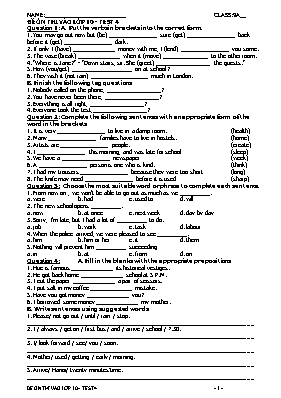
NAME: ___________________________ 	CLASS: 9A__
ĐỀ ÔN THI VÀO LỚP 10 - TEST 4
Question 1: A. Put the verbs in brackets into the correct form.
1. You may go out now but (be) ________________ sure (get) ________________ back before it (get) ________________ dark.
2. If only I (have) ______________ money with me, I (lend) ________________ you some.
3. The vase (break) ______________ when it (move) _______________ to the other room.
4. "Where is Jane?" 	- "Down stairs, sir. She (greet) __________________ the guests."
5. How (you/get) ____________________ on at school ?
6. They wish it (not rain) ___________________ much in London.
B. Finish the following tag questions.
1. Nobody called on the phone, __________________?
2. You have never been there, __________________?
3. Everything is all right, __________________?
4. Everyone took the test, __________________?
Question 2: Complete the following sentences with an appropriate form of the word in the brackets.
1. It is very ________________ to live in a damp room. 	(health)
2. Many ________________ families have to live in hostels. 	(home)
3. Artists are ________________ people. 	(create)
4. I ________________ this morning, and was late for school	(sleep)
5. We have a ________________ newspaper	(week)
6. A ________________ person is one who is kind.	(think)
7. I had my trousers ________________ because they were too short	(long)
8. The knife may need ________________ before it is used	(sharp)
Question 3: Choose the most suitable word or phrase to complete each sentence.
1. From now on , we won't be able to go out as much as we __________.
a. were 	b. had	c. used to 	d. will
2. The new school opens __________.
a. now	b. at once	c. next week	d. day by day
3. Sorry, I'm late, but I had a lot of __________ to do.
a. job	b. work	c. task	d. labour
4. When the police arrived, we were pleased to see __________.
a. him	b. him or her	c. it	d. them
5. Nothing will prevent him __________ succeeding
a. in 	b. at 	c. from 	d. on
Question 4: 	A. Fill in the blanks with the appropriate prepositions.
1. Hue is famous ______________ its historical vestiges.
2. He got back home ______________ school at 5 P.M.
3. I cut the paper ______________ a pair of scissors.
4. I put salt in my coffee ______________ mistake.
5. Have you got money ______________ you?
6. I borrowed some money ______________ my mother.
B. Write sentences using suggested words.
1. Please/ not go out / until / rain / stop.
___________________________________________________________________________
2. I / always / get on / first bus / and / arrive / school / 7.30. ___________________________________________________________________________
3. I/ look forward / see/ you / soon. ___________________________________________________________________________
4. Mother/ used / getting / early / morning. ___________________________________________________________________________
5. Arrive/ Hanoi/ twenty minutes’time. ___________________________________________________________________________
Question 5: Rewrite each sentence, so that the meaning stays the same.
1. John doesn't always speak the truth, I'm afraid.
You can't ___________________________________________________________________
2. Your hair is long . You ought to get it cut.
Your hair is long. It ___________________________________________________________
3. Does this camera belong to you?
Do ________________________________________________________________________
4. I will call the police if you don't leave me alone !
Unless _____________________________________________________________________
5. Couldn't you find a better hotel ?
Is this _____________________________________________________________________
6. It took us 3 hours to open the door.
We ________________________________________________________________________
7. Mark is too young to get married.
Mark is not _________________________________________________________________
8. He never has enough money.
He's always _________________________________________________________________
9. He could not afford to buy the car.
The car ____________________________________________________________________
10. She knows a lot more about it than I do.
I don't know ________________________________________________________________
Question 6: Fill each of the numbered blanks in the following passage. Use only one word in each space.
Public transport in London is expensive. The fare (1) ________________ on the length of the journey; you can not buy books of tickets in advance. Children (2) ________________ sixteen pay half and those under five travel free, you usually (3) ________________ bus tickets from a conductor. But on some buses you pay the driver. Most London (4) ________
are double-deckers.
On the (5) ________________ railway (or tube) you buy your ticket from a (6) __________ or ticket office, and give it up at the (7) ________________ of the journey. Not all trains from one (8) ________________ go to the same place, so watch the signs. The last train leaves at about 00.15.
Question 7: Read the passage and choose the best answer from A, B, C, or D.
Parents send their children to school to prepare for the time when they grow up. Children learn their native language so that they will be able to communicate fluently with other people around them. Moreover, they can preserve the valuable culture and literature of their country. They learn foreign languages in order to benefit from other countries’ heritage. The more foreign languages they learn, the more benefits they get. Children also learn math to calculate, geography to know about nature, and history to know about human beings and historical events. Nearly everything they study at school has some practical uses in their life.
1. Parents send their children to school to ________.
A. play better	B. learn English
C. prepare for their future	D. make them grow up
2. Why do children have to learn their native language?
A. To learn foreign languages. B. To communicate fluently with other people around them.
C. To benefit from foreign countries’ heritage.	D. To know about nature.
3. According to the passage, children learn history to know about ________.
A. people and historical events	B. practical uses in life
C. events of the history	D. the mankind
4. How many school subjects are mentioned in the passage?
A. Five.	B. Seven.	C. Six.	D. Four.
5. Most of the things children learn at school ________.
A. are useless 	B. have no use
C. are not necessary	D. have some practical uses
KEYS - TEST 4
Question1:	a) (10 points)
1. be - to get – gets	2. had - would lend
3. broke - was being moved	4. is greeting
5. are you getting ?	6. didn’t rain
b) (4 points)
1. ............, did they?	2. ............, have you?
3. ............, isn't it ?	4. ............, didn’t they?
Question 2: (8 points)
1. unhealthful	2. homeless	3. creative	4. overslept
5. weekly	6. thoughtful	7. lengthened	8. sharpening
Question 3: ( 5 points)
c: used to
c: next week
b: work
d: them
c: from
Question 4: a) ( 6 points)
for
from
with
by
with
from
b) (5 points)
Please don’t go out until the rain stops.
I always get on the first bus and arrive at school at 7.30.
I look forward to seeing you soon. (Or I'm looking forward to seeing you soon)
My mother is used to getting up early in the morning.
we'll arrive in Ha Noi in twenty minutes'time.
Question 5: (10 points)
You can't believe John because he doesn't always speak the truth(or he never speaks the truth)
Your hair is long. It ought to be cut.
Do you own this camera?
Unless you leave me alone, I will call the police.
Is this the best hotel you could find?
We spent 3 hours opening the door.
Mark isn't old enough to get married.
He is always short of money.
The car was too expensive for him to buy
 ( Or The car was so expensive that he couldn’t buy it)
I don’t know about it as/so much as she (does)
Question 6: (8 points)
1. depends	2. under	3. buy	4. buses
5. underground	6. machine	7. end	8. flatform.
Question 7: (8 points)
1. C
2. B
3. A
4. A
5. D
Tài liệu đính kèm:
 de_on_thi_vao_lop_10_thpt_mon_tieng_anh_de_4.doc
Đề thi liên quan
 Đề thi thử tuyển sinh lớp 10 THPT môn Tiếng anh - Năm học 2013-2014 - Phòng GD & ĐT Xuân Trường
 Lượt xem: 721
 Lượt tải: 0
 Đề kiểm tra 45 phút môn Tiếng Anh Lớp 9 (Thí điểm)
Lượt xem: 930
Lượt tải: 1
Đề kiểm tra 45 phút môn Tiếng Anh Lớp 9 (Thí điểm)
Lượt xem: 930
Lượt tải: 1- Bài tập viết lại câu môn Tiếng anh lớp 9
Lượt xem: 1365
Lượt tải: 0
- Đề thi chọn học sinh giỏi môn Tiếng Anh Lớp 9 - Phần Listening
Lượt xem: 975
Lượt tải: 1
- Đề thi chọn đội tuyển học sinh giỏi vòng 1 môn Tiếng Anh - Lớp 9 năm học 2015 - 2016
Lượt xem: 5218
Lượt tải: 5
- Đề thi chọn học sinh giỏi môn Tiếng Anh Lớp 9 - Năm học 2013-2014 - Phòng GD & ĐT Lâm Thao (Có đáp án)
Lượt xem: 929
Lượt tải: 0
- Đề thi chọn học sinh giỏi môn Tiếng Anh 9
Lượt xem: 904
Lượt tải: 2
 6 Đề kiểm tra học kì I Tiếng anh lớp 9
Lượt xem: 768
Lượt tải: 0
6 Đề kiểm tra học kì I Tiếng anh lớp 9
Lượt xem: 768
Lượt tải: 0- Đề và đáp án thi tuyển sinh lớp 10 THPT môn Tiếng anh - Đề số 1 - Năm học 2016-2017
Lượt xem: 809
Lượt tải: 0
- Đề thi tuyển sinh lớp 10 THPT môn Tiếng anh - Năm học 2016-2017 - Sở GD & ĐT Đà Nẵng
Lượt xem: 780
Lượt tải: 0
Copyright © 2026 ThuVienDeThi.com, Thư viện đề thi mới nhất, Đề kiểm tra, Đề thi thử

