
Đề cương ôn tập kiểm tra học kỳ II môn Tiếng Anh 8 - Năm học 2016-2017


Bạn đang xem 20 trang mẫu của tài liệu "Đề cương ôn tập kiểm tra học kỳ II môn Tiếng Anh 8 - Năm học 2016-2017", để tải tài liệu gốc về máy bạn click vào nút DOWNLOAD ở trên
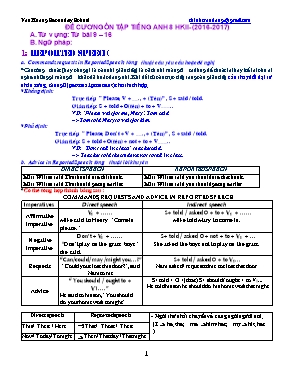
ĐỀ CƯƠNG ÔN TẬP TIẾNG ANH 8 HKII- (2016-2017) Từ vựng : Từ bài 9 – 16 Ngữ pháp: 1: REPORTED SPEECH Commands, requests in Reported Speech: têng thuËt c©u yªu cÇu hoÆc ®Ò nghÞ *C©u têng thuËt (hay cßn gäi lµ c©u nãi gi¸n tiÕp) lµ c¸ch nãi mµ ngêi ta dïng ®Ó thuËt l¹i hay kÓ l¹i cho ai nghe nh÷ng g× mµ ngêi kh¸c ®· hoÆc ®ang nãi. Khi ®æi tõ c©u trùc tiÕp sang c©u gi¸n tiÕp caàn thay ñoåi ñaïi töø nhaân xöng, t©n ng÷ (personal pronouns) cho thích hôïp. *Kh¼ng ®Þnh: Trùc tiÕp: “Please, V + ., + (Tªn)” , S + said / told. Gi¸n tiÕp : S + told + O(tªn) + to + V.. VD: “Please wait for me, Mary”. Tom said =>Tom told Mary to wait for him. *Phñ ®Þnh: Trùc tiÕp: “Please, Don’t + V + ., + (Tªn)” , S + said / told. Gi¸n tiÕp : S + told + O(tªn) + not + to + V.. VD: “Don’t talk in class!” teacher said. => Teacher told the students not to talk in class. b. Advice in Reported Speech: têng thuËt lêi khuyªn DIRECT SPEECH REPORTED SPEECH Miss Wilson said Tim should use this book. Miss Wilson said Tim should get up earlier. Miss Wilson said you should use that book. Miss Wilson said you should get up earlier *Cã thÓ tæng hîp thµnh b¶ng sau : COMMANDS, REQUESTS AND ADVICE IN REPORTED SPEECH Imperatives Direct speech Indirect speech Affirmative Imperative V1 + Mike said to Henry, “Come in, please.” S+ told / asked O + to + V1 + Mike told Mary to come in. Negative Imperative Don’t + V1 + "Don't play on the grass, boys," she said. S+ told / asked O + not + to + V1 + She asked the boys not to play on the grass. Requests “Can/could/ may /might you...?” “Could you close this door?”, said Nam to me. S+ told / asked O + to V1... Nam asked / requested me to close that door. Advice “ You should / ought to + V1.” He said to his son,” You should do your homework tonight.” S+ told + O +(that) S+ should/ ought + to V1... He told his son he should do his homework that night. Direct speech Reported speech - Ngoâi thöù nhaát chuyeån veà cuøng ngoâi ngöôøi noùi. (I he, she; me him/ her; myhis, her ) - Ngoâi thöù hai chuyeån veà cuøng ngoâi ngöôøi nghe (you I, we, he, she, they; you me, us, him, her, them; your my...) -Ngoâi thöù ba khoâng ñoåi ngoâi (sh/she/ it/ they) This / These / Here That / Those / There Now/ Today/ Tonight Then /That day /That night Tomorrow Yesterday Next week / year Last week / year The next/ following day The day before The following week/ year The previous week / year 2: The simple present perfect tense 1-Công thức: (+) S + have/ has + V(3/-ed)................. (-) S + have / has + not + V(3/-ed)........... (?) Have/ Has + S + V-(3/-ed).................? -Yes, S + have/ has. -No, S + have/ hasn’t. Notes: Have: they, we, you, 2TR Has : I, she, he, it, 1TR 2- Cách dung: -Diễn tả 1 sự việc vừa mới xảy ra. Ex: She has just arrived at the airport. They have begun a new English class recently. - Diễn tả sự việc xảy ra không nhớ rõ thời gian. Ex: I have already seen that play. Have you ever been to New York? He has not repaired his car yet? - Diễn tả một sự việc đã xảy ra trong quá khứ và còn liên quan đến hiện tại Ex: I have lived in Lam Cot since 2004. I have lived in Lam Cot for 4 years. 3 – Các từ đi kèm: Just, since, for, recently, yet, never, ever, already, before, so far, it’s the first/ second time, up to now, up to the present, till now(cho tới bây giờ), all + TTSH + life. * Vị trí của các từ: - Just, never, ever, already đứng ngay sau have/ has. - Yet, before đứng cuối câu. *Notes: yet: chỉ dung trong câu phủ định và câu hỏi. For + khoảng thời gian. Since + mốc thời gian ở quá khứ. Never: mang nghĩa phủ định. 3: PHRASE OF PURPOSE and ajectives 1-ADJECTIVE FOLLOWED BY AN INFINITIVE : It’s + adjective + to-V - It’s dangerous to swim in that river. ( Bôi ôû con soâng ñoù thaät nguy hieåm.) - It’s easy to learn English. ( Raát deã hoïc tieáng Anh. / Hoïc tieáng Anh raát deã.) - It’s difficult to do that exercise. ( Laøm baøi taäp ñoù raát khoù.) Nhöõng Adjectives thöôøng gaëp trong caáu truùc naøy laø: easy, difficult, hard, dangerous, important, necessary, lovely, interesting, nice, great => It’s + adj + to V.. = To V .. + tobe + adj = V-ing.. + tobe + adj 2- ADJECTIVE FOLLOWED BY A NOUN CLAUSE: Subject + Verb + adjective + noun clause - They are delighted that you passed your exam. (Hoï raát vui khi baïn thi ñaäu.) - He was happy that you remembered his birthday. ( OÂng aáy raát vui khi baïn nhôù sinh nhaät cuûa oâng aáy.) - I’m sure that they will come. (Toâi chaéc chaén hoï seõ ñeán.) Nhöõng Adjectives thöôøng gaëp trong caáu truùc naøy laø: happy, delighted, sad, sure, certain, relieved, afraid, sorry 3. PHRASE OF PURPOSE Ta coù theå duøng caáu truùc so as (not) to + Vo hoaëc in order (not) to + Vo ñeå dieãn taû 1 muïc ñích. Ví duï: - I study hard in order to pass the exam. - I study hard so as to pass the exam - She opened the umbrella in order to protect herself from rain. - She opened the umbrella so as to protect herself from rain. 4: passive voice 1-c«ng thøc tæng qu¸t: S + V + O S + be + V(3/-ed) +.... by+O *C©u bÞ ®éng ë th× hiÖn t¹i thêng: S + V-s,es + O S + am/ is/ are + V(3/-ed) + .... by+ O Ex: The workers make the pens. àThe pens are made by workers. *C©u bÞ ®éng ë th× qu¸ khø ®¬n: S + V-ed + O S + was / were + V(3/-ed) + .... by+ O EX: I visited my grandparents last week. àMy parents were visited by me last week. *C©u bÞ ®éng ë th× hiÖn t¹i hoµn thµnh: S + have/ has + V- (3/-ed) + O S + have/ has + been + V(3/-ed) +....by+ O Ex:They have built this house since last week. àThis house has been built since last week (by them) *C©u bÞ ®éng cña c¸c ®éng tõ khuyÕt thiÕu: S + modal + V + O S + modal + be + V(3/-ed) +....by+O Ex:He can mend this bike. àThis bike can be mended by him. 2-C¸ch chuyÓn tõ c©u chñ ®éng sang c©u bÞ ®éng: -X¸c ®Þnh chñ ng÷, ®éng tõ, t©n ng÷ cña c©u chñ ®éng. -T©n ng÷ cña c©u chñ ®éng chuyÓn thµnh chñ ng÷ cña c©u bÞ ®éng. -ViÕt be ë th× cña ®éng tõ chÝnh trong c©u chñ ®éng. -ViÕt ®éng tõ chÝnh cña c©u bÞ ®éng ë d¹ng qu¸ khø ph©n tõ. -Chñ ng÷ cña c©u chñ ®éng chuyÓn thµnh t©n ng÷ cña c©u bÞ ®éng, viÕt sau ch÷ BY. -NÕu chñ ng÷ lµ ®¹i tõ nh©n xng (they, he, she, we, you) hay ®¹i tõ bÊt ®Þnh (someone, everyone...) cã thÓ bá ë c©u bÞ ®éng. -§èi víi ®éng tõ khuyÕt thiÕu ë c©u bÞ ®éng, ta thªm BE vµo gi÷a ®éng tõ khuyÕt thiÕu vµ ®éng tõ chÝnh (ë d¹ng qu¸ khø ph©n tõ) 5: V-ing and V-ed participles and requests 1- HiÖn t¹i ph©n tõ vµ qu¸ khø ph©n tõ: V-ing and V-ed participles: Coù 2 loaïi Participle Phrases : Present Participle Phrases vaø Past Participle Phrases. a. Present Participle Phrases: dieãn taû yù chuû ñoäng (Active), hoaëc “ñang laøm gì”. Thường dùng với người - The boy standing over there is Jack. - The boys playing in the garden are his sons. b. Past Participle Phrases: dieãn taû yù thuï ñoäng (Passive). Thường dùng với đồ vật The car made from recycled aluminum cans is 5 dollars. The doll dressed in blue is Mary’s. 2-c©u yªu cÇu vµ ®Ò nghÞ: Chuùng ta coù theå duøng 1 trong nhöõng caùch sau ñaây ñeå ñöa ra 1 lôøi ñeà nghò hoaëc yeâu caàu. Löu yù ñoäng töø ñöùng sau mind phaûi ôû daïng V-ing (Gerund) C«ng thøc: Do you mind +V-ing Would you mind - Do you mind opening the window? (Phieàn baïn môû duøm cöûa soå.) - Would you mind opening the window? (Phieàn baïn môû duøm cöûa soå.) * Neáu ñoàng yù, ta coù theå duøng 1 trong nhöõng caùch sau ñaây: No, I don’t mind. No, of course not. Not at all. No problem. * Neáu khoâng theå laøm theo yeâu caàu, ta coù theå duøng 1 trong nhöõng caùch sau ñaây: I’m sorry, I can’t. I’m afraid, I can’t. I’m sorry, that is not possible. Neáu muoán xin pheùp cho mình laøm chuyeän gì, ta coù theå duøng 1 trong nhöõng caùch sau ñaây: C«ng thøc: Do you mind if I + V-htđ Would you mind if I + V-qkđ Do you mind if I open the window? (Toâi môû cöûa soå coù phieàn cho baïn khoâng?) Would you mind if I opened the window? (Toâi môû cöûa soå coù phieàn cho baïn khoâng?) * Neáu ñoàng yù, ta coù theå duøng 1 trong nhöõng caùch sau ñaây: No, I don’t mind. No, of course not. Not at all. No problem. Please do. Please go ahead. * Neáu khoâng ñoàng yù, ta coù theå duøng 1 trong nhöõng caùch sau ñaây: I’d prefer you didn’t. I’d rather you didn’t. 6: the past continuous tense 1-Th× qu¸ khø tiÕp diÔn: (past continuous) a-C«ng thøc: (+)S + was/ were + V-ing (-) S + was/ were + not + V-ing (?) Was/ Were + S + V-ing...? -Yes, S + was/ were. -No, S + was/ were + not. b-C¸ch dïng: -DiÔn t¶ 1 hµnh ®éng ®ang diÔn ra t¹i 1 thêi ®iÓm x¸c ®Þnh trong qu¸ khø. Ex: I was watching TV at 8 o’clock last night. -DiÔn t¶ 1 hµnh ®éng ®ang x¶y ra th× hµnh ®éng kh¸c c¾t ngang. Ex: When my mother came, I was watching TV. (hµnh ®éng nµo x¶y ra tríc: chia ë QKTD, hµnh ®éng x¶y ra sau: chia ë QK§ vµ ®i kÌm when) -DiÔn t¶ 2 hµnh ®éng cïng x¶y ra t¹i 1 thêi ®iÓm x¸c ®Þnh trong qu¸ khø. Ex:While I was watching TV, my father was reading a newspaper. c-C¸c tõ ®i kÌm: At 8 o’clock last night, at this time last week/ month/ year, when + QKĐ, while. *Mét sè ®éng tõ kh«ng chia ë th× tiÕp diÔn: Hear, know, understand, have, love, like, want, prefer, need, wish 2-Th× hiÖn t¹i tiÕp diÔn víi always: Mang ý nghÜa than phiÒn vÒ ®iÒu g×: You are always getting up late in winter. à Mai is always getting up late in winter. Asks Ss if they often talk in class in order to give the complain Encourage Ss to give the complain about their friends: SA : You are always talking in class. à Minh is always talking in class. à S + am/ is / are + always + V ing 7: REPORTED SPEECH * Direct – reported speech: (C©u trùc tiÕp- C©u gi¸n tiÕp) +C©u trùc tiÕp: lµ c©u nãi ®îc thuËt l¹i ®óng nguyªn v¨n lêi cña ngêi nãi. VD:Tom said, “I like reading books”. Note: c©u trùc tiÕp ®îc viÕt trong ngoÆc kÐp, vµ ng¨n c¸ch víi mÖnh ®Ò têng thuËt bëi dÊu phÈy. +C©u gi¸n tiÕp: lµ lêi nãi ®îc thuËt l¹i víi ý vµ tõ cña ngêi thuËt nhng vÉn gi÷ nguyªn ý. VD: Tom said he liked reading books. Note: C©u gi¸n tiÕp kh«ng bÞ ng¨n c¸ch bëi dÊu phÈy, dÊu ngoÆc kÐp vµ lu«n tËn cïng b»ng dÊu chÊm. *C©u trùc tiÕp vµ c©u gi¸n tiÕp bao giê còng gåm hai phÇn: -C©u têng thuËt/ mÖnh ®Ò têng thuËt. -C©u trùc tiÕp hay c©u gi¸n tiÕp. Tom said, “I like reading books”. M§ têng thuËt c©u trùc tiÕp Tom said he liked reading books. M§ têng thuËt c©u gi¸n tiÕp *Nh÷ng thay ®æi khi chuyÓn tõ c©u trùc tiÕp sang c©u gi¸n tiÕp : -§æi ng«i, ®æi th×, tõ chØ thêi gian vµ n¬i chèn theo quy t¾c. 1-§æi ng«i: -Ng«i thø nhÊt: I, me, my, mine, myself, we, us, our, ours, ourselves ®îc ®æi theo ng«i cña chñ ng÷ ë mÖnh ®Ò têng thuËt. Tom said, “I like reading books”. --> Tom said he liked reading books. -Ng«i thø 2: you, yours, your, yourself, yourselves ®îc ®æi theo ng«i cña t©n ng÷ cña mÖnh ®Ò têng thuËt. He said to me, “You can take my book”. --> He said to me (that) I could take his book”. Ng«i thø 2 ®îc ®æi thµnh ng«i thø 3 nÕu mÖnh ®Ò têng thuËt kh«ng cã t©n ng÷. He said, “You can take my book”. --> He said she could take his book”. -Ng«i thø ba: he, him, his, himself, they, them, their, theirs, themselves gi÷ nguyªn VD: Mai said, “They can’t finish their homework”. --> Mai said they couldn’t finish their homework”. 2-§æi th×: Khi chuyÓn tõ c©u trùc tiÕp sang c©u gi¸n tiÕp ta ph¶i lïi 1 th× : Trùc tiÕp Gi¸n tiÕp +HiÖn t¹i ®¬n +HiÖn t¹i tiÕp diÔn +Qu¸ khø ®¬n +HiÖn t¹i hoµn thµnh +Qu¸ khø tiÕp diÔn +HiÖn t¹i hoµn thµnh tiÕp diÔn. +T¬ng lai thêng: Will/ shall +T¬ng lai hoµn thµnh +Qóa khø hoµn thµnh +C¸c c©u ®iÒu kiÖn -->Qu¸ khø ®¬n -->Qu¸ khø tiÕp diÔn -->Qu¸ khø hoµn thµnh -->Qu¸ khø hoµn thµnh tiÕp diÔn -->T¬ng lai trong qu¸ khø : Would/ should -->would/ could + have + V-pII --> kh«ng ®æi --> kh«ng ®æi 3-§æi tõ chØ thêi gian, n¬i chèn: Trùc tiÕp Gi¸n tiÕp This These Here Now Ago Today Tonight Tomorrow Yesterday Last night/ week/ month/ year Next week/ month/ year That Those There Then/ at one/ immediately. Before That day That night The next/ following day. The day before/ the previous day The night/ week/ month/ year before hoÆc the previous night The following week/ month/ year. * C¸c d¹ng c©u trùc tiÕp chuyÓn sang c©u gi¸n tiÕp: 1-D¹ng c©u trùc tiÕp lµ c©u ph¸t biÓu: *C¸ch chuyÓn: -LÆp l¹i tõ said/ say. -Bá ngoÆc kÐp, bá dÊu phÈy thay b»ng that. -Thay ®æi th×, tõ chØ thêi gian vµ n¬i chèn, ng«i cho phï hîp víi nghÜa cña c©u (nÕu cã) *C«ng thøc: Trùc tiÕp: S + said, “ Clause” -->Gi¸n tiÕp: S + said + (that) Clause (lïi th×) VD: Lan said: “I am a student”. -->Lan said (that) she was a student. 2-D¹ng c©u trùc tiÕp lµ c©u cÇu khiÕn, c©u mÖnh lÖnh: *C¸ch chuyÓn: -§æi ®éng tõ say-->tell, said-->told, sau ®ã thªm t©n ng÷ vµo sau nã. -Bá dÊu phÈy, dÊu ngoÆc kÐp, dÊu chÊm than, tõ please (nÕu cã). -§æi ®¹i tõ nh©n xng, tÝnh tõ së h÷u, tr¹ng tõ chØ thêi gian, n¬i chèn (nÕu cÇn thiÕt) *C«ng thøc: +Kh¼ng ®Þnh: Trùc tiÕp: S + say/ said, “V” -->Gi¸n tiÕp: S + tell/ told + O + to + V VD: She said, “Close the books, please!” -->She told the students to close the books. +Phñ ®Þnh: Trùc tiÕp: S + say/ said, “Don’t + V” -->Gi¸n tiÕp: S + tell/ told + O + not + to + V... VD: She said, “Don’t sit down!” -->She told me not to sit down 3-D¹ng c©u trùc tiÕp lµ c©u hái ®¶o (Yes/ No- questions) *C¸ch chuyÓn: -§æi said-->asked (hoÆc wanted to know/ wondered) sau ®ã thªm t©n ng÷ (nÕu cÇn thiÕt). -Bá dÊu ngoÆc kÐp, dÊu phÈy vµ dÊu hái. -§Æt If/ whether lªn tríc chñ ng÷ cña c©u gi¸n tiÕp +®éng tõ lïi th×. -§æi ng«i, ®æi tõ chØ thêi gian vµ n¬i chèn(nÕu cÇn thiÕt). *C«ng thøc: Trùc tiÕp: Do/ Does/ Did + S + V-nd...? -->Gi¸n tiÕp: S + asked + O + if/ whether + S + V-lïi th× VD: “Do you go to school?” he said. -->He asked me whether/ if I went to school. +D¹ng ®éng tõ khuyÕt thiÕu: Trùc tiÕp: Can/ shall/ will+ S + V-nd.? -->Gi¸n tiÕp: S + asked + O + if/ whether + S + could/ should/ would + V-nd VD: Mary said to Nam, “Can you speak English?” -->Mary asked Nam if/ whether he could speak English. 4-D¹ng c©u trùc tiÕp lµ c©u hái cã tõ ®Ó hái: (Wh-questions) *C¸ch chuyÓn: -§æi said-->asked (hoÆc wanted to know/ wondered) sau ®ã thªm t©n ng÷ (nÕu cÇn thiÕt). -Bá dÊu ngoÆc kÐp, dÊu phÈy vµ dÊu hái. -§Æt tõ hái wh lªn tríc chñ ng÷ cña c©u gi¸n tiÕp +®éng tõ lïi th×. -§æi ng«i, ®æi tõ chØ thêi gian vµ n¬i chèn(nÕu cÇn thiÕt). *C«ng thøc: Trùc tiÕp: Tõ hái + do/ does/ did + S + V-nd...? -->Gi¸n tiÕp: S + asked + O + tõ hái + S + V-lïi th× VD: “Where do you live?” he said. -->He asked me where I lived. +D¹ng ®éng tõ khuyÕt thiÕu: Trùc tiÕp: Tõ hái + can/ shall/ will+ S + V-nd...? -->Gi¸n tiÕp: S + asked + O + Tõ hái + S + could/ should/ would + V-nd VD: Mary said to Nam, “How can you speak English?” -->Mary asked Nam how he could speak English. *Víi TOBE: VD1: “Are you a student?” She asked me. -->She asked me if I was a student. VD2: “Is she doing her homework?” Mary asked him. -->Mary asked him if she was doing her homework. VD3: “What are you doing?” Mai said to Hoa -->Mai asked Hoa what she was doing. Note:NÕu c©u hái víi will/ shalldiÔn t¶ yªu cÇu, lêi mêi, ®Ò nghÞ cã thÓ chuyÓn sang c©u gi¸n tiÕp d¹ng c©u hái hoÆc c©u cÇu khiÕn. VD: He said, “Will you open the door?” -->He asked me to open the door. (He asked me If I would open the door) 8: COMPOUND WORDS WITH noun V-ing / TO-INFINITIVE 1. QUESTIONS WORDS BEFORE TO-INFINITIVES: Wh-word + to-infinitive Nhöõng ñoäng töø thöôøng duøng trong caáu truùc naøy laø: tell, show, point out, learn He told me what to do. He showed us how to open the box. He pointed out where to get tickets. 2. VERB + TO-INFINITIVE Nhöõng ñoäng töø thöôøng duøng trong caáu truùc naøy laø: start, begin, decide, want, try, manage, would like, agree, I want to buy a new shirt. He decided to go home. They started to run. COMPOUND WORDS WITH noun – V-ing Haõy nhaän xeùt caùch thaønh laäp tónh töø keùp trong caùc ví duï sau: - The people who love peace => The peace-loving people - The story that breaks our heart => The heart-breaking story. Haõy nhaän xeùt caùch thaønh laäp danh töø keùp trong caùc ví duï sau: Stamp collecting - Window shopping Một số bài tập vận dụng: I/ Choose the suitable words or phrases: 1. Cool the burns immediately so as to _ tissue damage. (ease / relieve / minimize / maximize) 2. The lane is __ Nguyen Trai Street and Tran Hung Dao street. (near / between / beside / on) 3. __ you post this letter for me, please? ( Will / Do / Are / Won’t) 4. People use the first aid __ ease the victim’s pain and anxiety.( so that/ in order to /so as not to/ in order that) 5. __ is used to check one’s eyesight. ( Eye-shade / Eyeglass / Eyepiece / Eye chart) 6. Milk __ to the houses by the milkman very day. (brings / is bring / is brought / has brought) 7. We were delighted__ your letter last week. ( getting / to get / get / got) 8. Milk bottles can be __ after being clean. ( recycled / thrown away / broken / reused) 9. This project __ next month. ( is carried out / will carry out / carries out / will be carry out) 10. It’s dangerous __ in this river. ( swim / to swim / swimming / swam) 11. we are looking forward to __ you in June. ( seeing / see / saw / be seen) 12. I’m looking forward __ seeing you in June. (in / with / to / on) 13. Could I help you __ your luggage. (with / of / on / to) 14. Would you mind sitting __ the front seat the taxi? (on / at / during / in) 15. Ha Long Bay is recognized __ UNESCO as a World Heritage Site. ( of / by / to / for) 16. John is interested __ the history of Viet Nam. ( in / with / to / on) 17. She is thinking __ importing flowers from Viet Nam. ( on / around / to / off) 18. I can see a boy __ a water buffalo. ( ride / riding / to ride / rode) 19. It’s __ to travel around Viet Nam. ( interested / interesting / interestedly / interestingly) 20. Would you mind __ the window? ( to close / closing / closed / close) 21. This is the first time Shannon __ rice paddies. ( is seeing / saw / see / has seen) 22. I promised __ late. ( not being / not to be / to not be / not be) 23. She asked me __ a driving licence. (if I have/ whether I have / if I had / whether I have had ) 24. The pyramid of Cheops is one of the seven __ of the world. ( Pyramid / temples / landmarks / wonders ) 25. The only surviving wonder on Antipater’s list is __ ( The great Wall of China / The statue of Zues / The Pyramid of Cheops / Angkor Wat) 26. Angkor Wat was originally built for __. ( Hindus / Buddhists / kings / the citizens of Phnom Penh ) II/ Change the sentences into the passive voice: 1. They break the glass into small pieces 2. They wash the glass with a detergent liquid. 3. They dry the glass pieces completely. 4. People mix them with certain specific chemicals. 5. They melt the mixture until it becomes a liquid. 6. John will collect me at the airport. 7. He will play football all over the world. 8. We must pay this bill at once. 9. Lan can speak French . 10. People speak English all over the world. III/ Make the questions for the underlined words: 1. Two hundred people are employed by the company. 2. Cheese and butter are made from milk. 3. The result will be known next week. 4. a milk bottle can be reused thirty times. 5. The park gates are locked at 6:30 p.m. 6. The applications should be sent to the main office. 7. The room is cleaned every day. 8. Clement Clarke Moore wrote the poem “A Visit from Saint Nocholas”. 9. Angkor Wat was part of a royal Khmer city a long time ago. 10. Phong Nha Cave is in the North Viet Nam. IV/ Complete the letter: @ Dear Hoa Thank you v
Tài liệu đính kèm:
 de_cuong_on_tap_kiem_tra_hoc_ky_ii_mon_tieng_anh_8_nam_hoc_2.doc
Đề thi liên quan
 Đề và đáp án kiểm tra một tiết số 1 Tiếng anh lớp 8 - Đề số 3+4 - Năm học 2016-2017
 Lượt xem: 764
 Lượt tải: 0
 Bài tập về Mạo từ môn Tiếng anh lớp 8
Lượt xem: 1328
Lượt tải: 0
Bài tập về Mạo từ môn Tiếng anh lớp 8
Lượt xem: 1328
Lượt tải: 0- Đề kiểm tra lần 2 học kì II Tiếng anh lớp 8 - Năm học 2016-2017 - Trường THCS Vĩnh Công
Lượt xem: 769
Lượt tải: 0
- Đề kiểm tra lần 2 môn Tiếng anh lớp 8
Lượt xem: 753
Lượt tải: 0
- Đề và đáp án kiểm tra học kì I Tiếng anh lớp 8 - Năm học 2010-2011
Lượt xem: 806
Lượt tải: 0
- Đề kiểm tra một tiết học kì I Tiếng anh lớp 8 - Trường THCS Liễn Sơn
Lượt xem: 709
Lượt tải: 0
- Bộ đề ôn tập thi tuyển học sinh giỏi Tiếng Anh 8
Lượt xem: 722
Lượt tải: 0
- Bài tập ôn tập môn Tiếng anh lớp 8 (Bài 4 đến 6)
Lượt xem: 957
Lượt tải: 1
- Đề kiểm tra học kỳ I môn Tiếng Anh 8 - Năm học 2016-2017 - Phòng GD & ĐT Phú Quế Sơn (Có đáp án)
Lượt xem: 103
Lượt tải: 0
- Đề kiểm tra 45 phút môn Tiếng Anh Lớp 8 (Thí điểm)
Lượt xem: 805
Lượt tải: 0
Copyright © 2026 ThuVienDeThi.com, Thư viện đề thi mới nhất, Đề kiểm tra, Đề thi thử

