
Đề cương ôn tập học kỳ I môn Tiếng Anh 9 – Năm học 2016-2017


Bạn đang xem tài liệu "Đề cương ôn tập học kỳ I môn Tiếng Anh 9 – Năm học 2016-2017", để tải tài liệu gốc về máy bạn click vào nút DOWNLOAD ở trên
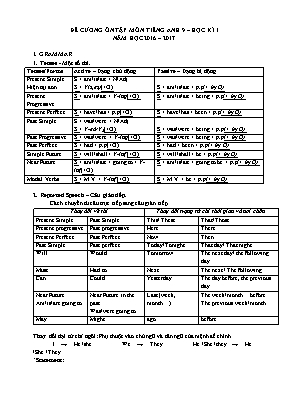
ĐỀ CƯƠNG ễN TẬP MễN TIẾNG ANH 9 – HỌC Kè I
NĂM HỌC 2016 – 2017
I. GRAMMAR
1. Tenses - Một số thỡ.
Tenses/Forms
Active – Dạng chủ động
Passive – Dạng bị động
Present Simple
Hiện tại đơn
S + am/is/are + N/Adj
S + V(s,es)(+O)
S + am/is/are + p.p(+ by O)
Present Progressive
S + am/is/are + V-ing(+O)
S + am/is/are + being + p.p(+ by O)
Present Perfect
S + have/has + p.p(+O)
S + have/has + been + p.p(+ by O)
Past Simple
S + was/were + N/Adj
S + V-ed/V2(+O)
S + was/were + being + p.p(+ by O)
Past Progressive
S + was/were + V-ing(+O)
S + was/were + being + p.p(+ by O)
Past Perfect
S + had + p.p(+O)
S + had + been + p.p(+ by O)
Simple Future
S + will/shall + V-inf(+O)
S + will/shall + be + p.p(+ by O)
Near Future
S + am/is/are + going to + V-inf(+O)
S + am/is/are + going to be + p.p(+ by O)
Modal Verbs
S + M.V. + V-inf(+O)
S + M.V. + be + p.p(+ by O)
2. Reported Speech – Cõu giỏn tiếp.
	Cỏch chuyển từ cõu trực tiếp sang cõu giỏn tiếp
Thay đổi về thỡ
Thay đổi trạng từ chỉ thời gian và nơi chốn
Present Simple
Past Simple
This/ These
That/ Those
Present progressive
Past progressive
Here
There
Present Perfect
Past Perfect
Now
Then
Past Simple
Past perfect
Today/ Tonight
That day/ That night
Will
Would
Tomorrow
The next day/ the following day
Must
Had to
Next
The next / The following
Can
Could
Yesterday
The day before, the previous day
Near Future
Am/is/are going to
Near Future in the past
Was/were going to
Last (week, month)
The week/month before
The previous week/month
May
Might
ago
before
Thay đổi đại từ chỉ ngụi: Phụ thuộc vào chủ ngữ và tõn ngữ của mệnh đề chớnh.
 I đ He /she We đ They He /She /they đ He /She /They
*Statement:
S + said (to + O) / told + O: “S’ + V + ”
đ S + said (to + O) (that) + S’đổi + Vlựi thỡ +
 S + told + O + (that) + S’đổi + Vlựi thỡ +
*Yes /No -question:
- S + asked + O: “Trợ từ để hỏi(Do, Does,...) + S’ +V + ?”
	đ S + asked + O + if /whether+ S’đổi + Vlựi thỡ +
	- S + asked + O: “Will/Shall; Can; May; + S’ + V-inf +?”
	đ S + asked + O + if /whether + S’đổi + would/should; could; might ;+V-inf +
*Wh-question:
- S + asked + O: “Question word + trợ từ để hỏi(do, does,...) + S’ +V + ?”
	đ S + asked + O + Question word+ S’đổi + Vlựi thỡ +
	- S + asked + O: “Question word + will/shall; can; may; + S’ + V-inf +?”
	đ S + asked + O + Question word+ S’đổi + would/should; could; might ;+V-inf +
*Chỳ ý dạng cõu đề nghị, yờu cầu, khuyờn ngăn:
S + asked/told/adviced + O + to V-inf
3. Một số ngữ phỏp khỏc:
a. Wish- sentences: (Cõu ước) If only = I wish
	- Hiện tại : S + wish/ wishes + S + were / V-ed / V2 + O.
	- Tương lai: S + wish/wishes + S could/would + V-inf.
 - Diễn tả một sự khụng cú thật hoặc trỏi ngược với sự thật ở hiện tại (tương lai).
	Cõu thực tế:	 Cõu ước:	 Cõu thực tế: Cõu ước:
	Can	đ Could not	V1 / V-s/es	đ	 Didn’t + Vinf
	Can’t	Could	Don’t / doesn’t+ Vinf V2/ V-ed
	Is / am / are	were + not	Will	wouldn’t
	Is / am / are + not	were	Won’t	would
b. Conditional sentence: Type 1 (Cõu điều kiện loại 1)
If- clause
Main –clause
S + V ( present simple tense )
S + will/ can / should / must / might / ought to + V1
Note: Unless = Ifnot
c. Connectives:
Clause of reason + “, so” / “; therefore,” + clause of result
= Because/Since/As+ clause of reason, clause of result = Clause of result + because/since/as + clause of reason.
d. Used to + V-inf: Một thúi quen trong quỏ khứ.
Be used to / Get used to+ V-ing/N: Quen với (Việc gỡ)
e. Tag- questions: (Cõu hỏi đuụi)
	S + V(+ O), trợ động từ (theo thỡ của V)+ not + S?
	S + trợ động từ/ +not + (V ) (+ O), trợ động từ + S ?
	S + Modal verb (ex: can) + V-inf (+ O), Modal Verb + not (ex: can’t) + S ?
* Note: - Cõu hỏi đuụi phủ định phải viết ở hỡnh thức viết tắt
	- Nếu chủ ngữ trong cõu trần thuật là danh từ, cõu hỏi đuụi phải dựng đại từ thay thế
ex:This machine works well, doesn’t it?
Đặc biệt: Let’s  , shall we?
f. Gerund after some verbs: S + like / love / enjoy / dislike / hate / mind / start / finish ...+ V-ing + O.
g. Prepositions of time: 	In, on, at, from...to, until = till, up to, between ...and, after, before
h. Lưu ý về thỡ hiện tại hoàn thành.
 S + have/has + p.p 	+ since + mốc thời gian, ex: Friday, last week, 1990,
	 + Mệnh đề chỉ hành động, chia ở thỡ QUÁ KHỨ ĐƠN (PAST SIMPLE)
	+ for + khoảng thời gian, ex: 2 hours, a long time,
* (The first time + S + have/has + p.p + was // S + began/started + V-ing// S + first + V-ed) + time
đ S + have/has + pp + since/for + time
* (The last time + S + have/has + p.p/ S + stopped + V-ing/S + last + V-ed) + time
đ S + have/has + not + pp + since/for + time
II. EXERCISES
Exercise 1. Choose the word that has the different underlined part.
A. dump	B. nuclear	C. junk-yard	D. ultimate
A. wrap	B. whole	C. where	D. wrist
A. required	B. bathed	C. looked	D. viewed
A. appliance	B. minimize	C. opinion	D. provide
A. category	B. saving	C. trash	D. standard
Exercise 2. Choose the best answer.
The Ao dai is the _____ dress of Vietnamese women.
casual	B. religional	C. international	D. national
That kind of microorganism was named _____ the scientist finding them out.
by	B. after	C. on	D. of
She’s taught here since she _____ from university.
graduates	B. graduated	C. was graduated	D. would graduate
There is a big banyan tree at the _____ the village.
mountain of	B. river bank in	C. shrine at	D. entrance to
No one has _____ forgotten the terrible earthquake in 1909.
ever	B. never	C. already	D. yet
I think it’s necessary for students _____ uniform at school.
wear	B. will wear	C. to wear	D. should wear
You should not go to that meeting _____ an invitation.
unless	B. without	C. except	D. instead of
Your children never go out in the evening, ______?
A. do they	B. don’t they	C. doesn’t he	D. does he
We have many well - ______ teachers.
A. qualify	B. quality	C. qualified	D. qualification
If you are not a teacher, please ______ around this area.
A. not go	B. don’t go	C. won’t go	D. can’t go
We often go to the mosque to pray because our religion is ______.
A. Islam	B. Buddhism	C. Hinduism	D. Taoism
We have some ______ students for the program.
A. exchange	B. exchanged	C. exchanging	D. change
Exercise 3. Supply the correct tense of the verbs:
1. I ___________(post) a letter to her 2 months ago, but she _______________ (not answer) me yet.
2. What _________________ (you do) from 2 pm to 6 pm yesterday? – I _________ (be) in the library.
3. Ba usually___________ (go) to school by bike.
4. Lan ___________ (read) book in her room at the moment. She always enjoy __________ (do) that.
5. A: ____________________________ (You ever eat) Chinese food?
 B: Yes, I ___________ (eat) at a Chinese restaurant last year.
Exercise 4. Choose the word that fits the gap.
TRANSPORT SOLUTIONS
First of all, walking is obliviously the _____1 means of travelling, and can be quicker in the city centre. Of course, the further you have to go, the _____2 you will become. In some ways walking is healthier than travelling by bus or car, but it can be just unhealthy because cities are much more polluted than they used _____3. Cars are faster of course and more convenient, but as cities become more crowded, parking is getting harder. Sometimes public transport is better, even though buses don’t go as fast as cars _____4. Cars are more convenient but as they cause most pollution, it is better to avoid _____5 them if possible. In the city, the fastest way of travelling is on a bike, which keeps you fitter and is not so noisy as a motorbike or a car.
A. fastest	B. cheapest	C. longest	D. farthest
A. tireder	B. tiredest	C. more tired	D. most tired
A. be	B. being	C. been	D. to be
A. do	B. will	C. go	D. are
A. use	B. to use	C. using	D. used
Exercise 5. a. Complete the talk of a Peace Corps volunteer with the correct forms of the verbs in the box.
remember
will be
can stay
can take
join
“I came here two years ago because I wanted to teach people about modern health care. I will be leaving in about two months; I wish I (1)______________ longer, but it’s time for me to go home.
My work here has been very interesting. I am learning so much. I always wish that there(2)______________ more hours in the day so that I could do more. Maybe it’s silly, but I worry about what will happen to the village after I leave. I wish my students (3)______________ all the things I’ve tried to teach them. I’ve become so close to the people here, I wish I (4)______________ them home with me! But of course that’s impossible. I wish more people (5)______________ the Peace Corps. It’s so rewarding, and there’s so much work to do.”
b. Decide if each statement is true or false.
_____ 6. The volunteer taught the local people how to read and write.
_____ 7. He does not want to stay longer.
_____ 8. He loved his work very much.
_____ 9. He wanted to have more hours in the day to work more.
_____ 10. He believed everything would be good after he left.
Exercise 6. Fill in each gap with one suitable preposition.
1. You must go to primary school ________ the ages of 6 and 11.
2. There is a shrine ________ the top of the mountain near my house.
3. She has come there ________ yesterday.
4. Mr. Robinson works ________ the farm and his children usually help him ________ his work.
Exercise 7. Write the tag for each question.
1. Your father often goes to work by car, ______________?
2. He is reading in his room,______________?
3. You will travel to England next week, ______________?
4. The man was listening to music when the accident occurred, ______________?
5. You didn’t finish your homework, ______________?
ANSWER KEYS:
Exercise 1. Choose the word that has the different underlined part.
B 2. D 3.C 4. C 5. B
Exercise 2. Choose the best answer.
1.D 2. B 3. D 4. A 5. C 6. B
7. A 8. C 9. B 10. A 11. A 12.D
Exercise 3. Supply the correct tense of the verbs:
1. I ___posted___(post) a letter to her 2 months ago, but she ___hasn’t answered__ (not answer) me yet.
2. What ___were you doing___ (you do) from 2 pm to 6 pm yesterday? – I ___was__ (be) in the library.
3. Ba usually__goes___ (go) to school by bike.
4. Lan ___is reading__ (read) book in her room at the moment. She always enjoy ___doing__ (do) that.
5. A: ____Have you ever eaten___ (You ever eat) Chinese food?
 B: Yes, I ___ate__ (eat) at a Chinese restaurant last year.
Exercise 4. Choose the word that fits the gap.
B 2. C 3. D 4. A 5. C
Exercise 5. a.Complete the talk of a Peace Corps volunteer with the correct forms of the verbs in the box.
“I came here two years ago because I wanted to teach people about modern health care. I will be leaving in about two months; I wish I (1)__could stay__ longer, but it’s time for me to go home.
My work here has been very interesting. I am learning so much. I always wish that there(2)__would be__ more hours in the day so that I could do more. Maybe it’s silly, but I worry about what will happen to the village after I leave. I wish my students (3)___remembered___ all the things I’ve tried to teach them. I’ve become so close to the people here, I wish I (4)___could take___ them home with me! But of course that’s impossible. I wish more people (5)__joined__ the Peace Corps. It’s so rewarding, and there’s so much work to do.”
b. Decide if each statement is true or false.
__F__ 6. The volunteer taught the local people how to read and write.
__F__ 7. He does not want to stay longer.
__T__ 8. He loved his work very much.
__T__ 9. He wanted to have more hours in the day to work more.
__F__ 10. He believed everything would be good after he left.
Exercise 6. Fill in each gap with one suitable preposition.
1. You must go to primary school ___between__ the ages of 6 and 11.
2. There is a shrine __on__ the top of the mountain near my house.
3. She has come there __since__ yesterday.
4. Mr. Robinson works __on__ the farm and his children usually help him ___with__ his work.
Exercise 7. Write the tag for each question.
1. Your father often goes to work by car, ___doesn’t he___?
2. He is reading in his room,__ isn’t he__?
3. You will travel to England next week, ___won’t you__?
4. The man was listening to music when the accident occurred, __ wasn’t he___?
5. You didn’t finish your homework, ___ did you___?
Tài liệu đính kèm:
 de_cuong_on_tap_hoc_ky_i_mon_tieng_anh_9_nam_hoc_2016_2017.doc
Đề thi liên quan
 2 Đề ôn luyện vào Lớp 10 THPT môn Tiếng Anh năm 2017 (Có đáp án)
 Lượt xem: 51
 Lượt tải: 0
- Đề luyện thi tuyển sinh vào Lớp 10 THPT môn Tiếng Anh - Đề 60 (Có đáp án)
Lượt xem: 45
Lượt tải: 0
 Cách phát âm trong tiếng Anh
Lượt xem: 828
Lượt tải: 2
Cách phát âm trong tiếng Anh
Lượt xem: 828
Lượt tải: 2- Bài tập luyện nghe học sinh giỏi môn Tiếng Anh Lớp 9 - Bài: A Surprise
Lượt xem: 684
Lượt tải: 0
 Đề thi vào Lớp 10 THPT môn Tiếng Anh - Đề B - Năm học 2017-2018 - Sở GD & ĐT Thanh Hóa
Lượt xem: 41
Lượt tải: 0
Đề thi vào Lớp 10 THPT môn Tiếng Anh - Đề B - Năm học 2017-2018 - Sở GD & ĐT Thanh Hóa
Lượt xem: 41
Lượt tải: 0- Đề thi thử vào Lớp 10 THPT lần 2 môn Tiếng Anh - Năm học 2017-2018 - Phòng GD & ĐT Thanh Hoa
Lượt xem: 44
Lượt tải: 0
- Đề thi thử vào Lớp 10 THPT môn Tiếng Anh - Năm học 2016-2017 - Trường THCS Vĩnh Khang
Lượt xem: 50
Lượt tải: 0
- Đề thi học kỳ II môn Tiếng Anh Lớp 9 - Mã đề 001 - Năm học 2016-2017 - Sở GD & ĐT Đồng Nai (Có đáp án)
Lượt xem: 243
Lượt tải: 0
- Tổng hợp bài tập viết lại câu (Có đáp án)
Lượt xem: 42
Lượt tải: 0
- Đề thi thử vào Lớp 10 THPT môn Tiếng Anh - Đề số 4
Lượt xem: 691
Lượt tải: 0
Copyright © 2026 ThuVienDeThi.com, Thư viện đề thi mới nhất, Đề kiểm tra, Đề thi thử

