
Đề cương ôn tập cuối năm môn Tiếng Anh Lớp 7


Bạn đang xem 20 trang mẫu của tài liệu "Đề cương ôn tập cuối năm môn Tiếng Anh Lớp 7", để tải tài liệu gốc về máy bạn click vào nút DOWNLOAD ở trên
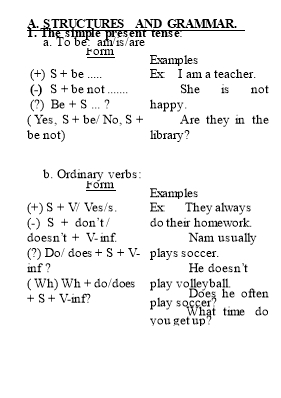
A. STRUCTURES AND GRAMMAR.
1. The simple present tense:
 a. To be: am/is/are
 Form
 Examples
 (+) S + be .....
 (-) S + be not .......
 (?) Be + S ... ?
( Yes, S + be/ No, S + be not)
Ex: I am a teacher.
 She is not happy.
 Are they in the library?
 b. Ordinary verbs:
 Form
 Examples
(+) S + V/ Ves/s.
(-) S + don’t / doesn’t + V-inf.
(?) Do/ does + S + V-inf ?
( Wh) Wh + do/does + S + V-inf?
Ex: They always do their homework.
 Nam usually plays soccer.
 He doesn’t play volleyball.
 Does he often play soccer?
 What time do you get up?
 Usage: is used to talk about something that is always true , the habits, that happens again and again...
- Adverbs of time: always, usually, often, sometimes, never , everyday/ every week, after school ...
2. The present progressive tense:
 Form
 Examples
- Form:
(+) S + be + V-ing.
(-) S + be + not + V-ing.
(?) Be + S + V-ing ?
 -Yes, S+ be.
 - No, S + be not.
( ?) Wh + be + S + Ving?
Ex:
 I am learning English now.
 Hung is not listening to music at the moment.
 Na and Hoa are watching TV at present.
- Usage: is used to talk about something that is happening at the moment of speaking.
- Adverbs of time: now , right now, at present, at the moment, Listen!, Look!, Be careful!
3. The simple future tense:
 Form
 Examples
- Form:
(+) S + will + V-inf.
(-) S + will not + V-inf.
(?) Will + S + V-inf ?
(Wh) Wh + will/ shall +S + V-inf?
Note: will not = won’t
Ex: We will go to Ha Long tomorrow.
 She won’t go to school next weekend.
- Usage: is used to talk about the future
- Adverbs of time: tomorrow, tonight , this afternoon, next week/ next month/ next year, soon....
4. Exclamations: What + a/an + adjective + noun!/ What+ adj + nouns!
Ex: What a nice cat!
 What an awful day!
 What beautiful girls!
5. Suggestions and invitations:
 Form
 Examples
- Form:
What about + V-ing?
Let’s + V-inf.
Why don’t we + V-inf?
Would you like to + V-inf?
Should + we + V-inf ?
( Polite refusal/ acceptance )
 What about going to the cinema?
 Let’s go to the cinema.
 Why don’t we go to the cinema?
 OK./ That’s a good idea......
 I’m sorry, I can’t.
 I would love to (but) .
6. Noun comparison:
a. MANY => MORE: nhiều hơn
 Ex: Ann has more pens than Thang.
b. FEW => FEWER: ớt hơn
 Ex: Thang has fewer pens than Ann.
c. MUCH => MORE: nhiều hơn
 Ex: Nam drinks more milk than Ba.
c. LITTLE => LESS: ớt hơn
 Ex: Ba drinks less milk than Nam.
 Form:
- So sỏnh nhiều hơn của danh từ đếm được:
 S1+ V(s/es) + more + Ns/es + than + S2.
- So sỏnh nhiều hơn của danh từ khụng đếm được:
 S +V(s/es) + more + N+ than+S2.
- So sỏnh ớt hơn của danh từ đếm được:
 S + V(s/es) + fewer + Ns/es + than + S2.
-So sỏnh ớt hơn của danh từ khụng đếm được:
 S + V(s/es) + less + N + than + S2.
7. WH-Questions:
What, When, Where , Why, How, How old
1. Ask about distances: How far is it from .. to .. ? It is about
2. Talk about time: What time..? It’s .
3. Enquire about prices: How much + is / are + S? It’s / They’re .
8. Prepositions of position:
ôin :
+ in Uong Bi/ Quảng Ninh /Viet nam
ôon:
+ on Tran Hung Dao street
+ on the first/ second floor:
+ on the way to: trờn đường đến..
+ on the right/ left
ôat:
+ at 280 Quang Trung Street
+ at home/ school/ work
+ at the back (of the library)
in front of
behind
to the right/ left of
in the middle
next to
near
opposite
between.... and
fromto
9. Compound nouns (Danh tu ghộp)
Ex* A summer vacation lasts three months.
→ It is a three-month summer vacation.
 A film lasts two hours.
→ It is a two-hour film.
 A stamp costs five hundred dong.
→ It is a five-hundred-dong stamp.
10. Time:
 What time is it? : mấy giờ rồi
 It’s + giờ + phỳt
 It’s + phỳt + TO + giờ (Giờ Kộm)
 It’s + phỳt + PAST + giờ (Giờ Hơn)
 Ex: 7: 20 It’s seven twenty/ It’s twenty past seven
B. EXERCISES:
Part I. Listening
1. Listen and write a name or a number.
0.What’s the girl’s name?
1, How many people are there in the photograph?
2. How many rooms are there in her house?..
3. What number is on the door? ..
4. What’s the name of her baby sister? ..
5. The girl is talking on the phone.
2. Listen and choose the best answer.
1. What’s Nga doing?
She is writing an essay B. She is cooking C. She is listening to music
2. What’s Peter doing?
A. He is playing soccer B. He is playing badminton C. He is drawing
3. What’s Hoa doing?
A. She is learning B. She is is washing C. She is reading
4. What’s Lan’s mother doing?
A. She is talking B. She is having a bath C. She is cooki ng
5. What’s Susan’s father doing?
A. He is watching T.V B. He is sleeping C. He is walking
Part II. Reading
1. Read the following text then answer the questions:
 We are in a secondary school. At school, we study various subjects. Many students , mostly boys love Math. They like working with numbers and shapes. Most girls like Literature. They love good poems. We must study all subjects because we know that all of them are important. Most of us think English is interesting to learn. To some students, English is easy. To others, English is quite hard. It doesn’t matter whether it is easy or hard. The problem is that we must try our best to study. We will know how to study when we receive the report cards.
1. Answer the questions.
a. Why must we study all subjects?
.
b. What do the students think of English?
.
c. What about you? Do you think English is easy or difficult?
.
d. Do the girls love good poems?
.
2. Read the passage and write T (True) or F (false) for each statement below it:
 	There are two main kinds of sports : team sport and individual sports. Team sports are such sport as baseball, basketball, and volleyball. Team sports require two separate teams. The teams play against each other. They compete against each other in order to get the best score. For example, in a basketball game, if team A gets 7 points and team B get 3 points, team a wins the game. Team sports are sometimes called competitive sports.
1.	______ Team sports and individual sports are tow main kinds of sports.
2.	______ Base ball, basketball and volleyball are individual sports.
3.	______ To get the best score, the two teams have to compete against each other.
4.	______ Competitive sport are sometimes all called team sports.
Part III .Writing.
Rewrite the sentences
1.	Tim’s father has more holidays than Hoa’s father.
	Hoa’s father has ................................................................................
2.	Why don’t we go to the cafeteria?
	What about 	......................................................................................
3.	Let’s go shopping with us.
	Why don’t you ...................................................................................
4.	Where do you live?
	What’s .................................................................................................
5.	We have a break that lasts thirty minutes.
	 We have a 	............................................................................................
6. The play is very interesting.
 What .....................................................................!
7. These computers are very modern.
 What..............
8. She goes to school at six forty – five.
 She ...............................................................................................
2. Rearrange the jumbled words to make correct sentences:
1. 45 / Each / lasts / period / for / minutes/.
2. get / It / me / 20 / to / to / minutes / takes /school/.
3. we / students / fewer / than / vacations / have / American/.
4. my / five / father / hours / a / works / day/.
5. do / on / you / what / usually / Saturday / do/?
6. is / computer / Mai / interested / books / in / and/.
7. go / have / drink / let’s / to / a / canteen / the / and/.
8. computer / like / I / games / don’t / playing / really/.
9. reading/ is/ newspapers/He/. .. 10.You/like/to/go/the/to/Would/cafeteria/?
11.Usually/rides/to/Ba/bike/school/his/ .
12.I/badminton/in/play/free time/my/.
Part IV. Speaking
	Topic 1: Talk about yourself
Name / middle name / family name
Age
Job
Class / grade
School
Home address
Topic 2: School subjects and schedule
1. How many subjects do you have at school?
2. Which subjects do you have on Monday / Tuesday / Wednesday / Thursday /?
3. When do you have English / Math / Literature / Geography / ?
4. What do you study in Geography / History / Literature / ?
5. What’s your favorite subject?
 6. Which subjects are you good at?
Topic 3: Your house ( describe rooms in your house)
 What are there in your room?/ Where is ...
 Topic 4: Activities at recess and after school.
What do you often do after school?
What do you always / usually /often / sometimes / never do on Monday / Tuesday / How often do you study in the library after school?
What is your favorite activity after school?
What do you often do at recess?
The Matrix
Tên chủ đề
Nhận biết
Thông hiểu
Vận dụng
Cộng
Listening
Số câu: 10
Số điểm: 2,5
Tỉ lệ: 25%
Listen to a text/ dialogue and fill in the information
Số câu: 5
Số điểm: 1,25
Tỉ lệ: 12,5%
Số câu: 5
Số điểm:1,25 Tỉ lệ: 12,5%
Listen to a text/ dialogue and choose the best answer
Số câu: 5
Số điểm: 1,25
Tỉ lệ: 12,5%
Số câu: 5
Số điểm: 1,25
 Tỉ lệ: 12,5%
Reading
Số câu: 10
Số điểm: 2,5
Tỉ lệ: 25%
Reading a text and answer the questions
Reading a text and answer the questions
Answer the question
Số câu: 3
Số điểm: 0,75
Tỉ lệ: 7,5%
Số câu: 2
Số điểm:0,5
Tỉ lệ: 5%
Số câu: 1
Số điểm: 0,25
Tỉ lệ: 2,5%
Số câu: 6
Số điểm: 1,5 =15%
Read the passage and decide which sentence is True/ False
Số câu: 4
Số điểm: 1
Tỉ lệ: 10%
Số câu: 4
Số điểm: 1
Tỉ lệ: 10%
Writing
Số câu: 10
Số điểm: 2,5
Tỉ lệ : 25%
Rewrite the sentences with the words given
Số câu: 4
Số điểm: 1
Tỉ lệ:10%
Số câu: 4
Số điểm: 1 Tỉ lệ:10%
Arrange the words to make correct sentences
Số câu: 6
Số điểm: 1,5
Tỉ lệ:15%
Số câu: 6
Số điểm: 1,5
Tỉ lệ:15%
Tổng số câu: 30
Tổng số điểm: 7,5
Tỉ lệ: 75%
Số câu: 12
Số điểm: 3.0
Tỉ lệ: 30%
Số câu: 13
Số điểm: 3,25
Tỉ lệ: 32,5%
Số câu: 5
Số điểm: 1,25
Tỉ lệ: 12,5%
Số câu: 30
Số điểm:7,5 =75 %
Tài liệu đính kèm:
 de_cuong_on_tap_cuoi_nam_mon_tieng_anh_lop_7.doc
Đề thi liên quan
 6 Bộ đề kiểm tra 1 tiết môn Tiếng Anh Lớp 7
 Lượt xem: 963
 Lượt tải: 1
- Đề kiểm tra học kỳ I môn Tiếng Anh Lớp 7 - Đề 1 - Phòng GD & ĐT Hoài Nhơn
Lượt xem: 716
Lượt tải: 1
- Đề thi olympic môn Tiếng Anh Lớp 7 - Đề 2 - Năm học 2014-2015 - Phòng GD & ĐT Thanh Oai (Có đáp án)
Lượt xem: 687
Lượt tải: 1
 Đề thi học kì 1 môn Tiếng Anh Khối 7 (Có đáp án)
Lượt xem: 756
Lượt tải: 0
Đề thi học kì 1 môn Tiếng Anh Khối 7 (Có đáp án)
Lượt xem: 756
Lượt tải: 0- Đề kiểm tra học kì II môn Tiếng anh lớp 7
Lượt xem: 842
Lượt tải: 0
- Đề kiểm tra Tiếng anh khối 7
Lượt xem: 1514
Lượt tải: 0
- Đề kiểm tra 45 phút môn Tiếng Anh Lớp 7 (Có đáp án)
Lượt xem: 686
Lượt tải: 1
- Đề kiểm tra môn Tiếng anh lớp 7 - Đề số 5
Lượt xem: 745
Lượt tải: 0
- Đề kiểm tra học kỳ II môn Tiếng Anh Lớp 7 - Năm học 2016-2017 - Phòng GD & ĐT Đất Đỏ
Lượt xem: 129
Lượt tải: 0
 Đề cương ôn tập học kỳ 2 môn Tiếng Anh Lớp 7
Lượt xem: 483
Lượt tải: 1
Đề cương ôn tập học kỳ 2 môn Tiếng Anh Lớp 7
Lượt xem: 483
Lượt tải: 1
Copyright © 2026 ThuVienDeThi.com, Thư viện đề thi mới nhất, Đề kiểm tra, Đề thi thử

