
Chuyên đề Directed speech and reported speech (Lời nói trực tiếp và lời nói gián tiếp)


Bạn đang xem tài liệu "Chuyên đề Directed speech and reported speech (Lời nói trực tiếp và lời nói gián tiếp)", để tải tài liệu gốc về máy bạn click vào nút DOWNLOAD ở trên
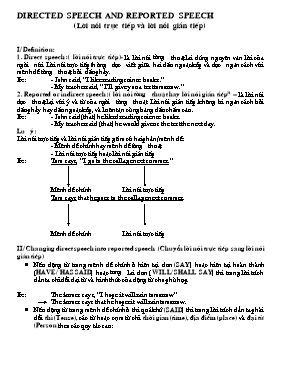
Directed speech and reported speech
(Lời nói trực tiếp và lời nói gián tiếp)
I/ Definition:
1. Direct speech: ( lời nói trực tiếp)- là lời nói tường thuật lai đúng nguyên văn lời của người nói. Lời nói trực tiếp thường được viết giữa hai dấu ngoặc kép và được ngăn cách với mệnh đề tường thuật bởi dấu phẩy.
Ex: 	- John said, “ I like reading scince books.”
	- My teacher said, “ I’ll give you a test tomorrow.”
2. Reported or indirect speech: ( lời nói tường thuật hay lời nói gián tiếp” – là lời nói được thuật lại với ý và từ của người tường thuật. Lời nói gián tiếp không bi ngăn cách bởi dấu phẩy hay dấu ngoặc kép, và luôn tận cùng bằng dấu chấm câu.
Ex:	- John said (that) he liked reading science books.
	- My teacher said (that) he would give us the test the next day.
Lưu ý:
Lời nói trực tiếp và lời nói gián tiếp gồm có hai phần/ mệnh đề:
- Mệnh đề chính hay mệnh đề tường thuật
- Lời nói trực tiếp hoặc lời nói gián tiếp
Ex: 	Tom says, “ I go to the collage next summer.”
	Mệnh đề chính	 Lời nói trực tiếp
	Tom says that he goes to the collage next summer.
	Mệnh đề chính	 Lời nói trực tiếp
II/ Changing direct speech into reported speech. (Chuyển lời nói trực tiếp sang lời nói gián tiếp)
Nếu động từ trong mệnh đề chính ở hiện tại đơn (SAY) hoặc hiện tại hoàn thành (HAVE/ HAS SAID) hoặc tương lai đơn (WILL/ SHALL SAY) thì trong lời trích dẩn ta chỉ đổi đại từ và hình thức của động từ cho phù hợp.
Ex: 	The farmer says, “ I hope it will rain tomorrow”
	The farmer says that he hopes it will rain tomorrow.
Nếu động từ trong mệnh đề chính ở thì quá khứ (SAID) thì trong lời trích dẩn ta phải đổi thì (Tense), các từ hoặc cụm từ chỉ thời gian (time), địa điểm (place) và đại từ (Person)theo các quy tắc sau:
A/ Thay đổi thì của động từ:
Trực tiếp
Gián tiếp
Ví dụ
* Simple present
* Present continuous
* - Simple past
 - Present perfect
* - past continuous
 - Present perfect
 continuous
* Simple future
* May
* can
- Simple past
- Past continuous
- Past perfect
- Past perfect
 Continuous
- Future in past
- might
- could
- “ I feel sick”
 He said he felt sick.
- “ I’m writing a letter”
 He said that he was writing a letter.
- “ I have seen that film.”
 He said that he had seen that film.
- “I was living in Viene then”
 He said that he had been living in Viene.
...
- “ I shall go to Japan in July”
 He said that he would go to Japan in July.
Lưu ý: Trường hợp không đổi dạng động từ khi chuyển từ câu trực tiếp sang gian tiếp.
* Must/ might/ could/ should/ had better/ ought to không đổi.
Ex: 	He said, “ I must finish this homework.”
	He said that he must finish that homework.
* Ta vẩn có thể dùng “simple present” thay vì “simple past” trong lời nói gián tiếp khi diển tả:
	- Một thói quen: “ I work late every morning.”
	- Một chân lý: “ The sun rises in the East.”
* Đối với các động từ khuyết thiếu (Không đủ các dạng thức chia ở các thì) ta phải mượn các từ có cùng nghĩa như:
	Must 	had to/ would have to
	Must not 	was to/ were to
	Can 	could/ be able to
	Will/ shall 	would/ be going to
* Các cấu trúc câu:
1. Cấu trúc câu Wish ( câu mong ước ) không đổi.
Ex: 	She said, “I wish I had known the truth.”
	She wished She had known the truth.
	She said that she wished
2. Cấu trúc: Would rather + S + V(quá khứ) - Không đổi
Ex: 	He said, “I’d rather Tom drove the car”
	He said he would rather Tom drove the car.
3. Cấu trúc: It’s (high) time + S + V (quá khứ) – Không đổi
Ex: 	- The man said, “It’s high time you went to school alone, my son”
	The man said to his son that it was high time he went to school alone.
4. Câu điều kiẹn loại 2 và 3 không đổi.
B/ Thay đổi tính từ và trạng từ:
Trực tiếp
Gián tiếp
Ví dụ
* This
*These
* Here
* Now
* today
* Yesterday
* Tomorrow
* ago
* Next week
* last week
- that
- Those
- There
- Then
- That day
- The day before
 The previous day
- The next day
 The following day
- Before
- The week after
 The following week
- The week before
 The previous week
- “I need this book”
 He said that he needed that book.
- “ I’ll take these with me.”
 He said that he would take those with her
- “I’ll return here at 3 o’clock.”
 He said He would return there at 3 o’clock
- “I’m going now.”
She said that she was going then.
- “I will do it today.”
 He said he would do it that day.
- “I was at Hue yesterday.”
 She said she had been at Hue the day before.
- “We’ll wait until tomorrow.”
 They said they would wait until the following day.
- “I was at Dalat three weeks ago.”
 He said he had been at Dalat Three weeks before
- “I’ll come to see her next week.”
 He said he would come to see her the week after.
- “I went to Hanoi last week.”
 He said he had gone to Hanoi the week before
C/ Đổi đại từ:
The first person:
Số ít: I/ me và những từ sở hữu my/ mine Sẽ được đổi theo ngôi của
Số nhiều: we/ us và các từ sở hữu our/ ours chủ từ trong mệnh đề
 tường thuật
	Ex: 	Jane said, “I have left my book at home.”
	 	Jane said that She had left her book at home.
The second person:
You/ you và các từ sở hữu của chúng your/ yours sẽ được đổi theo ngôi của túc từ ( Object) trong mệnh đề tường thuật.
	Ex: 	He said, “I’ll lend you my book, Alice.”
	He said to Alice that he would lend her his book.
The third person:
- Số ít: He/ him/ his/ she/ her/ her/ it/ it/ it/ its - Thường được giữ nguyên.
- Số nhiều: They/ them/ their/ theirs
Ex: 	She said, “I have posted their letters.”
	She said that she had posted their letter.
D/ Tường thuật gián tiếp các loại câu:
I. Câu mệnh lệnh,yêu cầu, đề nghị, lời khuyên gián tiếp.
- Khi các lọai câu mệnh lệnh,yêu cầu, đề nghị, lời khuyên được đổi từ trực tiếp sang gián tiếp thường được mở đầu băng các động từ: “ order/ command/ tell/ ask/ request/ advise/ invite.....” Thường được tường thuật theo cấu trúc sau:
+ Nếu các loại câu trên ở dạng khăng định:
	asked
	told
S + 	 requested + O + to V-infinitive
	.....
Ex: 	“Hurry up, Lan”
	She told Lan to hurry up.
	“Can you carry the bag for me?”
	She asked me to carry her bag.
	“Would you like to have a drink.”
	She invited me to have a drink.
+ Nếu các loại câu trên ở dạng phủ định:
	asked
	told
S + 	 requested + O + not to V-infinitive
	.....
Ex: 	“Don’t leave the room.”
	She told me not to leave the room.
	“Please don’t tell anyone what happened.”
	He asked me not to tell anyone what had happened.
II. Câu hỏi gián tiếp:
1. Yes/ No – questions:
- Khi đổi câu hỏi Yes – No sang câu gián tiếp ta thực hiện các bước sau:
a. Các quy tắc đổi thì và các trường hợp khác vẫn như dạng câu lời nói.
b. Dùng động từ “asked” hoặc “wanted to know” ở mệnh đề tường thuật.
c. Viết từ “if” hoặc “whether” sau mệnh đề tường thuật.
d. Nếu câu hỏi Yes – No bắt đầu băng động từ hình thái ( can/ will/ must...) thì đổi theo quy tắc.
e. Nếu câu hỏi Yes – No với trợ động từ “Do/ does/ did” thi bỏ trợ động từ và đua về câu khăng định lưu ý đổi thì của động từ chính theo quy tắc đổi thì.
g. Đổi dấu chấm hỏi “?” trong câu trực tiếp sang dấu chấm “ . ” trong câu gián tiếp.
Ex: 	- He said, “Are you enjoying yurself?
	He asked if I was enjoying myself.
- “ Can you hear a strange noise?” He said.
	He asked if I heard a strange noise.
2. Wh- questions:
- Khi đổi câu hỏi Wh- questions sang câu gián tiếp ta thức hiẹn các bước sau
a. Các quy tắc đổi thì và các trường hợp khác vẫn như dạng câu lời nói.
b. Dùng động từ “asked” hoặc “wanted to know” ở mệnh đề tường thuật.
c. Đăt “Wh – word” sau động từ trong mệnh đề tường thuât.
d. Sau Wh – word là một câu ở dạng sác định, không thành lập câu hỏi.
e. Đổi dấu chấm hỏi “?” trong câu trực tiếp sang dấu chấm “ . ” trong câu gián tiếp.
Ex: 	He said, “where are you going, Tom?”
	He asked Tom where he was going.
Bài tập
I. Put the following commands and requests into reported speech.
1. The teacher said to Tim, “Come into my office, please.”
..
2. Their mother said to them, “Don’t make so much noise.”
3. The traffic policeman said, “Show me your driving license, please.”
..
4. Mr. Jackson said to Tim, “Could you give me a hand, please?”
5. Nam said to the taxi driver, “please turn left at the first traffic light.”
..
6. She said to her son, “Go straight upstairs and get into bed.”
..
7. The policeman said, “Don’t touch anything in the room.”
8. Mary said to John, “Can you carry my suitcase, please.”
9. I said to him, “Would you mind if I took some photos?”
..
10. The doctor said to the boy, “Take off your shirt, please.”
.
II. Yesterday morning, Mr. Robinson was ill he went to the doctor and the doctor gave him some advice. Report the doctor’s advice in two ways as shown.
1. “You should take a few days off”
- The doctor said to Mr. Robinson that......................................................................
- The doctor advised Mr. Robinson............................................................................
2. “You should stay in bed for a few days.”
- The doctor said to Mr. Robinson that......................................................................
- The doctor advised Mr. Robinson............................................................................
3. “You should take these medicines every four hours.”
- The doctor said to Mr. Robinson that......................................................................
- The doctor advised Mr. Robinson............................................................................
4. “You ought to keep your body warm.”
- The doctor said to Mr. Robinson that......................................................................
- The doctor advised Mr. Robinson............................................................................
5. “You shouldn’t drink alcohol or smoke.”
- The doctor said to Mr. Robinson that......................................................................
- The doctor advised Mr. Robinson............................................................................
6. “You ought not to eat fatty food.”
- The doctor said to Mr. Robinson that......................................................................
- The doctor advised Mr. Robinson............................................................................
7. “You should take a little milk before sleeping.”
- The doctor said to Mr. Robinson that......................................................................
- The doctor advised Mr. Robinson............................................................................
III. Turn the following questions into indirect speech.
1. Marry asked me, “Do you want to visit London?”
.
2. She said, “Can you speak Spanish, Minh?”
..
3. Thanh said to her teacher, “Will I finish my exercises at home?”
4. My friend said, “Are you going to leave tomorrow?”
.
5. They said to us, “Must you go now?”
6. I asked Nam, “Are you free tonight?”
.
7. Nam said to me, “Did you stay at home last night?”
.
8. The mother asked her son, “Have you finished your homework?”
..
IV. Change the following sentences into reported speech.
1. He said to her, “you are my friend.”
.
2. Johnny said to his father, “I don’t know how to do this exercise.”
.
3. “Don’t come back before one o’clock.” my brother Advised.
..
4. “Cook it in butter.” Mrs. Brown said to her daughter.
..
5. The pupils said, “Teacher, give us better mark, please.”
..
6. “What are you doing now?” Ann said to her son.
..
7. “We are having a lot of lessons today”. The teacher told his students.
.
8. “I wonder who is coming tomorrow. ”. She said
9 “ You are a naughty boy”. Mrs. Brown said.
10. “It is a very nice evening. Why don’t we go out for a walk”. Jim suggested.
..
11. “It isn’t very foggy today as it was yesterday”, Said the teacher.
12. “you are a good student”, Said the teacher.
13. He said to her: “ I have not told you anything yet”
.
14. Mr. Ha asked his friend: “How did you manage to know my phone number?”
.
15. Minh said: “My father died a year ago”
.
16.”I said to the librarian: “Can I take out another book please?”
17.” She said to the boys: “Be careful.”
Tài liệu đính kèm:
 chuyen_de_directed_speech_and_reported_speech_loi_noi_truc_t.doc
Đề thi liên quan
 Bài luyện nghe môn Tiếng Anh - Bài: The museum
 Lượt xem: 725
 Lượt tải: 0
 Bộ đề thi học kỳ I môn Tiếng Anh Lớp 9
Lượt xem: 963
Lượt tải: 0
Bộ đề thi học kỳ I môn Tiếng Anh Lớp 9
Lượt xem: 963
Lượt tải: 0- Bài luyện nghe môn Tiếng Anh Lớp 9 - Bài 6: Jennifer the firefighter
Lượt xem: 770
Lượt tải: 0
- Cấu trúc câu điều kiện trong tiếng Anh
Lượt xem: 985
Lượt tải: 0
- Đề thi học kỳ II môn Tiếng Anh Lớp 9 - Mã đề 003 - Năm học 2016-2017 - Trường THPT Thạnh Lộc
Lượt xem: 126
Lượt tải: 0
- Bài tập về Câu hỏi đuôi môn Tiếng anh lớp 9
Lượt xem: 796
Lượt tải: 1
- Đề và đáp án ôn tập thi vào lớp 10 THPT môn Tiếng anh lớp 9 - Đề số 13
Lượt xem: 826
Lượt tải: 0
- Đề thi tuyển sinh lớp 10 THPT môn Tiếng anh - Năm học 2016-2017 - Sở GD & ĐT Thanh Hóa
Lượt xem: 777
Lượt tải: 0
- Đề và đáp án ôn tập thi vào lớp 10 THPT môn Tiếng anh lớp 9 - Đề số 20
Lượt xem: 1254
Lượt tải: 0
- Ngữ pháp Tiếng Anh Lớp 9
Lượt xem: 1266
Lượt tải: 2
Copyright © 2026 ThuVienDeThi.com, Thư viện đề thi mới nhất, Đề kiểm tra, Đề thi thử

