
Bài tập chương trình Tiếng Anh Lớp 8


Bạn đang xem 20 trang mẫu của tài liệu "Bài tập chương trình Tiếng Anh Lớp 8", để tải tài liệu gốc về máy bạn click vào nút DOWNLOAD ở trên
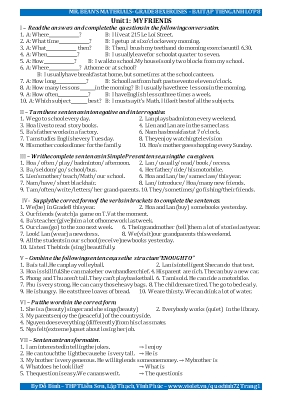
Unit 1: MY FRIENDS
I – Read the answers and complete the questions in the following conversation.
1. A: Where_______________?	B: I live at 215 Le Loi Street.
2. A: What time_______________?	B: I get up at six o’clock every morning.
3. A: What_______________ then?	B: Then, I brush my teeth and do morning exercise until 6.30.
4. A: When_______________?	B: I usually leave for school at quarter to seven.
5. A: How_______________?	B: I walk to school. My house is only two blocks from my school.
6. A: Where_______________? At home or at school?
	B: I usually have breakfast at home, but sometimes at the school canteen.
7. A: How long_______________?	B: School last from haft past seven to eleven o’clock.
8. A: How many lessons________ in the morning? B: I usually have three lessons in the morning.
9. A: How often_______________?	B: I have English lesson three times a week.
10. A: Which subject________ best?	B: I must say it’s Math. I like it best of all the subjects.
II – Turn these sentences into negative and interrogative.
1. We go to school every day.	2. Lan plays badminton every weekend.
3. Hoa lives to read story books.	4. Lien and Lan are in the same class.
5. Ba’s father works in a factory.	6. Nam has breakfast at 7 o’clock.
7. Tam studies English every Tuesday.	8. They enjoy watching television.
9. His mother cooks dinner for the family.	10. Hoa’s mother goes shopping every Sunday.
III – Writhe complete sentences in Simple Present tense, using the cues given.
1. Hoa / often / play / badminton/ afternoon.	2. Lan / usually/ read/ book / recess.
3. Ba/ seldom/ go/ school/ bus.	4. Her father/ ride/ his motorbike.
5. Lien’s mother/ teach/ Math/ our school.	6. Hoa and Lan/ be/ same class/ this year.
7. Nam/ have/ short black hair.	8. Lan/ introduce/ Hoa/ many new friends.
9. Tam/ often/ write/ letters/ her grand-parents. 10. They/ sometimes/ go fishing/ their friends.
 IV - Supply the correct form of the verbs in brackets to complete the sentences.
1. We (be) in Grade 8 this year.	2. Hoa and Lan (buy) some books yesterday.
3. Our friends (watch) a game on T.V at the moment.
4. Ba’s teacher (give) him a lot of homework last week.
5. Our class (go) to the zoo next week.	6. Their grandmother (tell) them a lot of stories last year.
7. Look! Lan (wear) a new dress.	8. We (visit) our grandparents this weekend.
9. All the students in our school (receive) new books yesterday.
10. Listen! The birds (sing) beautifully.
V – Combine the following sentences, use the structure “ENOUGH TO”
1. Ba is tall. He can play volleyball.	2. Lan is intelligent. She can do that test.
3. Hoa is skillful. She can make her own handkerchief. 4. His parent are rich. The can buy a new car.
5. Phong and Thu aren’t tall. They can’t play basketball.	6. Tam is old. He can ride a motorbike.
7. Phu is very strong. He can carry those heavy bags. 8. The children are tired. The go to bed early.
9. He is hungry. He eats three loaves of bread.	10. We are thirsty. We can drink a lot of water.
VI – Put the words in the correct form.
1. She is a (beauty) singer and she sings (beauty)	2. Everybody works (quiet)	 in the library.
3. My parents enjoy the (peaceful) 	of the countryside.
4. Nguyen does everything (differently) from his classmates.
5. Nga felt (extreme) 	upset about losing her job.
VII – Sentences transformation.
1. I am interested in telling the jokes.	→ I enjoy
2. He can touch the light because he is very tall.	→ He is
3. My brother is very generous. He willing lends someone money. → My brother is
4. What does he look like?	→ What is
5. The question is easy. We can answer it.	→ The question is
VIII – Put the words in correct orders.
1/ Brown/ has/ eyes/ he/ big.	2. She/ a/ man/ short/ married/ fat.
3. My/ teacher/ long/ straight/ dark/ has/ hair.	4. Car/ big/ black/ it/ is/ a.
5. She/ a/ beautiful/ girl/ is.
IX – Combine each of the following pairs of sentences into one sentences, using (not) adj + enough + to infinitive.
1. My sister is old. She can drive a car.	2. The radio isn’t small. You can’t put it in your pocket.
3. This coat isn’t warm. I don’t wear it in winter.
4. She is beautiful and intelligent. She can become Miss World.
5. The weather was fine. We could go camping.	6. Those apples aren’t ripe. We can’t eat them.
7. Mr. Robinson isn’t rich. He can’t buy a house.
8. The worker is clever. He can make fine things from wood.
X – Change the sentences into exclamatory sentences, using “What + (a/an) + adj + N?”.
1. The room is very dirty. 	2. The boys are naughty.	3. The weather is awful.
4. The dresses are very lovely.	5. The story is very interesting.	6. The milk is very sour.
7. The girl is very beautiful.
XI – Put the verbs in brackets into the present simple tense.
1. She (not drink) coffee. She (drink) Coca Cola.	2. It (be) often hot in the summer.
3. What you (do) every evening?	4. The earth (circle) the sun once every 365 days.
5. I (see) her very often.	6. Most rivers (flow) into the sea.
7. Vegetarians (not eat) meat.	8. Bees (make) honey.
9. Rice (not) in cold climates.	10. Where Martin (come) from? – He (be) Scottish.
XII – Fill in the blank with a suitable preposition.
1. There are lots of parties____ Christmas.	2. I received a letter____ my friend yesterday.
3. She usually goes swimming____ Sunday morning.
4. Khoi is my close friend. I spend most of my free time____ him.
5. He does volunteer work____ a local hospital.	6. His friend didn’t laugh____ his jokes.
7. My friends usually enjoy my sense____ humor.	8. He lives____ 26 Tran Phu Street____ Ha Noi.
XIII – Supply the correct word form.
1. People in my country are very warm and (friend).	4. I’m (extreme) sorry for the delay.
2. An (orphan) is a home for children whose parents are dead. 	3. L.A Hill is a (humor) writer.
3. She looks more (beauty) than her sister.	8. They were very (luck) to survive a shipwreck.
4. I love the (peaceful) of summer evenings in the countryside. 	9. Those cats look (love).
5. Bao is very (social) kind and generous.	10. Each of my friends has a (differ) character.
XIV – Put the words or phrases in correct order to make sentences.
1. enough/ Jane/ stay/ to/ alone/ old/ isn’t/ at home.
2. you/ going/ to/ are/ what/ do/ next weekend?
3. she/ hair/ black/ has/ long/ straight.	4. awful/ an/ what/ house!
5. in the east/ rises/ sun/ the/ in the west/ sets/ and.
6. table/ large/ was/ in the kitchen/ there/ a/ wooden/ round.
7. have/ money/ buy/ that/ we/ enough/ to/ didn’t/ car.
8. free/ he/ most/ time/ sports/ spends/ of/ his/ playing.
XV – Combine each of the following pairs of sentences into one sentence, using ADJ + ENOUGH.
1. She can reach the top of the cupboard. She’s tall.
2. The ladder isn’t very long. It doesn’t reach the window.
3. He is strong. He can carry the suitcase.	4. He was not patient. He couldn’t wait for you.
5. The house was very expensive. We couldn’t afford to buy it.
6. That chair is uncomfortable. I don’t want to sit on it.
7. These oranges are sour. We can’t eat them.	8. I am not strong. I can’t help you.
9. You aren’t well. You shouldn’t go to school today.
XVI – Complete the sentence with the correct form of the word in parentheses.
1. Thanks to the (generous) of our parent, we have almost everything we like.
2. I like people who have a sense of (humorous).
3. My younger brother draws (beauty). He wishes to become an artist.
4. The car hit a lamp post. (lucky), no one was hurt.
5. Many (voluntary) have taken part in the Green Summer Program.
6. Your son is rather reserved. He should (sociable) more.
7. Each of them solved the problem	 (different). 8. We need your help! Please give (generous)!
9. We were all amazed at the (beautiful) of the river.
10. Did he help you (volunteer) or did you ask him to do it?
UNIT 2: MAKING ARRANGEMENTS
I – Rewrite the following sentences, using “neither nor”.
1. The students can’t ride motorbikes. The students can’t drive cars.
2. They couldn’t talk so loud in class. They couldn’t laugh noisily class.
3. She doesn’t like to watch television. She doesn’t like to listen to music.
4. Ba didn’t do his homework. Ba didn’t learn his lesson.
5. Thu won’t go swimming. Thu won’t play sports.
6. He can’t speak Chinese. He can’t write Chinese words.
7. Her father doesn’t drink wine. Her father doesn’t smoke.
8. Their parents don’t leave him home alone. They don’t let him go out by himself.
9. Tam couldn’t play the piano. Tam couldn’t sing songs.
10. We won’t go to school late. We won’t come back home late.
II - Use the correct form in the parentheses.
1. Alexander Graham Bell (success) demonstrated his (invent) in the public.
2. You needn’t shout because I am not (deafness).
3. Alexander Graham Bell was born in (Scottish).
4. Nga is one of my (friendly). She always talks to everyone in a (friend) way.
5. He told this fairy story to his daughter (count) times.
III – Sentences transformation.
1. The question is very easy. All of us can answer it. 	→ The question
2. Tuan is good at swimming.	→ Tuan swims
3. My brother usually fixes the household appliances very well.	→ My brother
4. I intend to visit my friends next Sunday.	→ I am
5. She doesn’t go to the party because she has no time.	→ She doesn’t have
IV – Put the verb in brackets.
1. Someone (knock) at the door. Shall I answer it? I (come) in a minute. I just (wash) my hands.
2. You (do) anything this evening?	No, I’m not.
Well, I (go) to the cinema. Would you like to come with me?
3. We (have) breakfast at 6 tomorrow because Lan (catch) an early train.
4. Nga usually does the shopping, but I (do) it today because she isn’t fine.
5. Philip (go) to Dalat with his friends next week. 6. Bad driving (cause) many accidents.
7. Nga and Hoa (see) a movie tonight.	8. Sue can (speak) Vietnamese very well.
9. Mozard (write) more than 600 pieces of music.
10. “How you (learn) to drive?” “My father (teach) me.
11. We usually (go) to the library three times a week, but last week we (go) twice.
12. Alexandre Graham Bell	(introduce) the telephone in 1876.
13. Yesterday, I (be) busy, so I (not have) time to phone you.
14. “What you (do) next summer vacation?”. “I (visit) my grandparents in NhaTrang.
15. Would you like (come) to dinner tomorrow?
V – Complete the sentences using “Will” or “Going to”.
1. Look at those black clouds. It (rain).	2. I fell terrible. I think I (be) sick.
3. Tom (probably/ get) here at about 8 o’clock. 4. I think Sarah (like) the present we bought for her.
5. We (visit) my grandparents this evening. 	6. This cheese looks horrible. I (eat) it.
6. “Gary phoned you while you were out”. “OK, I (call) him back.
7. Tom (not/pass) the exam. He hasn’t studied hard enough.
9. “Are you going out this morning?” “No, I (tidy) my room. 10. (you/watch) television this evening?
VI – Fill in the blanks with a suitable preposition.
1. The post office is not far____ my house.	2. Let’s meet	 the City Theater____ 7 o’clock.
3. She was born____ May 16th, 2001____ NhaTrang.
4. He worked____ deaf-mutes____ Boston University.
5. Mrs. Lien said you could reach her____ 8 603 312. 6. Snow is falling all____ the country.
7. Will you pick me____ after the party?	8. The secretary took a message____ her boss.
9. He emigrated____ Canada____ 1870s.	10. We all agreed____ their request for a full investigation.
VII – Complete the second sentence so that it has a similar meaning to the first.
1. Peter is too young to see the horror film.	 	→ Peter is not
2. Remember to turn off the light before going out.	→ Don’t
3. That girl is very intelligent.	→ What 	!
4. I intend to come over to pick you up.	→ I am
5. Hoa is older than Nien.	→ Nien is
6. Her hair is long and black.	→ She has.
7. The theater is near Hoa’s house.	→ The theater isn’t
8. Alexander Graham Bell invented the telephone.	→ Alexander Graham Bell was
9. I’ll telephone you tomorrow evening.	→ I’ll make
10. How about going the movie tonight?	→ Let’s
VIII – Supply the correct word form.
1. I’ll make (arrange) for the meeting tonight. 	2. There was still no (agree)	on what to do next.
3. HCM city is an important (commerce) center.
4. Michael Faraday made a lot of (invent) in the field of electricity.
5. We’re thinking of (immigrate) to Australia.
6. There was an (exhibit) of paintings at the Art Gallery.
7. Your order is ready for (deliver).	8. This old man is (deafen) in one ear.
9. Thomas Watson was Bell’s (assist), wasn’t he?
10. He was (success) in the demonstrating his invention.
VIX – Make questions for the underlined words.
1. The film “Harry Potter” is on at 8.30.	2. I’m going to play table tennis this evening.
3. She lives downstairs.	4. They bought new fishing rods yesterday.
5. He worked with deaf-mutes.	6. They demonstrated the telephone to the public.
7. Alexander Graham Bell invented the telephone.	8. Marie Curie was born in Poland.
X – Supply the correct form or tense of the tense of the verbs in brackets.
	Isaac Newton (1. be) one of the greatest men in the history of scientists. He (2. bear) in a small village of Wootsphore in England. His father (3. be) a poor farmer. When the boy was 14, his father (4. die). Newton left school ad (5. help) his mother on the farm. But the boy (6. not like) farming, he was font of the poetry and mathematics. So Newton was sent to school. After he (7. leave) school, Newton studied at Cambridge University. He lectured on mathematics at Cambridge University after (8. graduate). His greatest discovery (9. be) the law of gravitation.
XI – Write a question with “going to” for each situation. User the words in brackets.
1. Phuong is going to go a party tonight. (what/ she/ wear?)
2. I have just bought a poster. (where/ you/ put/ it?)
3. My parents are going to China next summer. (how/ they/ travel?)
4. We are having a dinner party next Sunday. (Who/ you/ invite?)
5. They are meeting Tom at the airport. (When/ he/ arrive?)
6. My sister has invited some friends home for lunch. (What/ she/ cook?)
7. I’m too busy to paint the door today. (you/ paint/ it/ tomorrow?)
8. Minh isn’t going to visit his parents on Saturday. (He/ visit/ them/ Sunday?)
XII - Complete the sentences, using the appropriate words in the list: inside, outside, here, there, up, down, upstairs, downstairs, in, out.
1. There are 31 days_____ May.	2. _____ seemed to be no doubt about it
3. The cat belongs to the people who live_____. I live on the floor and she lives on the 2nd floor.
4. She bent_____ to pick up her glove.	5. Mr Green is _____ of town this week
6. Wait_____ in the hall.	7. Let`s get out of_____.
8. I didn`t go into the church – I only saw in from the_____.
9. _____ most of us is a small child screaming for attention.	10. I stayed_____ late last night.
XIII - Write the correct tense of the verbs in parentheses.
1. What (be) today ? Today (be) Monday.	2. Elvis (be) here next month
3. What Trang and Mai (do) at the moment? 	4. I (not get) up late tomorrow morning.
5. My brother always (do) His homework at nine o`clock.
6. Her granddad usually (have) a cup of milk in the morning.
7. What Vinh and Khoa (do) next Saturday evening?
8. How many tables there (be) in the classroom?
9. What they (do) now?	10. His mother (be) here tomorrow.
XIV – Make question using “Going to”.
1. How/ you/ get/ to school tomorrow?	2. What kind of car/ he/ buy?
3. Who/ you/ meet/ tonight?	4. What/ Lan/ wear/ to the wedding party?
5. How long/ your family/ stay in Ha Noi?	6. When/ you/ paint/ your house?
7. Where/ you/ buy/ a new house?	8. Where/ they/ meet?
XV – Choose the correct word in parentheses to complete each sentences.
1. This is not my car. Mine is over (here/ there).
2. This is my apartment. I’ve lived (here/there) for over 3 years.
3. “Where are the children? I can’t see them on the ground floor? “They’re playing (downstairs/ upstairs)”	4. Can you go (outside/inside) and see if it’s raining?.
5. Our house is not very large. We sleep upstairs, and we eat and receive guests (downstairs/ upstairs).	6. He searched the bag carefully, but there was nothing (outsides/ inside).
7. You should let your children play more (indoors/ outdoors). Fresh air is good for them.
8. Most plants grow well in the open air, but some plants can also grow (indoors/ outdoors).
9. Last month, our class went camping in a small village and we had a great time (here/ there).
10. I can’t leave this place. I must wait (here/ there) until my mother come back.
XVI – Complete the sentences with the correct form of the word in parentheses.
1. No one has ever know the (true) of his death.
2. The experiment was (success), so they had to do it again.
3. There was a wave of (emigrate) from Europe to America in the 19th century.
4. Thomas Watson worked as the only (assist) to Alexander G. Bell.
5. The supporters of the team cheered when the referee blew the (finally) whistle.
6. Alexander G. Bell was among the greatest (invent) of all time.
7. What is the (distant) between the Moon and the Earth?
8. This program is a live (transmit) from the Olympic Games.
9. Alexander Bell’s invention was (commerce) successful.
10. This (exhibit) gives young artists an opportunity to display their work.
11. The cost of schooling should be an (arrange) between the school and parents.
12. I have warned him (count) time, but he won’t listen.
13. Confidence is an important element of	 (succeed).
Unit 3: AT HOME
I – Put the verb in bracket into the present continuous tense or simple present tense.
1. What (make) that terrible noise?	2. What she (do) in the evening?
3. The last train (leave) the station at 11 o’clock.	4. Lan (make)	a dress for herself now.
5. I am afraid I(break) one of your coffee cups.	6. Don’t worry. I (not like) that set anyway.
7. I (wear) my sunglasses today because the sun is very strong.
II – Use the correct word form in parentheses.
1. Be (care)! The car is coming.	2. I were (nervously)	 before the race started.
3. I (phone) you as soon as I arrive in Can Tho city.	4. They (stop) talking when I came in.
5. It’s difficult (find) a comfortable flat here.
III – Sentences transformation.
1. What was your former teacher like? – She was very nice.	→ What	?
2. Trang enjoyed talking about her favourite sport.	→ Trang was
3. My friend swims very well.	→ My friend is a
4. Tam is very strong. He can’t ride a motorbike.	→ Tam is not
5. No one in my class is more beautiful than her.	→ She is the
IV – Complete the sentences with must or have to.
1. I’m afraid I can’t go with you. I______ learn for my next exam.
2. Tomorrow is our public holiday so we______ get up early.
3. You______ think over before answering my questions.
4. I’m a new comer here so I______ ask direction to everywhere.
5. You______ put the sharp things out of children’s reach.
V – Put the following words in right order.
1. By myself/ I/ to/ everyday/ go/ school.	2. Let’s/ out/ go/ for/ tonight/ dinner.
3. The/ right/ side/ there/ of/ the/ room/ in/ is/ a/ wardrobe.
4. parents’/ obey/ you/ advice/ must/ your.
5. My boss/ asks/ restaurant/ at/ to meet/ him/ me/ the.
VI – Fill in the blanks with the appropriate pronouns.
1. This is my book. Where’s______, Ba?	2. Ban wrote a long letter to	grandparents.
3. She always helps______ mother with the housework.
4. He has just bought a new car. ______ color is nice.
5. I, ______, stayed in a hotel with my family during the summer vocation in Ha Noi.
6. Long and Hoa made a birthday cake for Lan by______.
7. We ought to buy some new shirts. ______ are too tight now.
8. That lady is English teacher. They like______ very much.
9. The children are excited about	 coming holidays.
10. Romeo killed______ and Juliet killed______. It was a sad play from Shakespeare.
VII – Write sentences with the cues given.
1/ Tam/ have to/ b
Tài liệu đính kèm:
 bai_tap_chuong_trinh_tieng_anh_lop_8.docx
Đề thi liên quan
 Giáo án Tiếng Anh 8 - Tiết 38 - Năm học 2012-2013 - Nguyễn Bảo Toàn
 Lượt xem: 47
 Lượt tải: 0
- Đề thi học sinh giỏi môn Tiếng Anh 8 - Trường THCS Hòa Thạnh
Lượt xem: 88
Lượt tải: 0
 Đề kiểm tra một tiết môn Tiếng anh lớp 8 (Bài 1 đến 3)
Lượt xem: 753
Lượt tải: 0
Đề kiểm tra một tiết môn Tiếng anh lớp 8 (Bài 1 đến 3)
Lượt xem: 753
Lượt tải: 0- Đề và đáp án kiểm tra một tiết lần 1 Tiếng anh lớp 8 - Năm học 2016-2017 - Trường THCS Bồ Lý
Lượt xem: 797
Lượt tải: 0
- Đề thi thử học kỳ I môn Tiếng Anh Lớp 8
Lượt xem: 719
Lượt tải: 1
- Đáp án đề khảo sát chất lượng Tiếng anh lớp 8 - Năm học 2015-2016 - Phòng GD & ĐT Nghi Lộc
Lượt xem: 797
Lượt tải: 0
- Đề kiểm tra học kỳ I môn Tiếng Anh Lớp 8 - Đề số 14 (Có đáp án)
Lượt xem: 738
Lượt tải: 0
- Đề thi học kỳ 2 môn Tiếng Anh Lớp 8 - Năm học 2016-2017
Lượt xem: 165
Lượt tải: 0
- Đề và đáp án thi chọn học sinh giỏi cấp tỉnh Tiếng anh lớp 8 - Năm học 2016-2017
Lượt xem: 2213
Lượt tải: 0
- Tiếng Anh - Unit 1: Back to school
Lượt xem: 1346
Lượt tải: 0
Copyright © 2026 ThuVienDeThi.com, Thư viện đề thi mới nhất, Đề kiểm tra, Đề thi thử

